[SMM Analysis] the European electric vehicle market accelerates the outbreak of domestic power battery factories and highlights the advantages of overseas layout.

Đã xuất bản: Jan 13, 2021 17:04
Sales of new energy vehicles in the ten major European countries reached 251000 in December, up 257% from the same period last year and 70% month-on-month, and the impulse continued to exceed expectations at the end of the year. According to MarkLines data, sales of electric cars in Europe reached 1.05 million from January to November, and sales for the whole year are expected to be 1.28 million, an increase of nearly 200% over the same period last year! It is expected that the European new energy market has great potential in the future, will continue to maintain high growth in the next five years, and sales are expected to reach 4.7 million vehicles in 2025. When sales in the European market are growing by leaps and bounds, it also brings opportunities for domestic power battery companies.

SMM, Jan. 13: recent data on electric vehicle sales in Europe in December have also been released one after another. in December, sales of new energy vehicles in ten major European countries reached 251000, up 257% from the same period last year, up 70% from the previous month, and the impulse continued to exceed expectations at the end of the year. Among them, sales of electric cars in Germany, the main European country, were 83000 in December, up 636% from the same period last year, up 40% from the previous month, and the penetration rate reached 26.6%. Sales for the whole year reached 394000, an increase of 263% over the same period last year. In addition, France sold 36000 electric cars in December, up 403% from a year earlier, up 92.7% from a month earlier, and a penetration rate of 19%. Sales for the year reached 185000, up 225% from a year earlier. As can be seen from Germany, France and other major countries, the sales of the European electric car market in 2020 exceeded expectations, mainly due to the strong promotion of new energy subsidy policies in European countries, which are far stronger than before, and the superimposed listing of new European models to promote market demand. coupled with the strict carbon emission targets in Europe, we will speed up the completion of carbon emission targets by the end of the year. According to MarkLines data, sales of electric cars in Europe reached 1.05 million from January to November, and sales for the whole year are expected to be 1.28 million, an increase of nearly 200% over the same period last year!
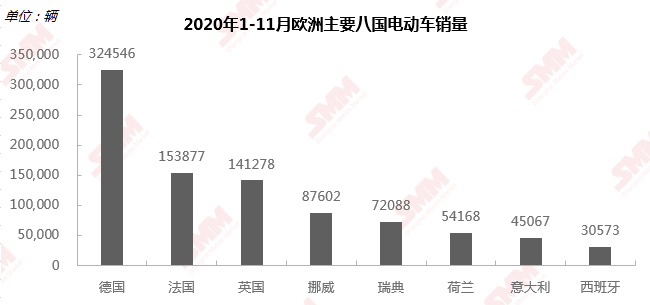
Source: MarkLines, SMM

At present, the European Union has basically raised the greenhouse gas emission reduction target by 2030 from 40% to 55% through the European Climate Target Plan 2030. In addition, countries have paid more attention to the electrification process and introduced the target time of fuel ban in advance. In addition, the high subsidy policies of various countries continue to be maintained, coupled with the number and promotion of new European models in the future, domestic car companies export Europe, and so on, to meet the needs of consumers in various countries. It is expected that the European new energy market has great potential in the future, will continue to maintain high growth in the next five years, and sales will reach 4.7 million vehicles in 2025.

When sales in the European market are growing by leaps and bounds, it also brings opportunities for domestic power battery companies. There are not many local battery enterprises in Europe, and the speed of putting into production is also slow. in recent years, many Japanese and South Korean head battery companies have taken the lead in laying out in the European market. For example, South Korean company LG Chemical has established the largest battery factory in Europe in Poland in 2018, and Samsung has also expanded its battery plant in Hungary. In addition, Chinese battery companies such as CATL, Honeycomb Energy, BYD and Funeng have all begun to speed up the battery layout in Europe. Ningde's first overseas factory in Thuringia, Germany, was started in October 2019. After the project is completed, it will become the largest lithium battery factory in Germany, and it is expected to achieve the annual battery production capacity of 14GWh in 2022. Honeycomb Energy announced plans to build a plant in Europe in July 2019. it will build a large-scale 24GWh power battery factory, a supporting cathode material factory and a battery technology center in Europe.
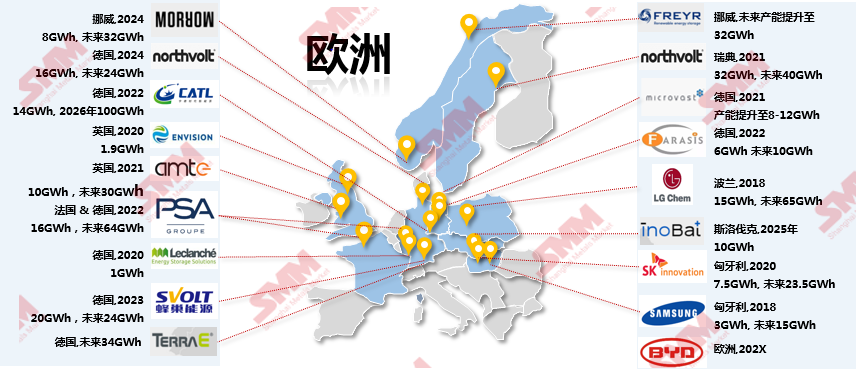
Source: SMM, company website

The main advantages of Chinese battery companies in Europe are:

1. At present, the process of electrification in Europe is accelerating, and the demand for lithium batteries in the new energy market is increasing in the future. It is expected that the demand for lithium batteries will reach 310GWH in 2025. At present, the battery capacity in the European local market is far from enough. Chinese power battery enterprises can seize the European market share as soon as possible by laying out the European market in advance.

2. European countries have attached great importance to electrification in the past two years, and have been increasing subsidies for electric vehicles since 2020. Superimposed in 2019, the Advanced Battery Technology Alliance has received 3.2 billion euros of financial support to support the research, development and innovation of battery technology. The project involves seven EU member states, namely, Germany, France, Italy, Belgium, Finland, Poland and Sweden. The support of huge subsidies is more beneficial to the future expansion of Chinese battery companies.

3. Last year, many domestic head battery companies such as Ningde Times, BYD and Funeng opened cooperation with overseas car companies such as Volkswagen, BMW and Daimler. after officially entering the European market in the future, it will be more convenient to match well-known overseas car companies. and increase international influence.

SMM battery materials research team

Mei Wangqin 021-51666759

Huo Yuan 021-51666898

Liu Xiaoyi 021-51666716

Yuan Ye 021-51595792

Tuyên bố về Nguồn Dữ liệu: Ngoại trừ thông tin công khai, tất cả dữ liệu khác được SMM xử lý dựa trên thông tin công khai, giao tiếp thị trường và dựa trên mô hình cơ sở dữ liệu nội bộ của SMM. Chúng chỉ mang tính chất tham khảo và không cấu thành khuyến nghị ra quyết định.

Để biết thêm thông tin hoặc có thắc mắc gì, vui lòng liên hệ: lemonzhao@smm.cn
Để biết thêm thông tin về cách truy cập báo cáo nghiên cứu, vui lòng liên hệ:service.en@smm.cn
Tin Liên Quan
MIIT Lấy Ý Kiến Công Chúng về Hệ Thống Tiêu Chuẩn Tái Chế Pin Điện [Phân Tích SMM]
4 giờ trước
MIIT Lấy Ý Kiến Công Chúng về Hệ Thống Tiêu Chuẩn Tái Chế Pin Điện [Phân Tích SMM]
Đọc thêm
MIIT Lấy Ý Kiến Công Chúng về Hệ Thống Tiêu Chuẩn Tái Chế Pin Điện [Phân Tích SMM]
Ngày 15 tháng 9 năm 2026, Vụ Khoa học và Công nghệ thuộc Bộ Công nghiệp và Công nghệ thông tin đã công bố Hướng dẫn xây dựng hệ thống tiêu chuẩn ngành tái chế và sử dụng pin điện (Phiên bản 2026) (dự thảo lấy ý kiến), lấy ý kiến công chúng từ ngày 16 tháng 9 đến ngày 15 tháng 10 năm 2026.
4 giờ trước
CAAM: Doanh số xe năng lượng mới tháng 8 đạt 1,643 triệu chiếc, tăng 17,8% so với cùng kỳ, tăng 5,3% so với tháng trước; tỷ lệ thâm nhập 60,6%, nội địa 1,118 triệu chiếc, xuất khẩu 526 nghìn chiếc
5 giờ trước
CAAM: Doanh số xe năng lượng mới tháng 8 đạt 1,643 triệu chiếc, tăng 17,8% so với cùng kỳ, tăng 5,3% so với tháng trước; tỷ lệ thâm nhập 60,6%, nội địa 1,118 triệu chiếc, xuất khẩu 526 nghìn chiếc
Đọc thêm
CAAM: Doanh số xe năng lượng mới tháng 8 đạt 1,643 triệu chiếc, tăng 17,8% so với cùng kỳ, tăng 5,3% so với tháng trước; tỷ lệ thâm nhập 60,6%, nội địa 1,118 triệu chiếc, xuất khẩu 526 nghìn chiếc
Dữ liệu từ CAAM cho thấy trong tháng 8, doanh số xe năng lượng mới (NEV) đạt 1,643 triệu chiếc, tăng 17,8% so với cùng kỳ năm ngoái và 5,3% so với tháng trước, với tỷ lệ thâm nhập khoảng 60,6%. Doanh số nội địa đạt 1,118 triệu chiếc, tăng 10,9% so với tháng trước nhưng giảm 4,6% so với cùng kỳ, trong khi xuất khẩu đạt 526.000 chiếc, giảm 5% so với tháng trước nhưng tăng 1,3 lần so với cùng kỳ. Doanh số NEV chở khách nội địa đạt 1,015 triệu chiếc, tăng 10,8% so với tháng trước nhưng giảm 8,2% so với cùng kỳ, và doanh số NEV thương mại nội địa đạt 103.000 chiếc, tăng 11,9% so với tháng trước và 56,6% so với cùng kỳ. Từ tháng 1 đến tháng 8, tổng doanh số NEV nội địa đạt 7,215 triệu chiếc, giảm 10,8% so với cùng kỳ. Doanh số NEV chở khách nội địa đạt 6,525 triệu chiếc, giảm 14,2% so với cùng kỳ, trong khi doanh số NEV thương mại nội địa đạt 690.000 chiếc, tăng 43,4% so với cùng kỳ. Từ tháng 1 đến tháng 8, tổng xuất khẩu NEV đạt 3,435 triệu chiếc, tăng 1,2 lần so với cùng kỳ. Xuất khẩu NEV chở khách đạt 3,357 triệu chiếc, tăng 1,3 lần so với cùng kỳ, trong khi xuất khẩu NEV thương mại đạt 78.000 chiếc, tăng 33,1% so với cùng kỳ.
5 giờ trước
534 triệu NDT! Tiến triển mới của dự án vật liệu pin natri-ion 30.000 tấn/năm tại Trường Trị, Sơn Tây
5 giờ trước
534 triệu NDT! Tiến triển mới của dự án vật liệu pin natri-ion 30.000 tấn/năm tại Trường Trị, Sơn Tây
Đọc thêm
534 triệu NDT! Tiến triển mới của dự án vật liệu pin natri-ion 30.000 tấn/năm tại Trường Trị, Sơn Tây
Gần đây, Công ty TNHH Công nghệ Năng lượng Tương An Sơn Tây đã công bố bản dự thảo đánh giá tác động môi trường để lấy ý kiến công chúng cho dự án sản xuất 30.000 tấn vật liệu pin natri-ion mỗi năm. Dự án tọa lạc tại Khu công nghiệp Phú Dương, Khu phát triển kinh tế và công nghệ Tương Viên, thành phố Trường Trị, tỉnh Sơn Tây, Trung Quốc. Hạng mục chính của dự án và các công trình phụ trợ bao gồm xây dựng hai dây chuyền sản xuất vật liệu catốt pin natri-ion và một dây chuyền sản xuất vật liệu anốt, cùng với các hệ thống phụ trợ như chuẩn bị nước tinh khiết, nén khí, tạo nitơ, hút ẩm và tuần hoàn nước làm mát. Các quy trình được áp dụng gồm: tiền xử lý (trộn + nghiền cát + loại bỏ sắt + sấy phun), nạp liệu vào thuyền nung, san rung, xếp lưới + thiêu kết, và xử lý cuối (nghiền tia + trộn mẻ + sàng + đóng gói). Sau khi đi vào hoạt động, dự án sẽ sản xuất 25.000 tấn vật liệu catốt pin natri-ion và 5.000 tấn vật liệu anốt mỗi năm. Tổng vốn đầu tư của dự án là 534 triệu nhân dân tệ, trong đó vốn đầu tư bảo vệ môi trường là 3,64 triệu nhân dân tệ, chiếm 0,68%.
5 giờ trước