

SHANGHAI, Nov 2 (SMM)—Manufacturing activity across nickel downstream sectors in China retreated to the contractionary territory in October.
SMM data showed that the purchasing manager's index (PMI) for downstream nickel industries, including stainless steel, electroplating, alloy and battery, stood at 49.68 in October, down 0.94 point from September. A reading below 50 indicates contraction.
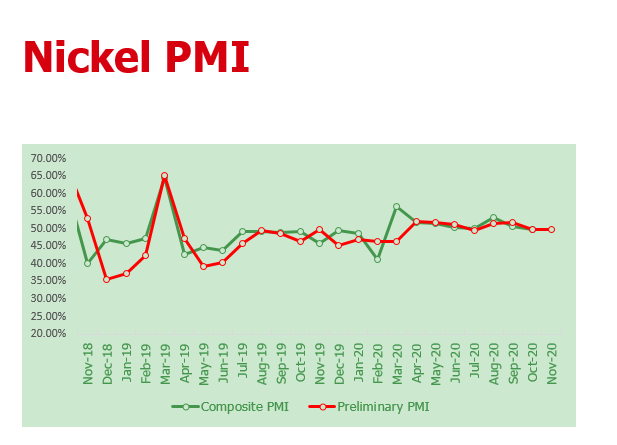
Production sub-index stood slightly higher above 50, with the battery and electroplating sectors still in expansion
The composite sub-index for production in October lost 1.32 points from September to 50.56 in October, staying in expansion.
The production sub-index in the stainless steel sector came in at 50, down 1.14 points from a month ago. Most of the steel makers kept stable production, and total stainless steel output in October is expected to be higher than in September. But output of the #300 series is likely to dip as some stainless steel mills switched to production of the #400 series. The production sub-index in the battery sector stood at 58.77 in October, as new energy enterprises mostly maintained relatively high production amid robust consumption. The production sub-index in the electroplating sector came in at 51.45, as many electroplating plants reported improved production in October though most of them halted production during the National Day holidays.
New orders sub-index fell to contraction, mainly dragged down by the stainless steel sector
The overall sub-index for new orders in October declined 1.79 points on the month to 49.23 in October, falling into contraction. Among the surveyed sectors, the stainless steel sector was the worst performer in terms of new orders, weighing on the overall sub-index. Its new orders sub-index slid 1.9 points from the final reading of September to 48.1 in October, retreating from expansion to contraction, basically in line with early expectations, as mills were in the face of great pressure in selling cold-rolled coil.
Raw materials inventory sub-index remained in contraction, with producers in the stainless steel and electroplating sectors slowing procurements
The composite sub-index for raw materials inventory in October gained 0.94 point month on month to 48.18 in October, remaining in contraction. The purchasing volume sub-index in the stainless steel sector dropped 2.1 points from the final reading of September to 46.19 in October, while the raw materials inventory sub-index inched up 0.48 point to 47.62. The two sub-indexes that both stood under 50 suggested slowed purchasing activities at steel mills. Although mills slashed purchasing volume of high-grade NPI, their production was barely affected as they replaced with other raw materials such as ferronickel and scrap stainless steel. The raw materials inventory sub-index in the electroplating sector dipped to 49.73 as plants reduced procurements as nickel prices rose consistently after the National Day holidays.
Finished goods inventory sub-index was still in contraction, inventory pressure of cold-rolled coil increased as expected
The overall sub-index for finished goods inventory fell 2.34 points on the month to 47.28 in October, staying in contraction. The finished goods inventory sub-index in the stainless steel sector retreated 3.3 points from the final reading of September to 46.7 in October. Tepid sales led to increased inventories.
![[SMM Điểm tin niken giữa ngày] Giá niken dao động ở mức yếu vào ngày 9/9, tâm lý chờ đợi trên thị trường mạnh trước khi Mỹ công bố CPI vào thứ Sáu](https://imgqn.smm.cn/usercenter/fzwTi20251217171733.jpg)
![[SMM Tin nhanh thép không gỉ] Šefčovič xác nhận bằng văn bản: Doanh nghiệp vừa và nhỏ phải trả phí để quy định thép của EU có hiệu lực](https://imgqn.smm.cn/usercenter/UpZsx20251217171731.jpeg)