SMM5, June 21: the Philippines reported on Thursday that its first-quarter nickel ore production fell 27% compared with the same period last year to 28006 tons, as more than half of the country's 29 nickel mines reported zero production. According to the Philippine Mines and Geology Bureau (The Mines and Geosciences Bureau), only 11 nickel mines in the country reported production in the first quarter, while the remaining 18 were either in a state of maintenance or stopped production due to adverse weather.
As Indonesia banned ore exports in January, the Philippines is expected to become China's main source of nickel ore supply this year. After processing, nickel ore imported from China is used to produce nickel pig iron, which is a key raw material for the production of stainless steel.
According to SMM, China's total nickel mine imports in April were 1.3591 million tons, down 87100 tons from March, 6 per cent lower than the previous month, and 70.2 per cent lower than a year earlier. Imports from the Philippines were 1.088 million tons, up 11.6% from the previous month, down 54.8% from the same period last year. Affected by the epidemic, although the rainy season in the Suligao region of the Philippines was over in April, it was still unable to ship goods, resulting in a significant drop in imports in April compared with the same period last year. Nickel ore exports gradually resumed in May and are expected to fully return to normal in June.
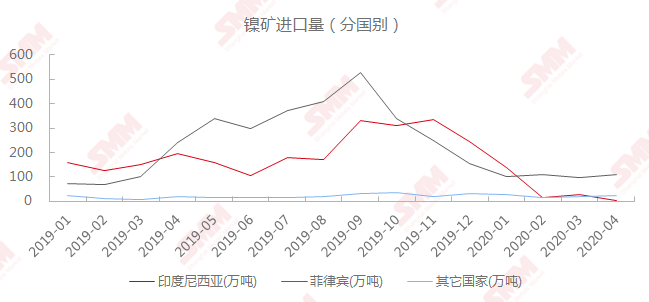
SMM predicts that nickel mine imports will pick up slightly in May, mainly due to the gradual lifting of the ban on Philippine mining areas in May, and the physical export volume may still have a slight decline compared with the same period last year. In addition, since the beginning of this year, there is no high-quality ore available in the Philippines, the grade of nickel ore has dropped more, and the export volume of metal has declined more or more from the same period last year.
As the supply of nickel ore continues to be tight, nickel pig iron is popular as a substitute. According to the latest research by SMM, at present, the mentality of raising prices in iron and nickel factories is stronger, and the shortage of nickel mines has been substantially alleviated for the time being. After the lifting of the ban in the Philippines, most of the negotiable goods in the market are purchased by large companies, while it is more difficult for small iron mills to purchase raw materials, and the worry about production by merchants increases, and the mentality of being reluctant to sell is still strong.
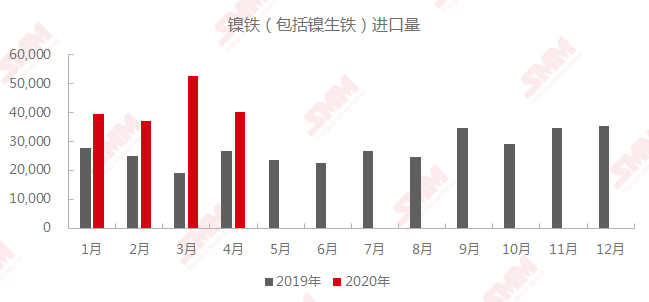
According to import data, China imported 333000 tons of ferronickel in March 2020 (physical tons, including NPI and FeNi), increased by 41.17%, 242.53% over the same period last year, and a cumulative increase of 107.25% over the same period last year. By country, Indonesia, South Korea and Colombia are the three countries with the largest sources of nickel and iron imports. The epidemic in Indonesia did not affect ferronickel production and export. NPI production continued to increase and the output shipped back to China increased steadily. The progress of enterprise production in the second quarter was only higher than that in the first quarter. SMM expects that imports may continue to increase in the future.
"related reading:" [SMM data] the total nickel ore imports affected by the epidemic decreased by 6% month-on-month to about 1.3591 million tons in April, down 70.2% from the same period last year.