China issued first batch of copper scrap import quotas for 2020

Đã xuất bản: Dec 24, 2019 15:02 (GMT+8)
China granted import allowances for 270,885 mt of high-grade copper scrap in the initial batch of quotas for use next year

SHANGHAI, Dec 24 (SMM) – China's environmental authorities on Monday issued the first batch of copper scrap import quotas for 2020, which is estimated to be able to satisfy needs at major scrap users in the three months to come.

The China Solid Waste and Chemicals Management Bureau, a unit of the Ministry of Ecology and Environment, granted import allowances for 270,885 mt of high-grade copper scrap in the initial batch of quotas for use next year. This is estimated to contain 217,000 mt of copper, with a Cu content of 80%, the average grade for imported volume in 2019.

The initial 2020 copper scrap import quotas were awarded to 108 companies, with nearly 95% of the total quotas allocated to firms in the major recycling hubs of Zhejiang and Guangdong.
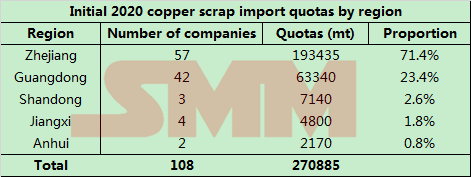
More quotas are expected to be issued for Q1 2020, as some companies who obtained quotas in 2019 were not included in the latest batch. This indicates that Chinese copper scrap users are unlikely to be beleaguered by import quota shortages in the three months ahead, as the same period last year saw 280,000 mt of copper imported in the form of copper scrap.

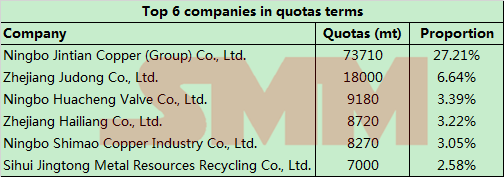
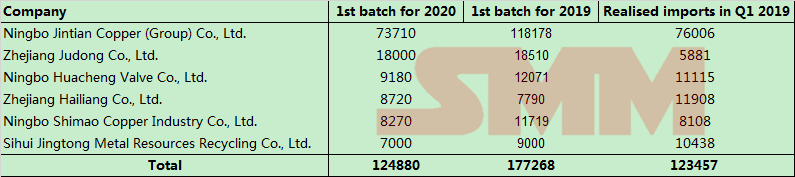
For the top six companies in terms of quotas they were awarded in the initial batch for 2020, they were granted a combined allowance volume of 124,880 mt, topping the volume of 123,457 mt they imported in Q1 2019 but accounting for just 70% of the allowance volume of 177,268 mt they were awarded in the initial batch for 2019.
Tighter restrictions on copper scrap imports came into force in July 2019, before when Chinese scrap users could import the so-called Category 6, high-grade copper scrap in unlimited amounts.

Import quotas for copper scrap, however, are set to be on the decline in the future batches, as Beijing aims to cut inbound waste to zero by the end of 2020.

“Solid waste imports next year will reduce sharply from this year,” said the recycling unit of China’s nonferrous metals industry association at a metals recycling forum in November. Import allowances will continue to be issued on a quarterly basis next year, and those for Q1 will take up a relatively higher proportion of the import volume for the full year, it added.

The metals recycling unit also mentioned that the standards for secondary copper and secondary aluminium raw materials will be introduced “as soon as possible.”

China now classes scrap metal as a solid waste, and high-grade copper scrap meeting the standards, expected to come into force before Q2 2020 at the latest, will no longer be classed as waste and can be exempted from the licensed quota-based import system.

The introduction of the long-anticipated scrap “reclassification” is set to help ease raw material supply crunch and ensure production at Chinese scrap users.

Tuyên bố về Nguồn Dữ liệu: Ngoại trừ thông tin công khai, tất cả dữ liệu khác được SMM xử lý dựa trên thông tin công khai, giao tiếp thị trường và dựa trên mô hình cơ sở dữ liệu nội bộ của SMM. Chúng chỉ mang tính chất tham khảo và không cấu thành khuyến nghị ra quyết định.

Để biết thêm thông tin hoặc có thắc mắc gì, vui lòng liên hệ: lemonzhao@smm.cn
Để biết thêm thông tin về cách truy cập báo cáo nghiên cứu, vui lòng liên hệ:service.en@smm.cn
Tin Liên Quan
HBIS Resources: Phần chính của dự án đồng Giai đoạn II về cơ bản đã hoàn thành, hiện đang trong giai đoạn tăng công suất
8 phút trước
HBIS Resources: Phần chính của dự án đồng Giai đoạn II về cơ bản đã hoàn thành, hiện đang trong giai đoạn tăng công suất
Đọc thêm
HBIS Resources: Phần chính của dự án đồng Giai đoạn II về cơ bản đã hoàn thành, hiện đang trong giai đoạn tăng công suất
8 phút trước
Rủi ro địa chính trị biến động và kỳ vọng tăng lãi suất nóng lên, giá đồng thoái lui sau đà tăng nhanh [SMM Điểm lại vĩ mô tuần]
16 phút trước
Rủi ro địa chính trị biến động và kỳ vọng tăng lãi suất nóng lên, giá đồng thoái lui sau đà tăng nhanh [SMM Điểm lại vĩ mô tuần]
Đọc thêm
Rủi ro địa chính trị biến động và kỳ vọng tăng lãi suất nóng lên, giá đồng thoái lui sau đà tăng nhanh [SMM Điểm lại vĩ mô tuần]
16 phút trước
Hạn chế hóa đơn giới hạn lưu thông nguồn cung miễn thuế, mức tăng giá hạn chế [SMM Đánh giá hàng tuần nguyên liệu đồng thứ cấp]
17 phút trước
Hạn chế hóa đơn giới hạn lưu thông nguồn cung miễn thuế, mức tăng giá hạn chế [SMM Đánh giá hàng tuần nguyên liệu đồng thứ cấp]
Đọc thêm
Hạn chế hóa đơn giới hạn lưu thông nguồn cung miễn thuế, mức tăng giá hạn chế [SMM Đánh giá hàng tuần nguyên liệu đồng thứ cấp]
[SMM Analysis: Hạn chế hóa đơn giới hạn lưu thông vật liệu chưa thuế, kìm hãm đà tăng giá] Tuần này, chênh lệch giá giữa cathode đồng và phế liệu đồng nới rộng đều đặn từ 3.141 nhân dân tệ/tấn đầu tuần lên mức cao nhất tuần là 4.626 nhân dân tệ/tấn. Thị trường phế liệu đồng cho thấy diễn biến bất thường "giảm nhưng không tăng" theo giá đồng—khi giá đồng tăng mạnh, giá nguyên liệu chỉ nhích nhẹ (tăng 300 nhân dân tệ/tấn so với tuần trước vào đầu tuần và tăng 200 nhân dân tệ/tấn vào giữa tuần), trong khi khi giá đồng thoái lui từ mức cao, giá nguyên liệu lại giảm theo (giảm 200 nhân dân tệ/tấn so với tuần trước vào cuối tuần, sau đó giảm thêm 100 nhân dân tệ/tấn)...
17 phút trước