The Southeast Asian secondary aluminum market remained largely range-bound this week. Aluminum scrap prices showed relative resilience, particularly for higher-quality grades, while ADC12 prices continued to face pressure from sluggish downstream demand.
Meanwhile, LME aluminum retreated sharply after a seven-session rally as progress in Emirates Global Aluminium’s (EGA) Al Taweelah restart eased some of the market’s earlier supply concerns. However, the restart does not imply that global aluminum supply has returned to normal. With other overseas restart and ramp-up projects showing limited acceleration and inventories remaining relatively low, the expected global primary aluminum supply deficit in 2026 has yet to be fundamentally reversed.
Southeast Asia Scrap Market Remains Range-Bound; High-Quality Grades Stay Resilient
The Southeast Asian aluminum scrap market remained broadly range-bound this week.
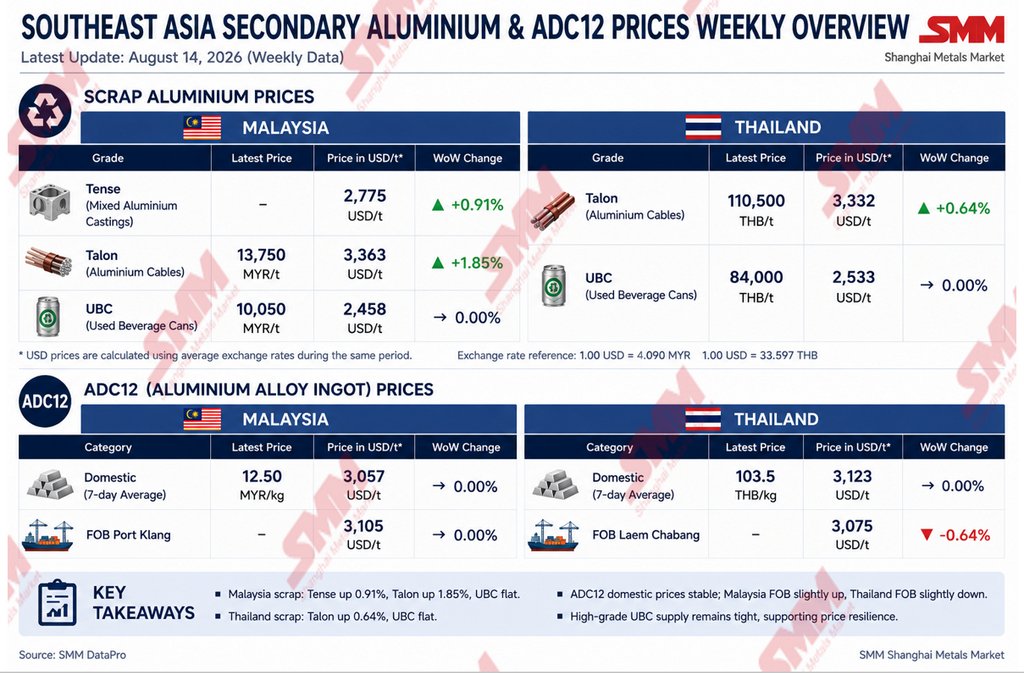
In Malaysia, mixed cast aluminum scrap (Tense) was assessed at US$2,775/mt, up 0.91% WoW. Talon stood at MYR 13,750/mt, equivalent to approximately US$3,363/mt, up 1.85% WoW, while used beverage cans (UBC) remained unchanged at MYR 10,050/mt, or approximately US$2,458/mt.
In Thailand, Talon was assessed at THB 110,500/mt, equivalent to approximately US$3,332/mt, up 0.64% WoW, while UBC remained unchanged at THB 84,000/mt, or approximately US$2,533/mt.
Trading activity remained largely demand-driven. Supply of higher-quality UBC continued to be relatively tight, supporting prices, while demand improvement for mixed scrap and cable grades remained limited. In Thailand in particular, high-quality UBC supply available to the spot market remains constrained as large secondary aluminum producers continue to compete for domestic material.
Notably, the recent increase in LME aluminum did not translate proportionally into higher scrap transaction prices. Secondary aluminum producers remain cautious about accepting higher raw-material costs because of compressed margins, while suppliers of premium scrap are also reluctant to lower offers amid limited availability.
As a result, scrap prices continue to follow the broader LME direction but with comparatively smaller fluctuations. Premium grades such as UBC and 6063 extrusion scrap are expected to remain relatively resilient compared with lower-grade material.
ADC12 Moves in a Narrow Range as Export Market Faces Demand Pressure
The Southeast Asian ADC12 market remained relatively stable this week, although export prices continued to face pressure.
Malaysia ADC12 domestic prices were assessed at MYR 12.50/kg, equivalent to approximately US$3,057/mt, while FOB Port Klang offers stood at around US$3,105/mt.
In Thailand, domestic ADC12 prices stood at THB 103.5/kg, equivalent to approximately US$3,123/mt, while FOB Laem Chabang prices edged lower to around US$3,075/mt.
Domestic prices remained relatively stable, but export offers continued to face resistance. Aluminum scrap costs remain firm, while recovery in automotive and die-casting orders has been slow. Buyers continue to favour short-term and demand-driven procurement, limiting producers' ability to pass higher raw-material costs downstream and keeping secondary aluminum margins under pressure.
Recent discussions with market participants also highlighted a noticeable pattern: prices have tended to fall faster than they rise.
When LME aluminum rises, weak end-user demand makes it difficult for ADC12 transaction prices to fully reflect higher raw-material costs. However, when LME falls sharply, overseas buyers tend to lower their target prices quickly and become more aggressive in negotiations.
The ADC12 market therefore remains caught between firm raw-material costs and weak downstream demand. Without a more meaningful recovery in end-user orders, further upside in export prices is likely to remain limited.
LME Falls Nearly US$100 in Two Days as EGA Restart Eases Supply Concerns
LME aluminum reversed sharply this week after a strong rally.
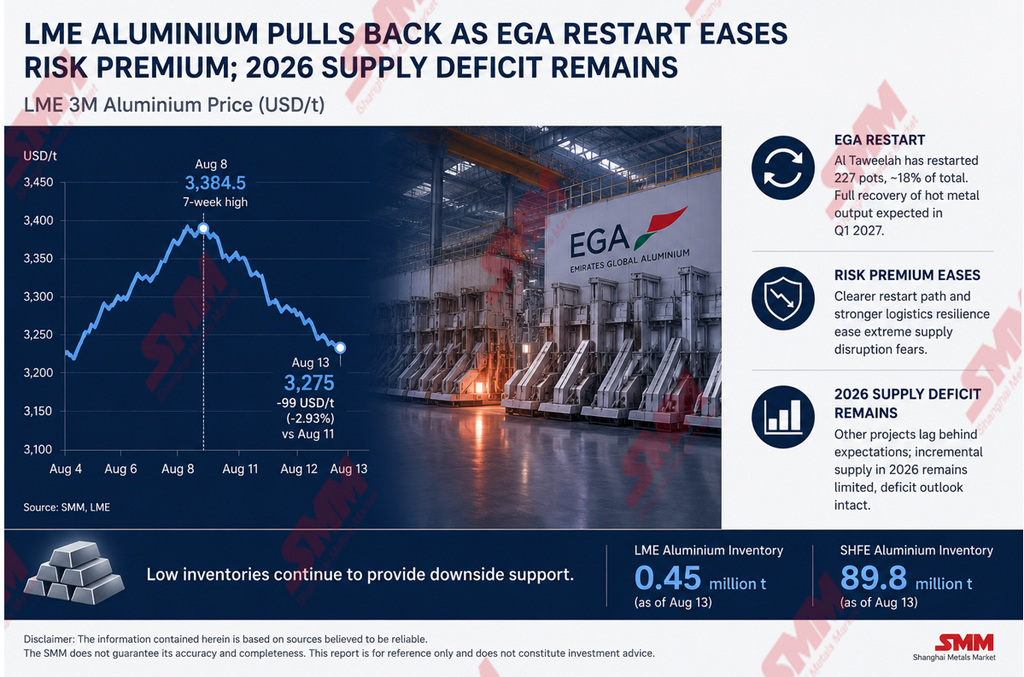
From August 11 to August 13, three-month LME aluminum fell from around US$3,374/mt to US$3,275/mt, a decline of approximately US$99/mt in two days, with selling accelerating on August 12.
The correction followed seven consecutive trading sessions of gains, during which LME aluminum rose around 4.7% and briefly reached a seven-week high of US$3,384.5/mt.
The pullback largely reflected a repricing of the supply-risk premium rather than a fundamental shift toward global aluminum oversupply.
One major trigger was progress in the restart of EGA's Al Taweelah smelter. Of the plant's 1,262 reduction cells, 227 cells, or around 18%, have restarted, while all three potlines have been re-energised. Hot-metal production is expected to return to pre-disruption levels in the first quarter of 2027.
A clearer restart pathway has reduced fears that Middle Eastern production losses could persist for significantly longer and further widen the global supply deficit.
EGA's logistics have also proved more resilient than initially feared. Despite continued risks surrounding the Strait of Hormuz, alternative logistics routes have allowed the company to maintain some raw-material inflows and product exports. EGA's first-half sales fell to approximately 939,000 mt, down 32% year on year, indicating that the supply disruption remains significant but has not resulted in the complete export stoppage previously feared under more extreme scenarios.
European physical premiums have also retreated from earlier highs. European primary aluminum premiums have fallen from around US$621/mt in May to approximately US$487/mt. While still well above pre-conflict levels, the decline suggests that concerns over a complete and prolonged disruption of Gulf aluminum supply have eased.
The market was also vulnerable to profit-taking after seven consecutive sessions of gains. With positioning and sentiment already relatively bullish, improving restart expectations were sufficient to trigger a rapid correction even before significant additional physical supply returned to the market.
EGA Restart Does Not Eliminate the 2026 Supply Deficit
Despite improving restart progress, EGA's recovery should not be interpreted as a return to normal global supply conditions.
Only around 18% of Al Taweelah's reduction cells have restarted so far, while a full recovery to pre-disruption hot-metal production is not expected until the first quarter of 2027.
At the same time, although other overseas restart and greenfield projects continue to progress, the overall pace of supply additions has not shown a significant acceleration, with some projects still ramping up more slowly than previously expected.
As a result, incremental production available to the global market during 2026 remains limited, and the expectation of a global primary aluminum supply deficit in 2026 has not been fundamentally reversed.
Low inventories provide another layer of support. As of August 13, China's aluminum ingot social inventories in major consumption regions stood at approximately 898,000 mt, down 35,000 mt from the previous Thursday. Overseas aluminum inventories also remain relatively low.
The latest LME correction should therefore be viewed primarily as a partial unwinding of the supply-risk premium following improved EGA restart expectations, rather than a transition from shortage to oversupply.
Outlook
SMM expects the overseas secondary aluminum market to remain caught between downside support from low inventories and tight supply, and upside resistance from improving restart expectations and weak demand in the near term.
For primary aluminum, further unwinding of the Middle East supply-risk premium could keep LME prices under pressure at elevated levels. However, EGA's full recovery will take time, while other overseas restart and new-capacity projects have yet to show a meaningful acceleration. With the 2026 supply deficit expectation still intact and inventories remaining low, fundamental support on the downside persists.
For aluminum scrap, premium grades such as UBC and 6063 extrusion scrap are expected to remain more resilient due to constrained availability. If LME prices continue to fall, outright scrap prices may soften, but the decline could be smaller than that of LME, keeping scrap-to-LME ratios relatively elevated.
For ADC12, prices are expected to remain range-bound. Weak automotive and die-casting demand remains the key constraint. If LME falls further, overseas buyers may quickly lower their target prices, while secondary aluminum producers could face a lag before raw-material costs decline, maintaining pressure on margins.
For China's imported aluminum scrap market, actual cargo arrivals in mid-to-late August will be an important factor to monitor. A concentration of arrivals without a corresponding improvement in downstream demand could increase spot supply pressure. Conversely, if import economics remain favourable, Chinese demand for overseas scrap could continue to improve.
Overall, the market is gradually shifting from pricing in the risk of prolonged Middle East supply disruptions toward assessing the balance between the actual pace of supply recovery and real downstream demand. EGA's restart has improved the longer-term supply outlook, but it is not yet sufficient to overturn expectations of a tight global aluminum market in 2026.