

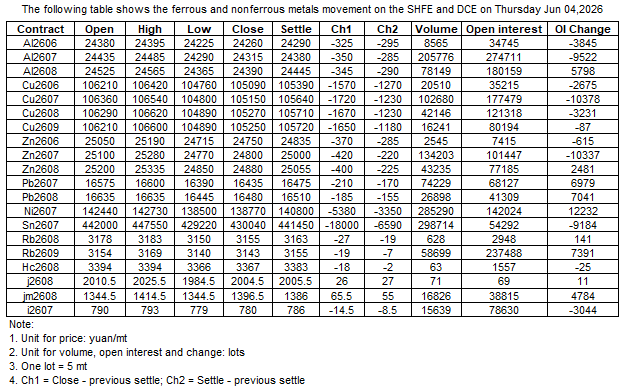
Data: SHFE, DCE market movement (Jun 04)
The following table shows the ferrous and nonferrous metals movement on the SHFE and DCE on 04 Jun , 2026
Data Source Statement: Except for publicly available information, all other data are processed by SMM based on publicly available information, market communication, and relying on SMM‘s internal database model. They are for reference only and do not constitute decision-making recommendations.
For any inquiries or to learn more information, please contact: lemonzhao@smm.cn
For more information on how to access our research reports, please contact:service.en@smm.cn
Related News
6 mins ago
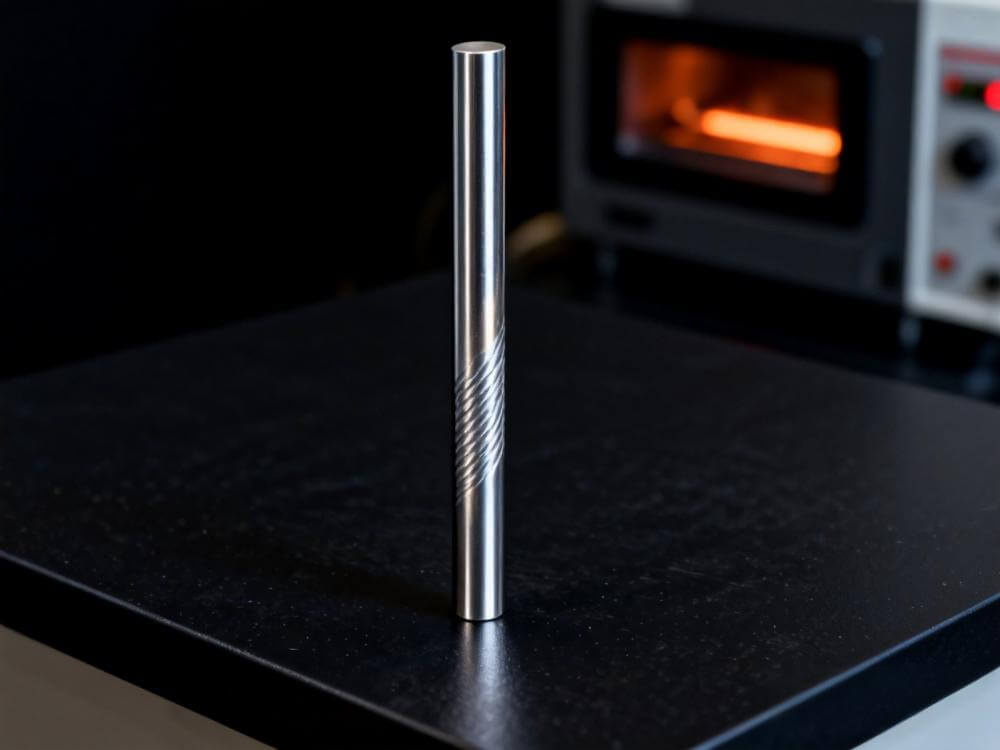
Panchangte Open Inquiry and Comparison Procurement Tender for the Second Batch of Molybdenum Bars in June 2026
Read More
Panchangte Open Inquiry and Comparison Procurement Tender for the Second Batch of Molybdenum Bars in June 2026
6 mins ago
![[SMM Iron & Steel] Global Recycled Steel Consumption Rises in 2025 Amid Declining Crude Steel Output](https://imgqn.smm.cn/usercenter/NtHAJ20251217171719.jpg)
2 hours ago
[SMM Iron & Steel] Global Recycled Steel Consumption Rises in 2025 Amid Declining Crude Steel Output
Read More
[SMM Iron & Steel] Global Recycled Steel Consumption Rises in 2025 Amid Declining Crude Steel Output
The Bureau of International Recycling (BIR) reported that global recycled steel consumption grew by 4.5% year-on-year to 480 million metric tons (mt) in 2025 across key markets, even as global crude steel output fell by 1.9% to approximately 1.85 billion mt. Global direct reduced iron (DRI) production also climbed 4.9% to 153 million mt, largely driven by India's 7.4% output increase to 58.9 million mt. In terms of trade flows, the EU-27 and the US remained the largest scrap exporters at 16.68 million mt and 11.76 million mt, respectively, while Turkey retained its position as the top importer with 18.76 million mt despite a 6.6% volume decline. Pakistan posted exceptionally strong import growth, surging 39.8% to 3.02 million mt. This decoupling of scrap consumption from total crude steel production underscores the accelerating global shift toward lower-carbon electric arc furnace (EAF) steelmaking. The sustained demand for scrap and DRI signals structurally tighter future raw material supplies, which will continually reshape global trade dynamics as countries secure resources for decarbonization.
2 hours ago
![[SMM Iron & Steel] Japan Launches Anti-Dumping Investigations on CRC and HRC Imports from Three Asian Nations](https://imgqn.smm.cn/usercenter/QMaot20251217171719.jpg)
2 hours ago
[SMM Iron & Steel] Japan Launches Anti-Dumping Investigations on CRC and HRC Imports from Three Asian Nations
Read More
[SMM Iron & Steel] Japan Launches Anti-Dumping Investigations on CRC and HRC Imports from Three Asian Nations
Japan's Ministry of Economy, Trade and Industry (METI) has officially initiated an anti-dumping investigation into cold-rolled coil (CRC) and hot-rolled coil (HRC) imported from South Korea, China, and Taiwan. The probe, prompted by petitions from domestic producers including Nippon Steel and JFE Steel, targets the growing market penetration of these imports. According to METI, CRC import volumes increased from 830,818 metric tons (mt) in fiscal year 2021 to 874,353 mt in fiscal year 2023, while HRC imports surged from 1.22 million mt in FY2021 to 1.43 million mt between October 2024 and September 2025. Scheduled to conclude within one year, this defensive trade measure highlights the intense pressure on Japanese steelmakers caused by lower-priced imports amid stagnant domestic demand. If duties are imposed, it could significantly restrict regional trade flows, forcing foreign suppliers to divert tonnages elsewhere while simultaneously tightening local supply to support the profit margins and pricing power of Japanese mills.
2 hours ago
Related News
Panchangte Open Inquiry and Comparison Procurement Tender for the Second Batch of Molybdenum Bars in June 2026
Jun 04, 2026 17:03
[SMM Iron & Steel] Global Recycled Steel Consumption Rises in 2025 Amid Declining Crude Steel Output
Jun 04, 2026 14:46
[SMM Iron & Steel] Japan Launches Anti-Dumping Investigations on CRC and HRC Imports from Three Asian Nations
Jun 04, 2026 14:45
[SMM Iron & Steel] Italy's Assofermet Warns EU Safeguard Measures and CBAM Threaten Downstream Steel Sector
Jun 04, 2026 14:45