

SMM May 6 News:
Metal market:
From May 1 to May 5, China was on the Labour Day holiday, with the domestic market closed and trading suspended.
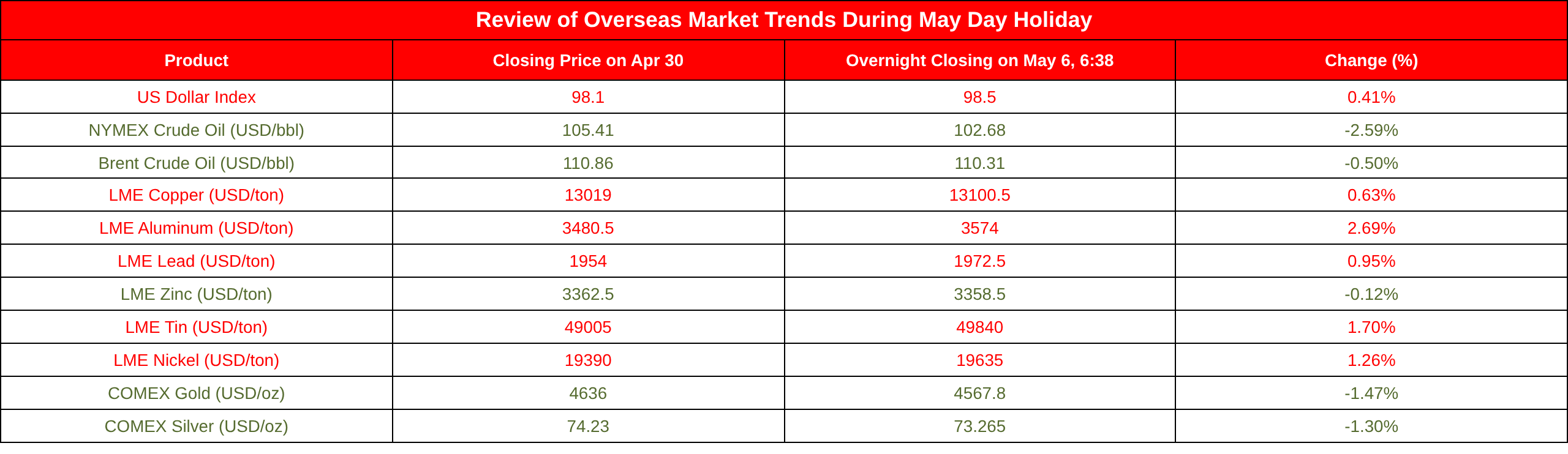
Overseas base metals generally rose during the Labour Day holiday, with LME zinc being the only decliner, down 0.12%. LME aluminum led the gains with a 2.69% increase, while LME tin and LME nickel both rose over 1%, with LME tin up 1.7% and LME nickel up 1.26%.
Other metals gained less than 1%.The London Metal Exchange (LME) was closed on May 4 due to the UK Early May Bank Holiday and resumed trading on May 5.
Precious metals: COMEX gold and COMEX silver both fell, with COMEX gold down 1.47% and COMEX silver down 1.3%.
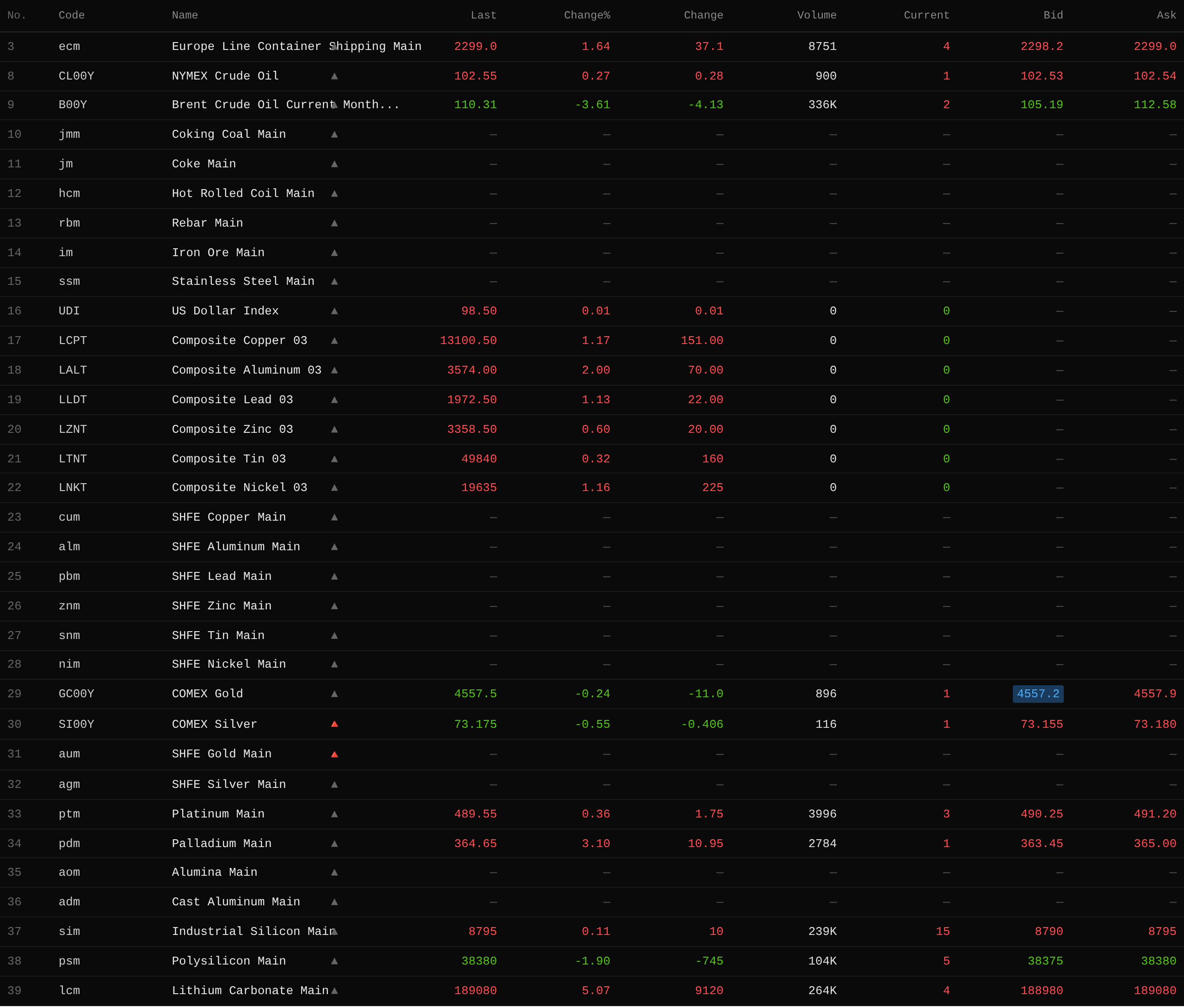
As of 6:38 AM on May 6, overnight closing prices
Macro front
China:
[China Bulk Commodity Index Continued to Rise in April, Market Operations Stable and Improving] The China Federation of Logistics and Purchasing released the April China Bulk Commodity Price Index on May 5. In terms of index performance, driven by improved supply and demand in some domestic industries and external input factors, the index continued to rise in April, though the increase narrowed MoM, indicating that the bulk commodity market remained generally stable and continued its positive development trend. The China Bulk Commodity Price Index stood at 132.1 points in April, up 1.7% MoM and up 20.2% YoY. Among the 50 bulk commodities monitored by the China Federation of Logistics and Purchasing, 38 saw price increases MoM in April. Among them, paraxylene, methanol, and polypropylene led the gains, up 22.4%, 14.5%, and 11.8% MoM respectively. (CCTV News) (Jin10 Data APP)
[National Road Traffic Generally Smooth and Orderly on Day 4 of Labour Day Holiday] According to the Traffic Management Bureau of the Ministry of Public Security, on the fourth day of the Labour Day holiday, various regions had successively entered the return travel peak, with traffic volumes on major national highways and provincial/national trunk roads generally fluctuating at highs. Local public security traffic management departments strengthened order control, strictly investigated prominent violations, enhanced emergency response, and widely disseminated safety reminders to ensure smooth and safe road traffic. As of 18:00, except for congestion and slow traffic on individual road sections due to excessive traffic volume and minor scraping accidents, traffic on major national trunk roads was generally smooth and orderly, with no prolonged or widespread traffic congestion. May 5 was the last day of the Labour Day holiday, and various regions were expected to see the peak of return travel, with traffic volumes on highways and provincial/national trunk roads expected to fluctuate at highs. (CCTV News) (Jin10 Data APP)
[Guangzhou Property Market "Sui Eight Measures" Implemented: Queues Return at Sales Offices, Second-hand Housing Online Signings Exceeded 10,000 Units for Two Consecutive Months] Leveraging the policy dividends of the "Sui Eight Measures," Guangzhou's real estate market started strong during this year's Labour Day holiday. According to incomplete statistics from Guangzhou Centaline Property, from May 1-2, cumulative average project visits for new homes in Guangzhou grew 12% YoY, cumulative average project subscriptions grew 37% YoY, and transaction conversion rates improved steadily compared to the same period last year. The second-hand housing market also maintained an active trend, with cumulative property viewings exceeding 7,000 visits and transactions exceeding 280 units during the same period, up 37% and 11% respectively from the two days before the holiday. On the first day of the Labour Day holiday, some new projects even saw queues at entrances. Notably, before the new policy was implemented, Guangzhou's second-hand housing market had already stabilized and recovered, with monthly online signing volumes staying above 10,000 units for two consecutive months. Data from the Guangzhou Real Estate Agency Association showed that in April, second-hand residential online signings in Guangzhou totaled 10,426 units and 1.0406 million m² in area, up 4.84% and 1.47% YoY respectively. (Jin10 Data APP)
[Cui Dongshui: China's Share of Global BEV Market at 56% in 2026] Cui Dongshui, Secretary General of the China Passenger Car Association (CPCA), stated that global auto sales reached 22.4 million units from January to March 2026, with NEV sales reaching 4.53 million units. The NEV share from January to March 2026 reached 20.2%, with BEVs accounting for 13.8%, PHEVs at 6.4%, and HEVs performing well at 7.2%. China's share in the global BEV market remained relatively stable, at around 63% from 2023 to 2025; in 2026, China's share in the global BEV market was 56%, with China's BEV performance temporarily weaker due to beginning-of-year factors. China's share in the global PHEV market was far ahead. In 2025, China's share in the global PHEV market reached an ultra-high level of 76.4%, and in 2026, China's share in the global PHEV market reached a high level of 73%, demonstrating China's exceptionally strong performance in the global PHEV market. (Jin10 Data APP)
[Indonesia Plans to Impose Export Tax and Windfall Tax on Coal and Nickel to Ease Subsidy Pressure] Indonesia plans to impose export taxes and windfall taxes on coal and nickel as one of the measures to offset growing subsidy costs in the national budget. Indonesian Finance Minister Purbaya Yudhi Sadewa said the proposed measures are still under discussion with the Ministry of Energy and Mineral Resources. "Discussions with the Energy Ministry are ongoing, but what is clear is that the related revenue will be sufficient to help bridge the subsidy gap." Purbaya noted that coal and nickel exports had not previously been subject to export taxes, creating regulatory loopholes that could foster under-invoicing and smuggling, while also limiting customs authorities' ability to inspect goods before shipment. (Wallstreetcn)
US dollar:
During China's Labour Day holiday, the US dollar index generally showed a volatile upward trend. As of the overnight close on May 6, the US dollar index gained 0.41% over the holiday. Bond traders are increasing bets that the US Fed's next policy move could be a rate hike rather than a cut. Swap contracts linked to central bank rate decisions now show that the market expects a greater than 50% probability of the US Fed raising rates before next April, ahead of any rate cut. An increasing number of traders are also building positions to hedge against the rising probability of a rate hike before year-end. This shift in market sentiment comes as policymakers appear increasingly divided on the interest rate outlook. Lawrence Gillum, chief fixed income strategist at LPL Financial, believes that the possibility of interest rate cuts this year still exists, but will gradually diminish as the Iran conflict drags on. He said: "Without question, the road ahead for Warsh will be challenging." (Jin10 Data APP)
New York Fed President Williams publicly stated on Monday that as long as inflation pulls back toward the US Fed's 2% target as expected, the US Fed will eventually need to cut interest rates. However, due to inflation running higher than expected this year, the timing of rate cuts has been forced to delay, though the overall policy direction has not fundamentally changed. Williams told reporters after a speech in New York on Monday: "As inflation comes down, at some point we will need to cut interest rates to match fundamentals. Inflation this year has been higher than previously expected, and in my view, this only delays the timing of rate cuts and does not change the overall policy logic." Last week, the US Fed decided to keep the benchmark rate unchanged, but internal policy divisions were highlighted, with three officials opposing the easing bias implied in the meeting statement, preferring more neutral language to signal that rates could move in either direction. Regarding the disputed language, Williams was clear: he fully endorsed the current statement, believing that based on day-to-day economic data, there was no sufficient reason to support a rate hike in the near term. (Jin10 Data)
Former New York Fed President Dudley said that Powell's decision to remain as a Fed governor after stepping down as Fed Chairman will help reassure Wall Street and the public at a time when President Trump is pressuring for lower interest rates. "The Fed has been under relentless attack from the president, and its independence has been questioned," Dudley said. "Powell believes that his continued presence at the Fed will actually strengthen the perception of Fed independence. I think it's a wise move for him to stay on if he's willing." Powell's term as a Fed governor runs until 2028, and his choice to remain on the board after stepping down as chairman on May 15 is uncommon in Fed history. Trump's nominee Warsh has made the case for supporting the rate cuts the president seeks. But traders are no longer betting on any rate cuts this year, and Dudley also said the case for monetary easing is "very thin." (Jin10 Data APP)
According to CME "FedWatch": the probability of the US Fed holding rates unchanged through June is 95.2%, with a 4.8% probability of a cumulative 25 bps cut. The probability of holding rates unchanged through July is 92.2%, with a 7.7% probability of a cumulative 25 bps cut and a 0.2% probability of a cumulative 50 bps cut. The probability of holding rates unchanged through September is 86.1%, with a 13.2% probability of a cumulative 25 bps cut and a 0.6% probability of a cumulative 50 bps cut. (Jin10 Data APP)
Other currencies:
According to ECB Governing Council member Kazimir, the ECB is very likely to raise rates at its next meeting in June. Kazimir said that tightening policy in June is "almost inevitable" given the need to address broad price increases and slowing eurozone economic growth. An ECB survey showed that professional forecasters expect inflation at 2.7% this year, pulling back to 2.1% in 2027 and 2% in 2028. (Wallstreetcn APP)
Bank of France Governor and ECB Governing Council member Villeroy said the ECB must be cautious and ready to act on rates if inflation spreads beyond oil price increases. Villeroy noted that before tightening monetary policy, a "critical mass of data" on core inflation, wages, and enterprise and consumer expectations for price increases is needed. He warned that if France fails to meet its deficit targets, it will face further increases in financing costs, affecting households, enterprises, and economic growth. (Wallstreetcn)
Former Bank of Japan Governor Kuroda Haruhiko said in an interview published in the Yomiuri Shimbun on Saturday that the BOJ has achieved its 2% inflation target and Japan does not need fiscal expansion or monetary easing. Kuroda said that given the coexistence of inflation and economic slowdown risks, the BOJ's decision not to raise rates on April 28 was the right one.
(Source: Wallstreetcn APP)
Data:
This week, on the China front, data including China's April foreign exchange reserves (TBD) and China's April RatingDog Services PMI will be released; on the US front, data including US April ADP employment, US April Global Supply Chain Pressure Index, US April Challenger enterprise layoffs, US April Challenger enterprise layoffs, US March construction spending MoM, and US April NY Fed 1-year inflation expectations will be released; on the Eurozone front, data including Eurozone April Services PMI final, Eurozone March PPI MoM, and Eurozone March retail sales MoM will be released; on the France front, data including France March industrial output MoM, France April Services PMI final, and France March trade balance will be released; Germany April Services PMI final, UK April Services PMI final, and Switzerland April seasonally adjusted unemployment rate will also be released.
In addition, 2028 FOMC voter and St. Louis Fed President Musalem will deliver a speech on the economic outlook and monetary policy, and 2027 FOMC voter and Chicago Fed President Goolsbee will participate in a panel discussion at a conference.
Crude oil:
Oil prices on both exchanges experienced volatile swings during the holiday, with an overall downward trend. As of the overnight close on May 6, WTI fell 2.59% and Brent fell 0.5%. Crude oil futures prices continued to show a tug-of-war pattern as the market awaited clarity on the prospects for reopening the Strait of Hormuz. Analyst Nikos Tsabralas said in a report that a renewed outbreak of hostilities could undermine the ceasefire agreement, thereby maintaining the risk premium. He added that as the conflict continues, crude oil prices are still poised to reach new highs, but the prolonged energy shock has heightened the risk of demand destruction, which "could ultimately cause the crude oil rally to lose support." (Source: Jin10 Data APP)
Saudi Aramco cut the June official selling price for Arab Light crude to Asia by $4/barrel to a premium of $15.5 over the regional benchmark, a smaller reduction than the market expectation of $8/barrel. The price hit a record high in May, and despite the cut, the June premium remains the second highest on record. With the Strait of Hormuz largely closed, export channels for Gulf oil-producing nations have been severely disrupted. Saudi Arabia is one of the few countries still able to export crude via pipeline through the Red Sea port of Yanbu. Traders noted that Saudi Aramco's official selling prices primarily apply to crude loaded at Ras Tanura port in the Persian Gulf, and supply from Yanbu may incur additional costs. Saudi Aramco uses Dubai and Oman benchmark pricing, and since the Middle East war caused regional benchmark crude shortages, volatility in these two indices intensified, with April pulling back from March highs. (Jinshi Data APP)
On May 1, according to CCTV citing Iranian media reports on Friday, May 1 local time, Iran submitted its latest negotiation proposal text to Pakistan on Thursday, with Pakistan serving as an intermediary for negotiations with the US. Later, according to CCTV citing US media, Pakistani officials said that Iran's latest negotiation proposal had been forwarded to US officials. After the news broke, crude oil prices reacted notably, with WTI falling more than 2% intraday and Brent dropping over 1% intraday.
However, just after the weekend, on May 4, tensions between the US and Iran resurfaced, as the two countries once again vied for dominance over the Strait of Hormuz. According to CCTV News, Iranian Foreign Minister Araghchi stated on social media on May 5 local time that the various incidents in the Strait of Hormuz clearly demonstrated that political crises cannot be resolved through military means. As negotiations made progress under Pakistan's active mediation, the US should be wary of being dragged into a quagmire again by those with ulterior motives. The UAE should also be vigilant. The "Freedom Plan" is a "Deadlock Plan." On May 3, US President Trump announced the launch of an operation called the "Freedom Plan" to "guide" stranded vessels out of the Strait of Hormuz. The renewed escalation of US-Iran tensions drove crude oil prices significantly higher on May 4, with WTI rising 3.14% and Brent rising 5.45%.
Meanwhile, it is important to note that as the Strait of Hormuz blockade continued, international oil majors issued stern warnings: commercial inventory, strategic reserves, and crude oil stored on vessels were being depleted at an accelerating pace, while the market had yet to feel the full impact of this energy crisis. The supply disruption triggered by the Strait of Hormuz blockade had forced global markets to simultaneously draw on three types of reserve resources — commercial inventory, national strategic petroleum reserves, and floating inventory previously stored on tankers.
ExxonMobil, Chevron, and ConocoPhillips delivered highly consistent messages this week, all pointing out that the three types of buffer resources mentioned above were being rapidly depleted. Eimear Bonner's wording was particularly direct: existing buffers were "extremely limited." This means that if the strait blockade persists, global markets will face a genuine supply gap rather than merely relying on reserves to bridge the shortfall. The impact of this crisis had spread from Southeast Asia to Europe, with energy costs rising significantly across multiple regions. Although the US was relatively cushioned to some extent, upward pressure on oil prices was equally evident. (Wallstreetcn)
International Energy Agency (IEA) Executive Director Birol reiterated on Thursday that the world was facing the largest energy crisis in history due to supply disruptions caused by the conflict with Iran. Birol stated at a conference in Paris: "The oil market and the natural gas market are going through enormous difficulties. The last time I checked, oil prices were above $120, which is putting enormous pressure on many countries. Our world is facing major economic and energy challenges." (Jin Shi Data APP)
Related Reading:
![Crude oil fell for two consecutive weeks, overseas market metals broadly declined, LME zinc dropped over 2%, LME lead and LME nickel led the decline, and NY silver posted a six-week losing streak [Overnight Market]](https://imgqn.smm.cn/usercenter/BVoXk20251217171736.jpg)
![Zinc Concentrate TCs Continue to Decline, SHFE Zinc Maintains Fluctuating Trend [SMM Zinc Futures Brief]](https://imgqn.smm.cn/usercenter/oTrxc20251217171755.jpg)
![In the short term, ferrous metals will remain under pressure [SMM Steel Industry Chain Weekly Report]](https://imgqn.smm.cn/usercenter/YxksS20251217171748.jpg)