Low Net Imports Persist as African Logistics Disruptions and Middle East Shipping Risks Cloud Supply Outlook

Published: Apr 20, 2026 18:42
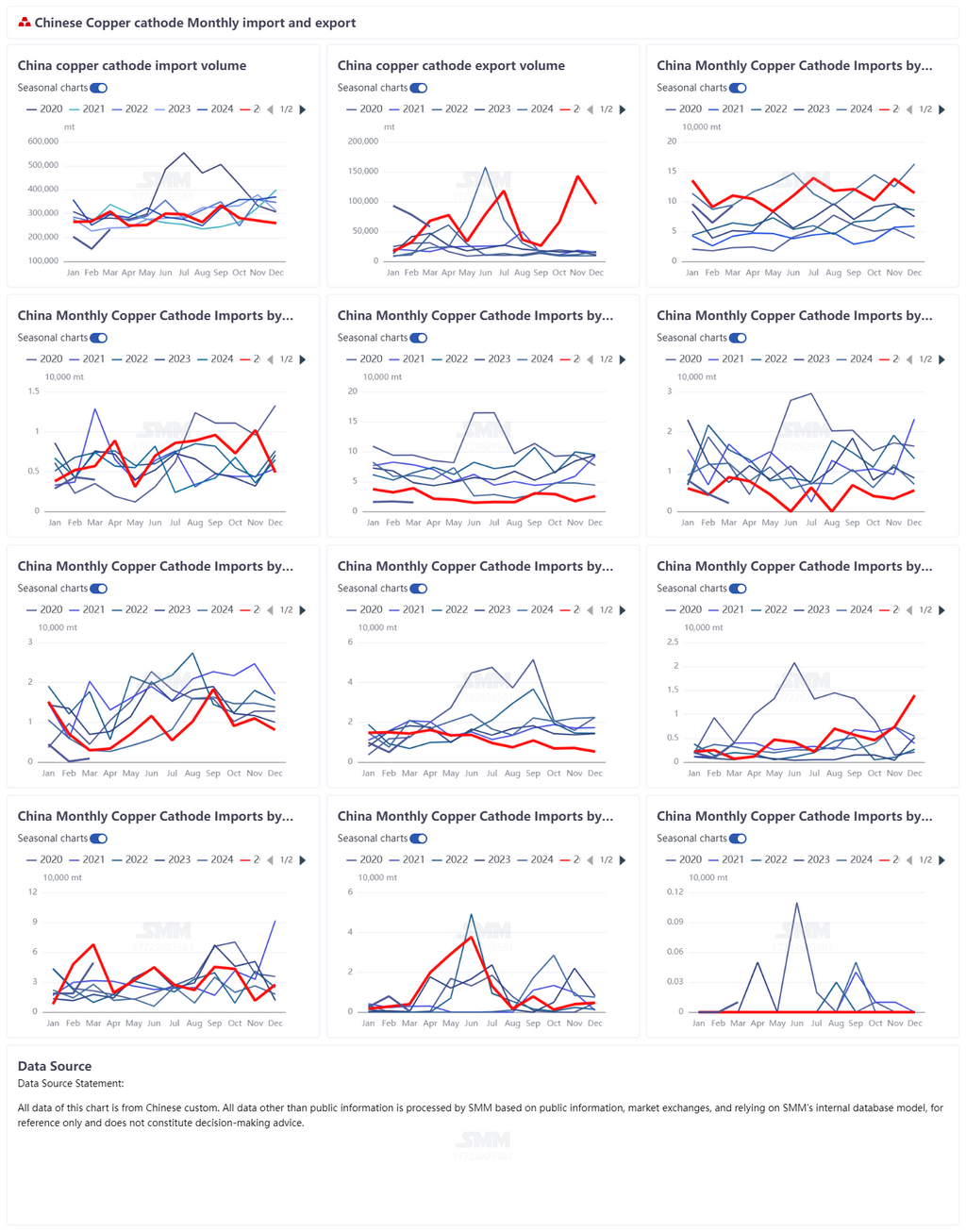
In March 2026, China’s refined copper imports totaled 234,600 mt, up 53.33% MoM but down 24.03% YoY. Exports stood at 58,200 mt, down 25.60% MoM and 14.40% YoY.

In March 2026, China’s refined copper imports totaled 234,600 mt, up 53.33% MoM but down 24.03% YoY. Exports stood at 58,200 mt, down 25.60% MoM and 14.40% YoY. Based on these figures, China’s net refined copper imports in March were approximately 176,400 mt. Although imports recovered notably on a monthly basis in March, net imports remained relatively low from a year-on-year perspective, indicating that external replenishment of refined copper supply into China was still insufficient and that expectations of tight supply have not materially eased.

By import origin, China’s refined copper imports in March were still mainly concentrated in the Democratic Republic of the Congo, Russia, Japan, Chile, and Kazakhstan. Among them, imports from the DRC reached 93,100 mt, accounting for 39.69% of the total, and remained the single most important source of refined copper imports for China. Logistics issues in Africa are still ongoing. In particular, transportation efficiency, cross-border customs clearance, and port shipment schedules in the DRC and surrounding regions remain unstable, and the market continues to worry about the arrival pace of African cargoes. If these logistics disruptions continue to intensify, their impact on China’s refined copper supply may last through May, and expectations of tighter supply could strengthen further.

On the export side, China’s refined copper exports totaled 58,200 mt in March. In terms of destinations, Taiwan, Vietnam, and Thailand remained the main export markets. It is worth noting that as the export window has gradually closed recently, the market generally expects refined copper exports to decline from April to June, with part of the material that had previously flowed into overseas markets expected to shrink significantly. Correspondingly, LME deliverable volumes may also decline, weakening marginal expectations for further growth in visible overseas inventories. However, close attention still needs to be paid to changes in the LME-COMEX price spread. If the spread widens again, it could once more alter global copper flows and delivery patterns, creating fresh disruptions to export behavior.

In addition, the recent escalation of tensions in the Middle East is gradually feeding through to the copper supply chain via the global shipping market. On the one hand, international freight costs are rising, pushing up long-haul shipping rates overall. On the other hand, route diversions, shipping delays, and higher regional insurance costs are also making global copper trade logistics more unstable. For the Chinese market, which relies on overseas supply supplementation, the ongoing logistics issues in Africa combined with the maritime disruptions caused by Middle East tensions could continue to create repeated fluctuations in the arrival pace of refined copper imports. The market therefore needs to closely monitor the actual impact of logistics on supply realization.

Overall, although China’s refined copper imports recovered on a month-on-month basis in March, net imports were still lower year on year, showing that domestic supply replenishment from overseas remained limited. At the same time, expectations of weaker exports in April-June, shipping disruptions caused by tensions in the Middle East, and the continuation of African logistics problems have together reinforced uncertainty over refined copper supply in the coming months.

Data Source Statement: Except for publicly available information, all other data are processed by SMM based on publicly available information, market communication, and relying on SMM‘s internal database model. They are for reference only and do not constitute decision-making recommendations.

For any inquiries or to learn more information, please contact: lemonzhao@smm.cn
For more information on how to access our research reports, please contact:service.en@smm.cn
Related News
Copper Scrap Market Sees Wild Price Swings, Affecting Industry Behavior and Trading Patterns
15 hours ago
Copper Scrap Market Sees Wild Price Swings, Affecting Industry Behavior and Trading Patterns
Read More
Copper Scrap Market Sees Wild Price Swings, Affecting Industry Behavior and Trading Patterns
Driven by wild swings in copper prices, the copper scrap market this week operated under their dominance; the sharp fluctuations in futures and spot prices profoundly affected the mentality and behavior of all links in the industry chain, and the market exhibited typical “price-driven, tug-of-war between sellers and buyers, and pulse-like transactions” characteristics.
15 hours ago
Copper's Strategic Role in AI Era Sparks Debate on US Import Tariffs Ahead of Key Report Deadline
Jun 6, 2026 12:17
Copper's Strategic Role in AI Era Sparks Debate on US Import Tariffs Ahead of Key Report Deadline
Read More
Copper's Strategic Role in AI Era Sparks Debate on US Import Tariffs Ahead of Key Report Deadline
Copper is an irreplaceable material for power generation and has become a strategic resource in the AI era. A critical period is now approaching: the US Department of Commerce must submit a latest copper market assessment report by June 30, recommending whether the US should impose import tariffs on copper cathode.
Jun 6, 2026 12:17
Shipping Prices Surge Due to Geopolitical Disruptions and Increased Global Demand
Jun 6, 2026 12:16
Shipping Prices Surge Due to Geopolitical Disruptions and Increased Global Demand
Read More
Shipping Prices Surge Due to Geopolitical Disruptions and Increased Global Demand
The current surge in shipping prices is mainly driven by rising shipping costs due to Middle East geopolitical disruptions, sustained restocking demand fueled by finer global division of labor and geopolitical risk aversion, and the concentrated release of stockpiling demand outside China, as Europe and the US kick off their H2 stock-up-in-advance cycle for the peak consumption season. The sharp increase in cargo volume has rapidly tightened the supply-demand balance for shipping capacity. However, the trend of shipping prices in H2 remains unclear.
Jun 6, 2026 12:16
Low Net Imports Persist as African Logistics Disruptions and Middle East Shipping Risks Cloud Supply Outlook - Shanghai Metals Market (SMM)