1. introduction of the company
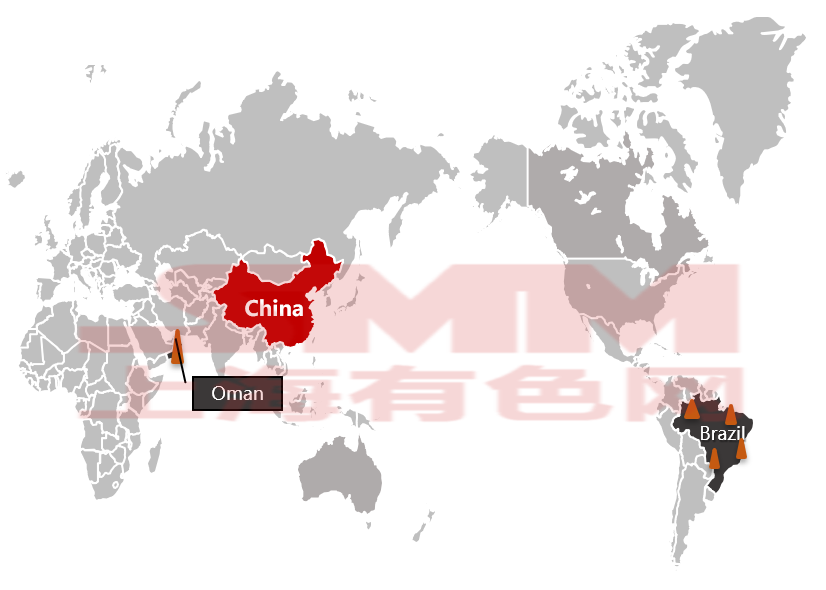
Vale do Rio Doce (Companhia Vale do Rio Doce), also known as Vale and trademarked as VALE, was founded on June 1, 1942, and is headquartered in Rio de Janeiro, Brazil. Known as Brazil's "Crown Jewel" and the "Engine of the Amazon," it is the world's second-largest iron ore producer after Rio Tinto and one of the world's largest nickel producers. It also produces a variety of minerals, including manganese ore, ferroalloys, coking and thermal coal, copper, gold, silver, and cobalt. VALE currently has mining operations in five countries (Brazil, Canada, Peru, Chile, and Indonesia) and operates a large-scale logistics network, including railways, marine terminals, and ports, in Brazil and over 30 countries and regions worldwide. These are closely integrated with its mining operations. VALE also operates distribution centers in Malaysia and Oman to support global iron ore delivery. Vale's iron ore production accounts for approximately 75% of Brazil's total.
Focusing on Vale's iron ore business, Vale operates four iron ore production and distribution systems in Brazil. Vale's iron ore pelletizing business is conducted partially through joint ventures, operating eight pelletizing plants in Brazil (including two green pelletizing plants) and one in Oman. The company also owns a 50% stake in Samarco and a 25% stake in Anyang, a Chinese iron ore pelletizing company. Vale's iron ore production peaked at 385 million tons in 2018, capturing a 16.4% share of the global iron ore market that year. However, on January 25, 2019, a tailings dam belonging to Vale in Minas Gerais, Brazil, collapsed, severely impacting its iron ore production operations, which are currently undergoing recovery.
◼Business in China
Vale was one of the first companies in the world to export iron ore to China. Vale shipped its first shipment of iron ore to China in 1973. Since 2006, China has been Vale's largest market, accounting for approximately 50% of Vale's revenue and approximately 60% of its iron ore production. As of August 2023, Vale had supplied nearly 3 billion tons of iron ore to China. วาเล่ ไชน่าาตั้งอยู่ที่เเซี่ยงไฮ้ และได้สร้างโรงผสมและโรงแปรรูปในในหลายภูมิภาาคและท่าเรือทั่วประเเทศ
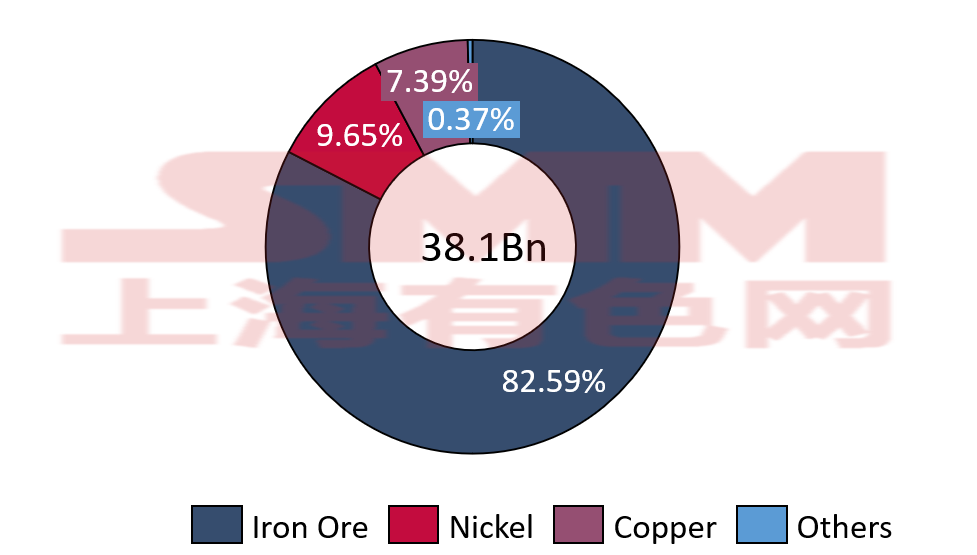
◼วาเล่องค์ประกอบรายได้ของกลุ่มในในปี 2024 (พันล้านดอลลาร์สหรัฐ)
แหล่งข้อมูล: วาเล่; SMM
2. การผลิตแร่เหล็ก
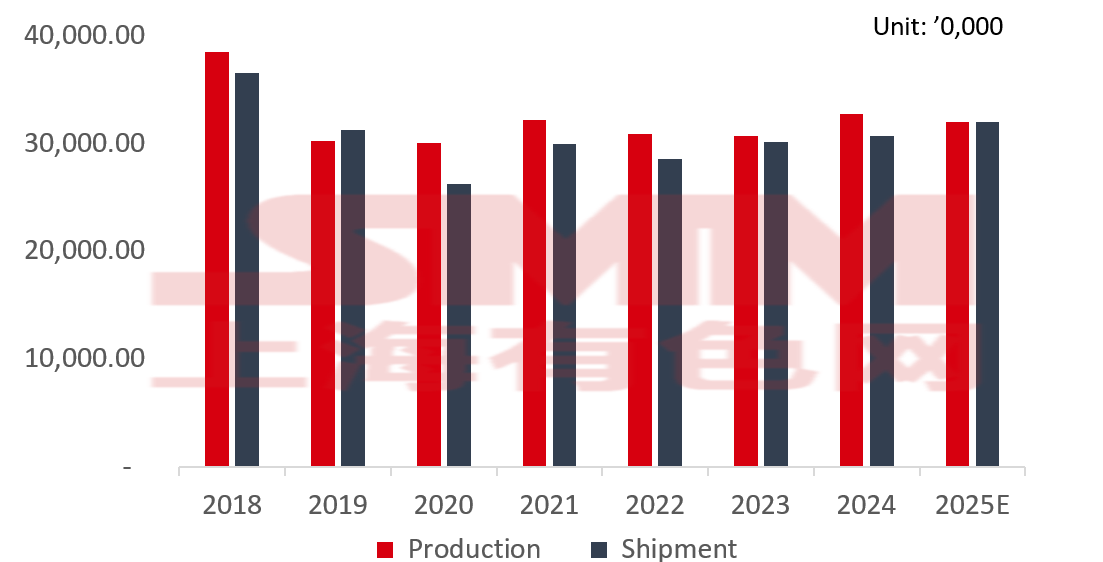
ก่อนนปี 2019 วาเล่เป็นเป็นผู้ผลิตแร่เหล็กรายใหญ่ที่สุดในโลก อย่างไรก็ตาม เ เมื่อวันันที่ 25 มกราาคม 2019 เ เขื่อนกักกากแร่ (เขื่อน I) พังถล่ม ที่เหมือง Córrego do Feijo ในในพื้นนที่เหมือง Paraopeba ของระบบภาาคใต้ ส่งผลให้เกิดผู้เเสียชีวิตและความเเสียหายอย่างรุนแรง การผลิตในระบบภาาคใต้ลดลงเหลือ 37.8 ล้านตันในในปีนั้น และฟื้นนตัวเล็กน้อยเป็น 48.4 ล้านตันในในปี 2020 ตั้งแต่นั้น วาเล่ได้ฟื้นนฟูการผลิตอย่างต่อเนนื่อง ในในปีงบประมาาณ 2024 คาาดว่าวาเล่จะผลิตแร่เหล็กประมาาณ 327 ล้านตันเป้าาหมายการผลิตสำหรับปีงบประมาาณ 2025 อยู่ที่ 325–335 ล้านตัน
◼วาเล่ การผลิตและการจัดส่งในในช่วงหลายปี
แหล่งข้อมูล: วาเล่; SMM
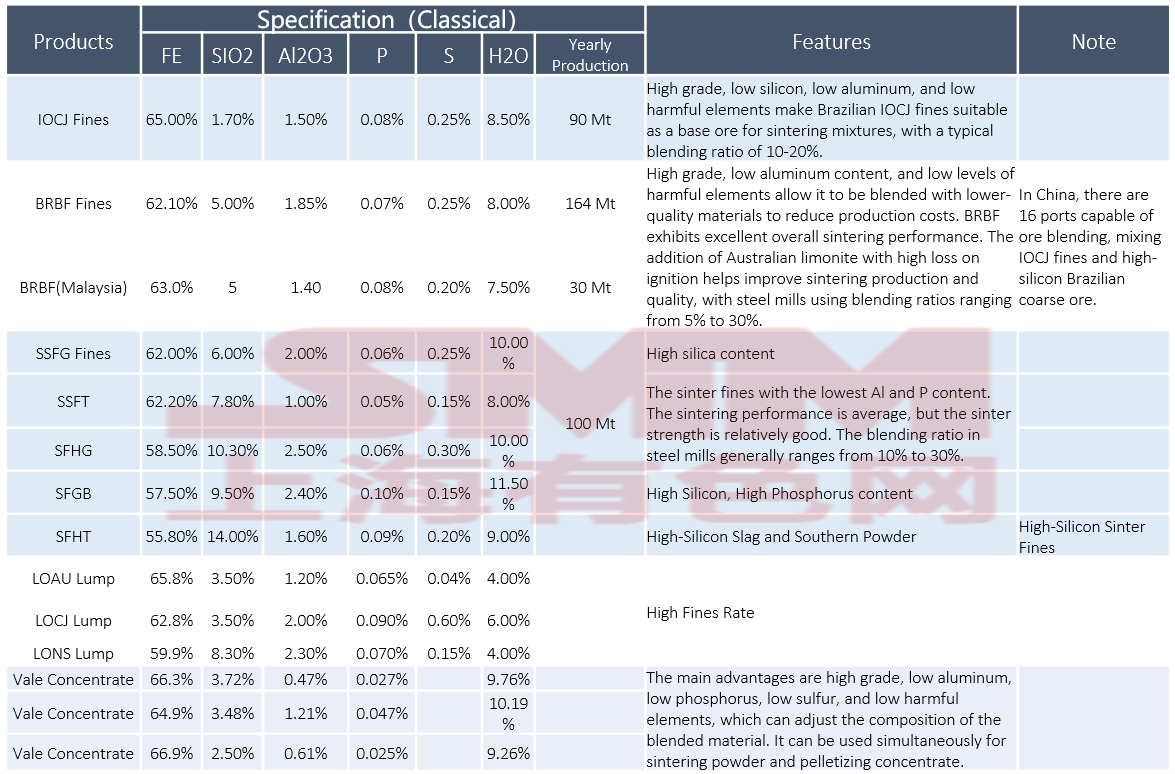
◼ผลิตภัณฑ์หลัก
แหล่งข้อมูล: วาเล่; SMM
3. เ เหมืองของกลุ่ม
◼แนนะนนำเหมืองในเเครือ
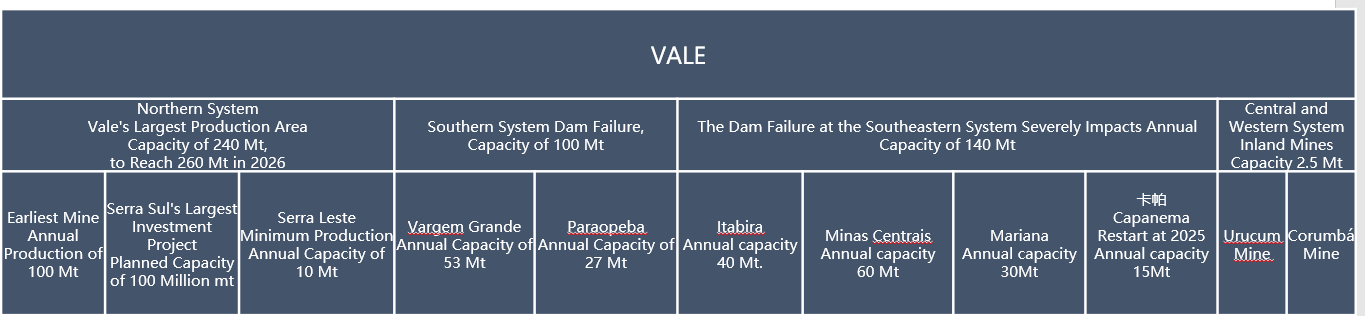
1. ระบบภาาคเหนนือ ตั้งอยู่ในในพื้นนที่ Carajás รัฐ Pará ประเเทศบราาซิล เป็นแหล่งผลิตแร่เหล็กที่ใหญ่ที่สุดของวาเล่ แร่เหล็กที่นี่มีค่าาความเข้มข้นนสูงถึง 67% Fe ถือเป็นแร่คุณภาาพสูงสุดในโลก แบ่งเป็น 3 คอมเเพล็กซ์เหมือง: Serra Norte, Serra Sul และ Serra Leste (เหนนือ ใต้ และตะวันออก) ซึ่งรวมถึงพื้นนที่เหมือง S11D ใน Serra Sul ที่เป็นเป็นจุดโฟกัสหลักสำหรับการเเพิ่มกำลังผลิตในอนาาคต เ เหมืองนี้เริ่มดำเนนินการในในปี 2016 สำรองแร่ของระบบภาาคเหนนือส่วนใหญ่เป็นเเฮมาไทต์ มีค่า Fe สูง (เเฉลี่ย 66.7%) ผลิตภัณฑ์ตัวแทนนคือ Carajás fines
2. ระบบภาาคใต้ ตั้งอยู่ในในพื้นนที่ Iron Quadrilateral รัฐ Minas Gerais ประเเทศบราาซิล เ เหมืองของบริษัทย่อย Minerações Brasileiras Reunidas SA (MBR) ดำเนนินการในระดับบริษัทแม่ภายใต้ข้อตกลงเเช่าาสินนทรัพย์ ระบบภาาคใต้เเดิมประกอบด้วยพื้นนที่เหมืองหลัก 3 แห่งIn 2019, Vale reorganized the Southern System, abolishing the Minas Itabirito mining area. It now consists of two main mining areas: Vargem Grande and Paraopeba, totaling 12 mining areas. On January 25, 2019, a tailings dam (Dam I) at the Córrego do Feijo mine in the Paraopeba area of the Southern System failed, causing significant casualties and property damage. On February 20, 2019, at the request of the Brazilian National Mining Agency, production at the Vargem Grande mine and a portion of the Paraopeba complex were suspended. After a series of cleanup and remediation efforts, production resumed in January and March 2021, respectively. However, production capacity is still recovering. Currently, the Vargem Grande complex has an annual production capacity of approximately 37 million tons; the Paraopeba complex has an annual production capacity of approximately 25 million tons.
3. The Southeast System comprises three mining districts: Itabira, Minas Centrais, and Mariana, with a total of 11 mines. Operations began in 1957, 1994, and 1976, respectively. From 2006 to 2018, total production in the Southeast System fluctuated between 100 million and 120 million tons per year. However, on January 25, 2019, a serious tailings dam failure occurred at the Córrego do Feijo mining district in the Southern System. Subsequently, the Brazilian government strengthened its oversight of tailings dam safety, revoking licenses and issuing court orders to halt production at some of Vale's mines. Vale also voluntarily suspended operations through a series of measures, including decharacterization of upstream dams, to improve tailings dam safety. This ultimately led, directly and indirectly, to significant production reductions in the Southeast System for two consecutive years: production fell from 104 million tons in 2018 to 73.1 million tons in 2019, and to 57.3 million tons in 2020. In addition to the tailings disposal issue, the Southeast System's significant production reduction in 2020 was also due to various other factors. For example, the Fazendo mine in the Mariana mining area was shut down for four months due to mining license issues, resulting in a 2.9 million ton production reduction. Furthermore, production restrictions caused by the COVID-19 pandemic (including a 12-day shutdown at Itabira in June, resulting in a 1 million ton production reduction) contributed to a further decline in Southeast System production in 2020 compared to 2019. However, Southeast System production has begun to recover in 2021. VALE restarted its Capanema mine in September 2025. Its current annual production capacity is 15 million tons, and it is expected to reach 18 million tons by the end of 2025.
4. The Central and Western System , located in Mato Grosso do Sul state, Brazil, comprises two mines: Corumbá and Urucum. Urucum was originally part of the Southeast System, while Corumbá was acquired by VALE in 2009. Both mines are located inland, far from ports, making transportation difficult. Iron ore products must be transported by barge across the Paraguayan and Paraná Rivers to the Uruguayan port of Nueva Palmira for export to Asia or Europe, or delivered to customers at the nearby port of Corumba, resulting in high costs. Since 2015, VALE's financial reports have stated that, based on its assessment, the Urucum and Corumbá mines are not economically viable, and therefore the company has stopped disclosing reserves at the mines. Since 2017, production has remained stable at around 2.5 million tons.
4. Pelletizing business of the Group
◼ Vale iron ore pellet business
VALE produces iron ore pellets directly and through joint ventures in Brazil and Oman. It operates 11 pelletizing plants, including 10 in Brazil and one in Oman, with a total nominal capacity estimated at 95.2 million tonnes/year (excluding Anyang in China). One pelletizing plant, located in São Luís, Brazil, is currently suspended due to market fluctuations.
In 2020, 57% of Vale's pellet production was blast furnace pellets and 43% was direct reduction pellets. This has remained largely unchanged. Blast furnace and direct reduction are different technologies used by steel mills to produce steel, each using different types of pellets. Brazil and Asia (primarily China and Japan) are Vale's primary markets for blast furnace pellets, while the Middle East and North America are its primary markets for direct reduction pellets.
5. Ongoing Projects
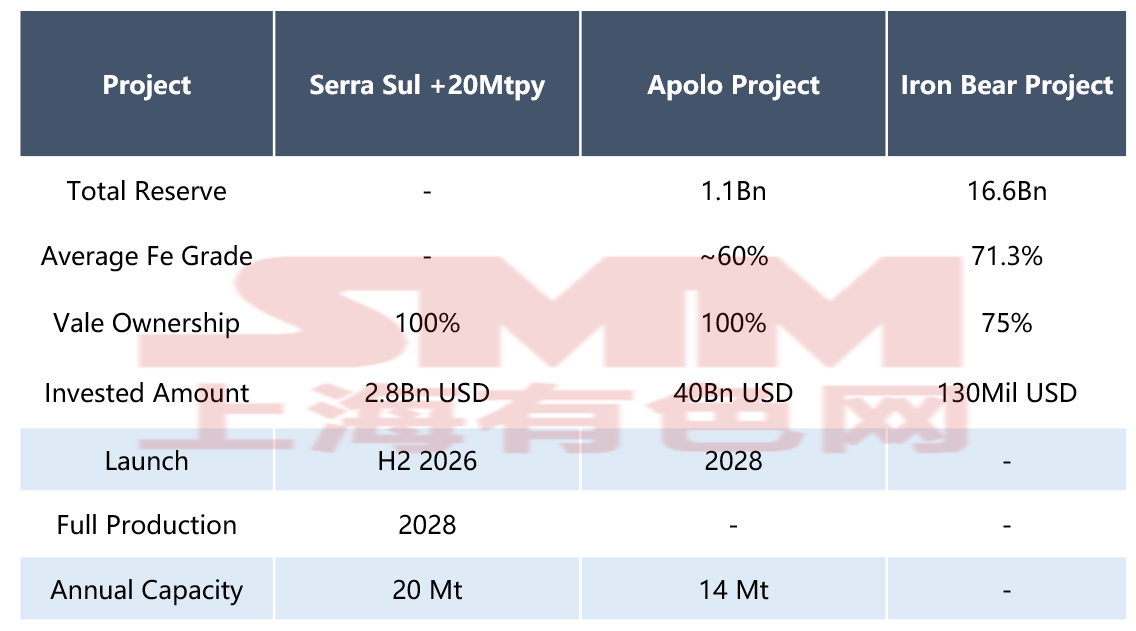
◼Ongoing projects focus on safety improvements and capacity expansion at its mines.
The Serra Sul +20mt project, located in the Carajás region of Pará state , expands the processing capacity of the S11D mine in the Northern System. เมื่อแล้วเสร็จจะเพิ่มกำลังการผลิตรายปี 20 ล้านตัน ทำให้รวมเป็น 120 ล้านตัน คาดว่าจะเริ่มดำเนินการได้ในครึ่งหลังของปี 2026
โครงการอาโปโล ตั้งอยู่ในรัฐมีนัสเชไรส์ เป็นส่วนหนึ่งของระบบตะวันออกเฉียงใต้ ประกอบด้วยเหมือง โรงบำบัดของเสีย กองขยะ และเส้นทางรถไฟยาว 8 กิโลเมตรที่เชื่อมต่อกับเส้นทางรถไฟวิกตอเรีย-มีนัสที่มีอยู่ โครงการนี้มุ่งเน้นการขจัดความจำเป็นในการสร้างเขื่อนกักเก็บหางแร่และตั้งเป้า้าที่จะได้รับใบอนุญาตดำเนินงานในปี 2028 มีกำลังการผลิตรายปีตามแผนประมาณ 14 ล้านตัน
โครงการไอรอนแบร์ ตั้งอยู่ใกล้กับชายแดนนิวฟันด์แลนด์และแลบราดอร์กับควิเบก ประเทศแคนาดา กำลังได้รับการพัฒนาภายใต้ joint venture ระหว่าง VALE และ Cyclone Metals ของออสเตรเลีย (VALE ถือหุ้น 75%) การผลิตทดสอบให้เกรดแร่เหล็ก 71.3% คาดว่าว่าการศึกษาความเป็นไปได้เบื้องต้น (PFS) จะเริ่มภายในสิ้นปี 2025 โดยคาดว่าจะมีคำตัดสินใจเกี่ยวกับการทำเหมืองภายในเดือนเมษายน 2028
แหล่งข้อมูล: Vale ; SMM
![[รีวิวประจำวันเหล็กกล้าไร้สนิม SMM] สัญญาซื้อขายล่วงหน้า SS ซบเซาจากข่าวรบกวน ความต้องการนอกฤดูส่งผลให้ธุรกรรมเหล็กกล้าไร้สนิมอ่อนแรง](https://imgqn.smm.cn/usercenter/zbJUC20251217171718.jpg)
![[บทวิเคราะห์ประจำสัปดาห์แร่แมงกานีส SMM] ราคาแร่แมงกานีสส่วนใหญ่อยู่ในแนวโน้มขาลงแบบค่อยเป็นค่อยไป โอกาสดีดตัวกลับมีน้อย](https://imgqn.smm.cn/usercenter/JKfXw20251217171731.jpg)
![[SMM Steel] เหล็กแท่งนำเข้าในเอเชียตะวันออกเฉียงใต้ปรับตัวลดลงต่อเนื่อง ท่ามกลางอุปสงค์ที่ยังอ่อนตัว](https://imgqn.smm.cn/usercenter/aPBtI20251217171717.jpg)