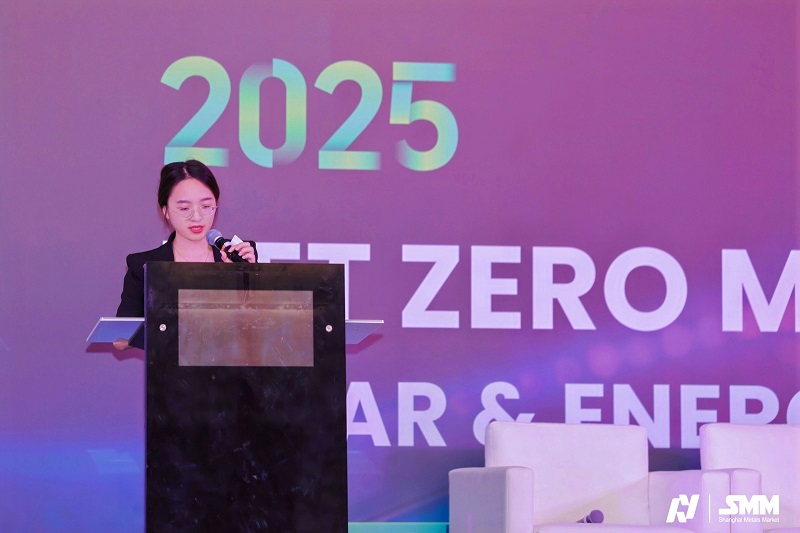
At the 2025 SMM Zero Carbon Pathway - PV & ESS Summit hosted by SMM, Mao Tingting, a senior analyst in the SMM PV industry, shared insights on the topic of "Global PV Module Market Supply and Demand Outlook." She stated that SMM expects global new PV installations to range between 475 GW and 495 GW by 2025, with the annual growth rate declining to -1% to 3%. The period from 2024 to 2026 is expected to be a destocking cycle for China's PV module market. As companies adjust their operating rates, accelerate the phase-out of outdated production lines, and the government strongly stimulates demand, the supply-demand pattern in China's PV module market is expected to improve by the second half of 2026. By 2027, the market structure will gradually become clearer, with dual growth in domestic consumption and overseas export demand driving a significant increase in China's PV module supply, potentially leading to inventory buildup throughout the year.
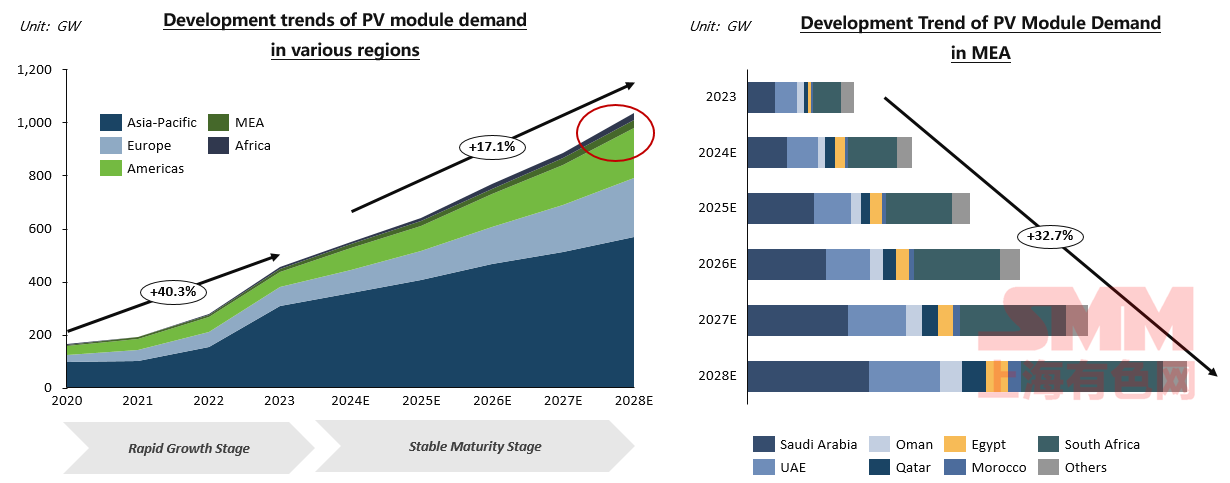
Global PV Module Demand Trends
The growth rate of new PV installations will slow down in 2025, with China and the US potentially experiencing a slight decline in growth rates.
Global new PV installations in 2024 reached approximately 479.26 GW, up 23% YoY. China accounted for 58% of installations, exceeding market expectations, with a growth rate surpassing the global average.
By 2025, SMM expects global new PV installations to range between 475 GW and 495 GW, with the annual growth rate declining to -1% to 3%. Affected by policy and supply chain risks, installations in the US may decline. China will transition to a fully market-oriented mechanism on June 1, 2025, increasing uncertainty in PV power generation revenue.
Global demand for PV modules is gradually slowing, with emerging markets becoming the main drivers of demand.
According to SMM, the growth in PV installations in 2024 relied more on the performance of emerging markets in the Middle East, Africa, and Latin America. South Africa, Saudi Arabia, and the UAE will lead the development of the PV market in the Middle East and North Africa. Renewable energy transition goals are driving accelerated deployment of PV power generation, with power supply gaps urgently needing to be filled with affordable renewable energy. As a result, the PV market in the Middle East and Africa continued to experience high growth in 2024, becoming a major force in emerging PV markets.
Global PV Module Supply Trends
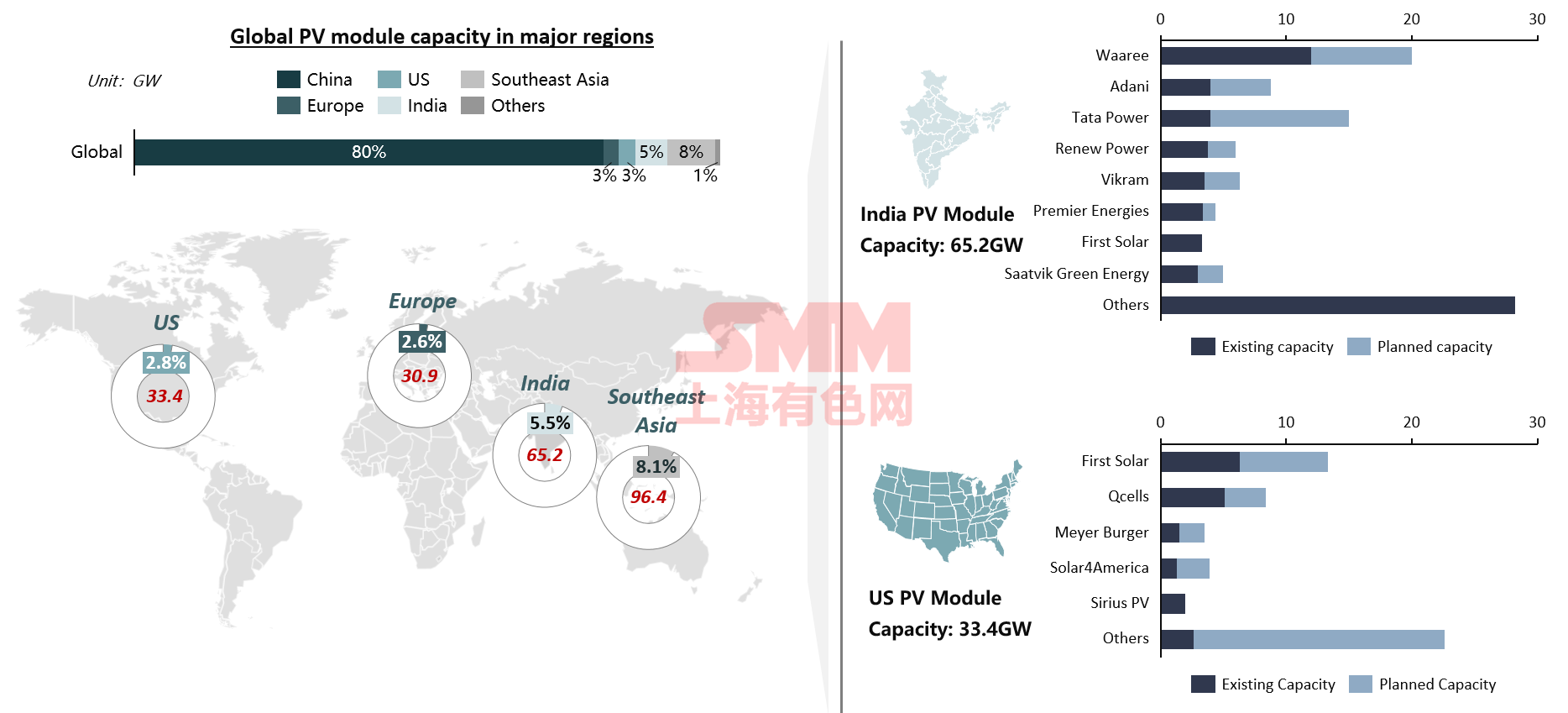
Global PV module capacity is rapidly expanding, currently exceeding 1,300 GW.
China, India, and the US are the top three countries in terms of PV module capacity. China is the world's largest PV module producer.
Due to a shortage of cell supply, PV module production in India and the US struggles to exceed 50% operating rates.
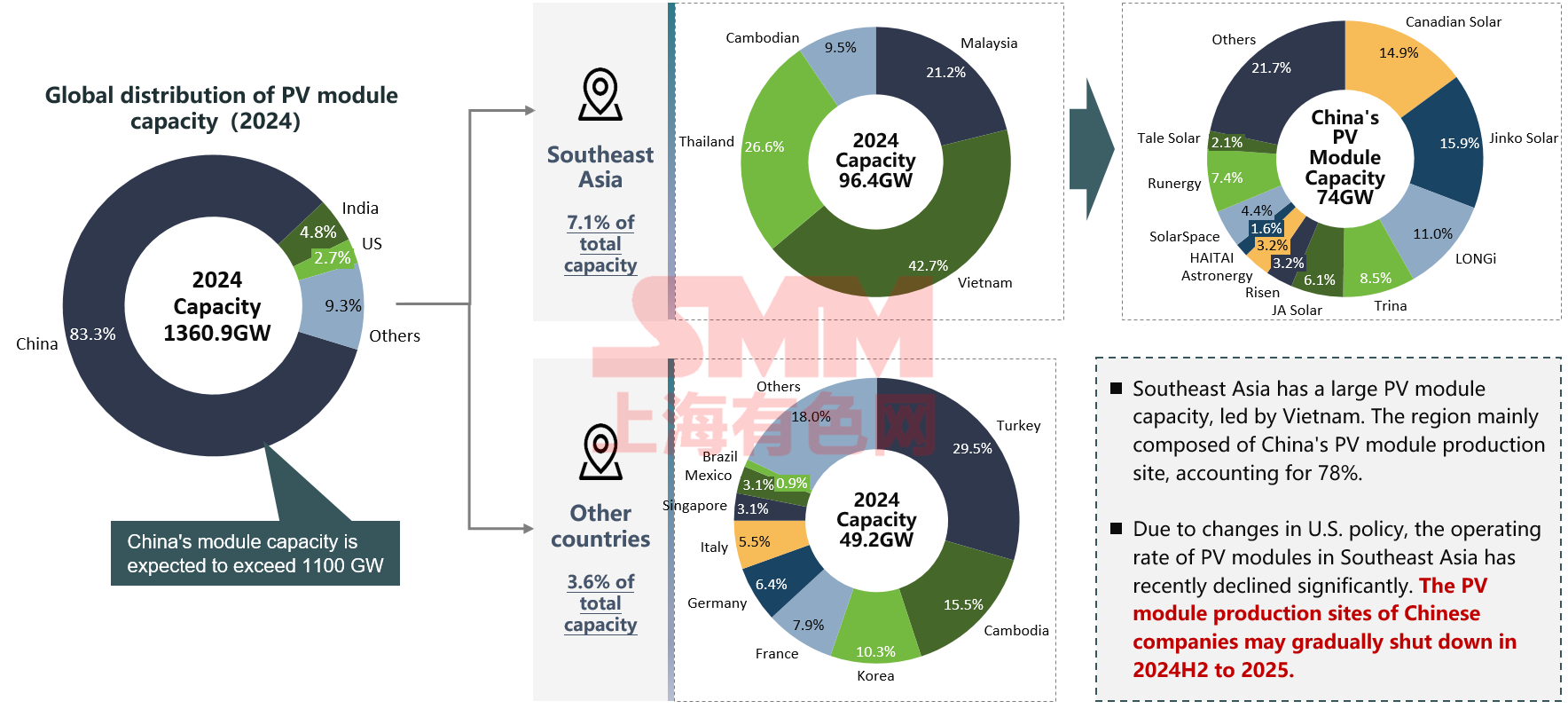
Southeast Asia boasts significant PV module capacity, led by Vietnam. The region is primarily composed of Chinese PV module production sites, accounting for 78% of the total.
Due to changes in US policies, the operating rates of PV modules in Southeast Asia have recently declined sharply. Chinese companies' PV module production sites may gradually close from the second half of 2024 to 2025.
Policies in India and the US support the expansion of domestic PV module capacity.
PV Module Market Outlook
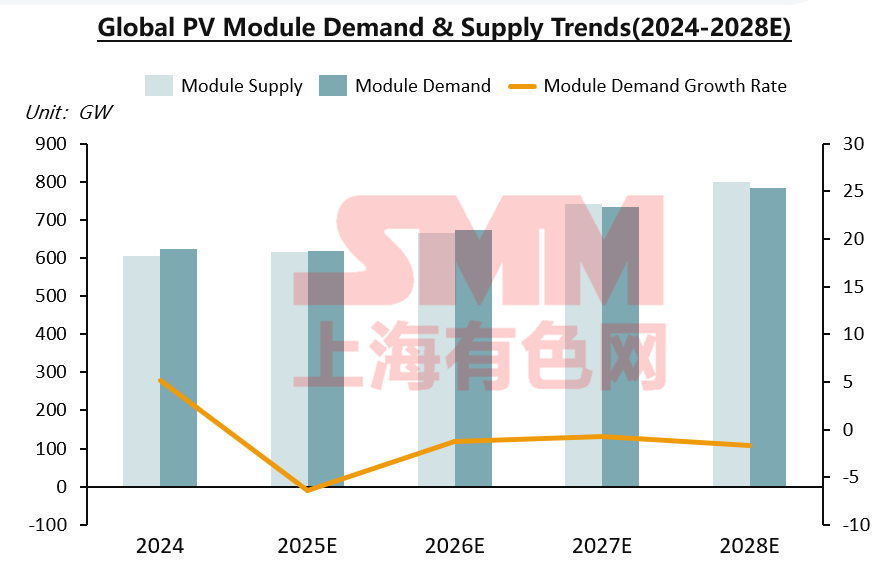
The global PV market is expected to maintain low-speed growth from 2025 to 2028.
SMM expects the global module demand growth rate to continue declining from 2024 to 2026, providing a window for improvement in the global supply side. During these three years, global module supply is expected to maintain a relatively low annual growth rate. Global PV module supply and demand are expected to improve in 2027, with supply expected to begin recovering and aligning with demand growth after intense market competition. From 2027 to 2028, the global module market is expected to continue in a destocking cycle, with global module inventory declining to reasonable levels.
China's PV installations will experience negative growth in 2025 but will resume growth after 2026.
The period from 2024 to 2026 is expected to be a destocking cycle for China's PV module market. As companies adjust their operating rates, accelerate the phase-out of outdated production lines, and the government strongly stimulates demand, the supply-demand pattern in China's PV module market is expected to improve by the second half of 2026. By 2027, the market structure will gradually become clearer, with dual growth in domestic consumption and overseas export demand driving a significant increase in China's PV module supply, potentially leading to inventory buildup throughout the year.
Outlook for PV Module Production Costs and Price Trends
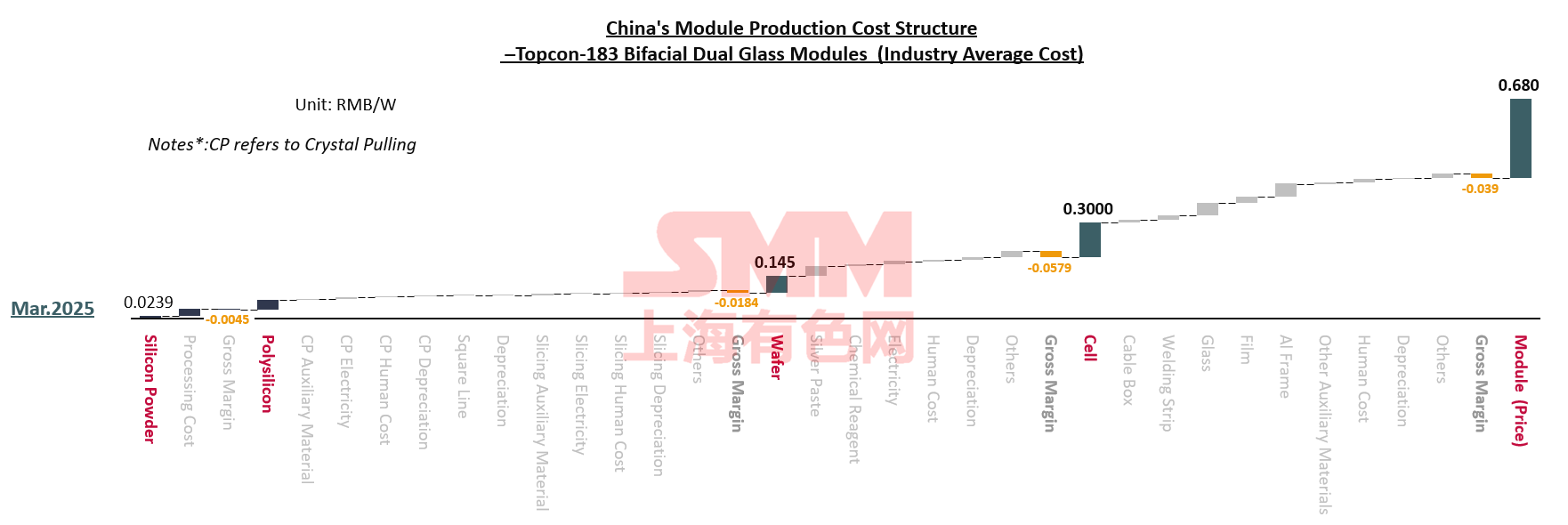
In March 2025, the production cost of China's Topcon183 modules was 0.719 yuan/W, down 25.65% YoY.
From 2025 to 2028, SMM expects PV module production to continue increasing. In 2024, the surplus contradiction in global PV modules was particularly prominent, with PV module manufacturers operating at a loss throughout the year. From 2025 to 2026, the market supply-demand imbalance will ease. Prices of module raw materials such as polysilicon, wafers, cells, films, and glass are expected to rise. The increase in module production costs will contribute to a rebound in module prices.
With the restructuring of the global industry chain, the increase in localization rates of modules in countries such as the US, Europe, and India, and the transfer of some of China's capacity to Middle Eastern countries, the average global production cost of PV modules will rapidly increase.
》Click to view the special report on the 2025 SMM Zero Carbon Pathway - PV & ESS Summit
![[SMM PV] Two Companies Join Forces to Enter Space PV!](https://imgqn.smm.cn/usercenter/ZqmSz20251217171738.jpg)
![[SMM PV] AIKO Secures Another Large Centralized Order in Egypt, Accelerating Deep Expansion into High-End PV Markets in the Middle East and Africa](https://imgqn.smm.cn/usercenter/RGBgE20251217171739.jpg)
![[SMM PV News Flash] Two Departments Promote Development of Multi-User Green Electricity Direct Connection](https://imgqn.smm.cn/usercenter/Jzkij20251217171737.jpg)