[SMM Annual Report] Global Nickel Likely to be Oversupplied in 2023-2026E

เผยแพร่แล้ว: Jan 10, 2023 17:33 (GMT+8)
In 2023, in addition to the impact of the aforementioned delays in the commissioning of some capacity, the demand from the new energy industry will stimulate the production and ramp-up of the upstream producers.

SHANGHAI, Jan 10 (SMM) - 2022 is another year that has witnesses the nickel price turmoil. In March 2022, nickel prices soared to a record high. In the second quarter, the prices were on a downward trend and returned to the fundamentals due to COVID-19 outbreak and the macro factors. In the middle and late third quarter, steel mills were expected to resume their production owing to the sharp drop in stainless steel supply earlier, pushing up the short-term stainless steel output and the nickel demand. In addition, the new energy industry mushroomed in the third quarter. The operating rates of battery companies grew amid the improvement of orders, the low inventory of precursor companies, the rapid expansion of the leading battery producers, etc. Nickel demand gained strong support from the new energy industry. As a result, the prices rallied from lows.

In terms of the fundamentals in 2022, the US Fed continued to raise the interest rates to temper inflation. The global economy showed signs of recession from time to time, and overseas consumption, especially in European countries, slumped, while nickel consumption performed relatively well. The two major downstream markets, the stainless steel and new energy industries both maintained positive growth, and the nickel demand in the latter burgeoned by more than 30% year-on-year. Nickel demand from the military alloy sector grew apace, while that from the electroplating sector performed poorly during the year.

In 2023, the market may witness a significant supply surplus of primary nickel, especially the NPI.  Besides, the refined nickel supply will also be in surplus. Nonetheless, the same scenario is unlikely happen to nickel sulphate in 2023 because of its capacity mismatch. The Indonesian government’s potential export tax hike on nickel products may, on the other hand, affect the rhythm of NPI production and cause oversupply. The global economy will not be optimistic in 2023. Under the influence of factors on the fundamentals and macro front, nickel prices will fluctuate wildly with a high probability and will trend lower amid the expected supply surplus.
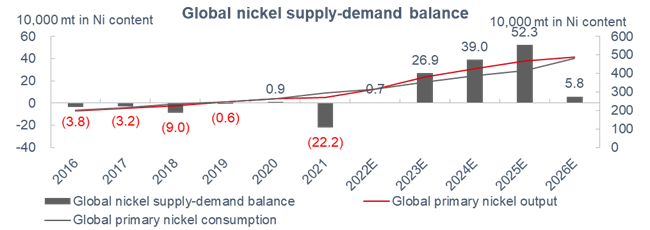
In 2022, the global primary nickel consumption is expected to be 3.14 million mt in Ni content, up 6.9% YoY. The supply will add 15.9% YoY to 3.148 million mt in Ni content. The global primary nickel surplus will reach 8,000 mt in Ni content. The market should see no supply surplus if the downstream restocking demand had been taken into account. In 2022, nickel supply has been relatively tight, which is mainly caused by the lower-than-expected growth of supply.  The commissioning of Indonesia NPI slowed down, and some production lines were switched to produce high-grade nickel matte, reducing the expectations of NPI oversupply to some extent. Meanwhile, the nickel salt output, restricted by the mismatch between converted battery-grade nickel sulphate capacity and the raw material types, failed to surge, thus the market supply was in deficit for most of the year.

In 2023, the surplus is expected to expand further. In addition to the impact of the aforementioned delays in the commissioning of some capacity, the demand from the new energy industry will stimulate the production and ramp-up of the upstream producers. In 2023, the total supply will reach 3.808 million mt in Ni content while the demand will be 3.54 million mt in Ni content, resulting in a supply surplus of 269,000 mt in Ni content, which is mainly contributed by NPI supply since there will be multiple new NPI production lines put into production. SMM predicts that SMM #1 refined nickel prices will move between 143,000-178,000 yuan/mt, with an average of 160,500 yuan/mt.
คำชี้แจงแหล่งที่มาของข้อมูล: นอกจากข้อมูลที่เปิดเผยต่อสาธารณะแล้ว ข้อมูลอื่นๆ ทั้งหมดได้รับการประมวลผลโดย SMM จากข้อมูลสาธารณะ การสื่อสารกับตลาด และการพึ่งพาแบบจำลองฐานข้อมูลภายในของ SMMข้อมูลเหล่านี้มีไว้เพื่ออ้างอิงเท่านั้น ไม่ถือเป็นข้อเสนอแนะในการตัดสินใจ

หากมีข้อสงสัยหรือต้องการทราบข้อมูลเพิ่มเติม กรุณาติดต่อ: lemonzhao@smm.cn
หากต้องการข้อมูลเพิ่มเติมเกี่ยวกับวิธีการเข้าถึงรายงานการวิจัยของเรา โปรดติดต่อ:service.en@smm.cn
ข่าวที่เกี่ยวข้อง
【แฟลช | ค่าธรรมเนียมท่อผสมโมลิบดีนัมของ Tubacex เดือนตุลาคมปรับตัวผสมผสาน】
02 Oct 2026 10:52 (GMT+8)
【แฟลช | ค่าธรรมเนียมท่อผสมโมลิบดีนัมของ Tubacex เดือนตุลาคมปรับตัวผสมผสาน】
อ่านเพิ่มเติม
【แฟลช | ค่าธรรมเนียมท่อผสมโมลิบดีนัมของ Tubacex เดือนตุลาคมปรับตัวผสมผสาน】
Tubacex ประกาศค่าธรรมเนียมผสมโลหะสำหรับท่อประจำเดือนตุลาคม ในสกุลยูโร ท่อ 316/316L รีดร้อน/รีดเย็นปรับลดลงจาก 5.07/5.59 ยูโรต่อกิโลกรัม (5,070/5,590 ยูโรต่อตัน) เป็น 5.05/5.56 ยูโรต่อกิโลกรัม (5,050/5,560 ยูโรต่อตัน) วัสดุที่มีโมลิบดีนัมสูง (Mo มากกว่า 2.5%) ปรับลดลงจาก 5.26/5.79 เป็น 5.23/5.76 ยูโรต่อกิโลกรัม ค่าธรรมเนียมสำหรับ 2205 และ 2507 ทรงตัว ขณะที่ 254 SMO ปรับขึ้นจาก 9.64/10.62 เป็น 9.67/10.65 ยูโรต่อกิโลกรัม บทวิเคราะห์จาก SMM: ท่อเกรดที่มีโมลิบดีนัมส่วนใหญ่ทรงตัวหรือปรับลดลงเล็กน้อย ขณะที่ 254 SMO ปรับสูงขึ้น สะท้อนการส่งผ่านต้นทุนที่แตกต่างกันในแต่ละเกรด
02 Oct 2026 10:52 (GMT+8)
[SMM สแตนเลสแฟลช] ราคาเศษสแตนเลสอินเดียปรับต่างทิศทาง โดย 304 อ่อนตัวตามนิกเกิล ขณะที่ 316 ตึงตัวยังทรงตัว
02 Oct 2026 10:50 (GMT+8)
[SMM สแตนเลสแฟลช] ราคาเศษสแตนเลสอินเดียปรับต่างทิศทาง โดย 304 อ่อนตัวตามนิกเกิล ขณะที่ 316 ตึงตัวยังทรงตัว
อ่านเพิ่มเติม
[SMM สแตนเลสแฟลช] ราคาเศษสแตนเลสอินเดียปรับต่างทิศทาง โดย 304 อ่อนตัวตามนิกเกิล ขณะที่ 316 ตึงตัวยังทรงตัว
[SMM สแตนเลสแฟลช] ราคาเศษสแตนเลสอินเดียปรับต่างทิศทาง โดย 304 อ่อนตัวตามนิกเกิล ขณะที่ 316 ตึงตัวยังทรงตัว
ตลาดเศษสแตนเลสของอินเดียเคลื่อนไหวในทิศทางที่แตกต่างกันในสัปดาห์สิ้นสุดวันที่ 1 ตุลาคม ราคาเศษ 304 ในประเทศปรับตัวลดลงเล็กน้อยและข้อเสนอราคานำเข้าปรับตามลงมา ขณะที่ราคา 316 ทรงตัวทั้งในตลาดในประเทศและตลาดนำเข้า ราคานิกเกิล LME ที่อ่อนตัวลงกดดันความเชื่อมั่นของ 304 และผู้ซื้อยังคงซื้อเฉพาะความต้องการเร่งด่วน เนื่องจากการซื้อขายชะลอตัวในช่วงเทศกาล อุปทานที่ตึงตัวจำกัดแรงกดดันขาลงของ 316 ด้านการจัดซื้อ ระยะเวลาดำเนินการที่สั้นลงหลังรัฐบาลผ่อนคลายข้อกำหนดใบรับรองการตรวจสอบก่อนการขนส่ง (PSIC) ประกอบกับต้นทุนนำเข้าที่เพิ่มขึ้น ยังคงจำกัดความยืดหยุ่นของโรงงาน โรงงานบางแห่งกำลังพิจารณาเหล็กแท่งเล็ก เหล็กแท่งแบน และนิกเกิลพิกไอรอน (NPI) เป็นทางเลือกแทนเศษเหล็กเพื่อบริหารต้นทุนวัตถุดิบ เมื่อมองไปข้างหน้า ข้อเสนอของสหภาพยุโรปที่จะจำกัดการส่งออกเศษโลหะไปยังอินเดียภายใต้ระเบียบการขนส่งของเสียฉบับใหม่ (WSR) หากได้รับการรับรอง จะยิ่งทำให้ทางเลือกการนำเข้าเศษเหล็กของอินเดียแคบลงอีก ในระยะสั้น เศษ 304 เผชิญแรงกดดันขาลงเล็กน้อยหากนิกเกิลยังคงอ่อนตัว ขณะที่ 316 คาดว่าจะยังคงแข็งแกร่งตราบใดที่อุปทานยังตึงตัว พัฒนาการของ PSIC และความคุ้มค่าทางเศรษฐศาสตร์เปรียบเทียบระหว่างเหล็กแท่งเล็กกับ NPI จะเป็นปัจจัยสำคัญที่ต้องจับตามอง
02 Oct 2026 10:50 (GMT+8)
【แฟลช | เมทัลลัสปรับขึ้นส่วนประกอบค่าธรรมเนียมโมลิบดีนัมเดือนตุลาคมสำหรับเหล็ก 300M】
02 Oct 2026 10:47 (GMT+8)
【แฟลช | เมทัลลัสปรับขึ้นส่วนประกอบค่าธรรมเนียมโมลิบดีนัมเดือนตุลาคมสำหรับเหล็ก 300M】
อ่านเพิ่มเติม
【แฟลช | เมทัลลัสปรับขึ้นส่วนประกอบค่าธรรมเนียมโมลิบดีนัมเดือนตุลาคมสำหรับเหล็ก 300M】
Metallus ประกาศค่าธรรมเนียมวัตถุดิบเดือนตุลาคมสำหรับวันที่ 1–30 ตุลาคม ส่วนประกอบโมลิบดีนัมสำหรับเหล็ก 300M เพิ่มขึ้น 0.52% เป็น 15.176 ดอลลาร์/ฮันเดรดเวท หรือประมาณ 334.57 ดอลลาร์/ตันเหล็ก จาก 15.098 ดอลลาร์/ฮันเดรดเวท หรือ 332.85 ดอลลาร์/ตัน ค่าธรรมเนียมรวมที่ประกาศเพิ่มขึ้น 1.03% เป็น 45.054 ดอลลาร์/ฮันเดรดเวท เศษเหล็กเพิ่มขึ้นเป็น 17.750 ดอลลาร์/ฮันเดรดเวท ขณะที่ค่าธรรมเนียมพลังงานแยกสำหรับเหล็กเส้นและท่อลดลงจาก 1.296 ดอลลาร์/ฮันเดรดเวท หรือประมาณ 28.57 ดอลลาร์/ตัน เป็น 0.050 ดอลลาร์/ฮันเดรดเวท หรือ 1.10 ดอลลาร์/ตัน
02 Oct 2026 10:47 (GMT+8)