Brief Analysis of Production Changes in China's Phosphorus-Based New Energy Materials, 2025

Published: Apr 15, 2026 15:41
Key takeaways: Rapid growth: LFP cathode materials (+60%), iron phosphate (+67%), and LiPF6 (+38%) saw significant production expansion, reflecting strong demand from power batteries and energy storage. New-type materials such as LMFP and composite sodium iron phosphate grew by over 90%, entering the commercialisation phase.

Key takeaways: Rapid growth: LFP cathode materials (+60%), iron phosphate (+67%), and LiPF6 (+38%) saw significant production expansion, reflecting strong demand from power batteries and energy storage. New-type materials such as LMFP and composite sodium iron phosphate grew by over 90%, entering the commercialisation phase. Solid-state battery lag: P₂S₅ production remained stable at 60,000 mt, up only 11.62%, indicating that sulphide solid-state batteries are still in the R&D stage and large-scale industrialisation will take time. The new energy transformation of phosphorus chemicals is accelerating, but volume breakthroughs for next-generation materials are yet to come.
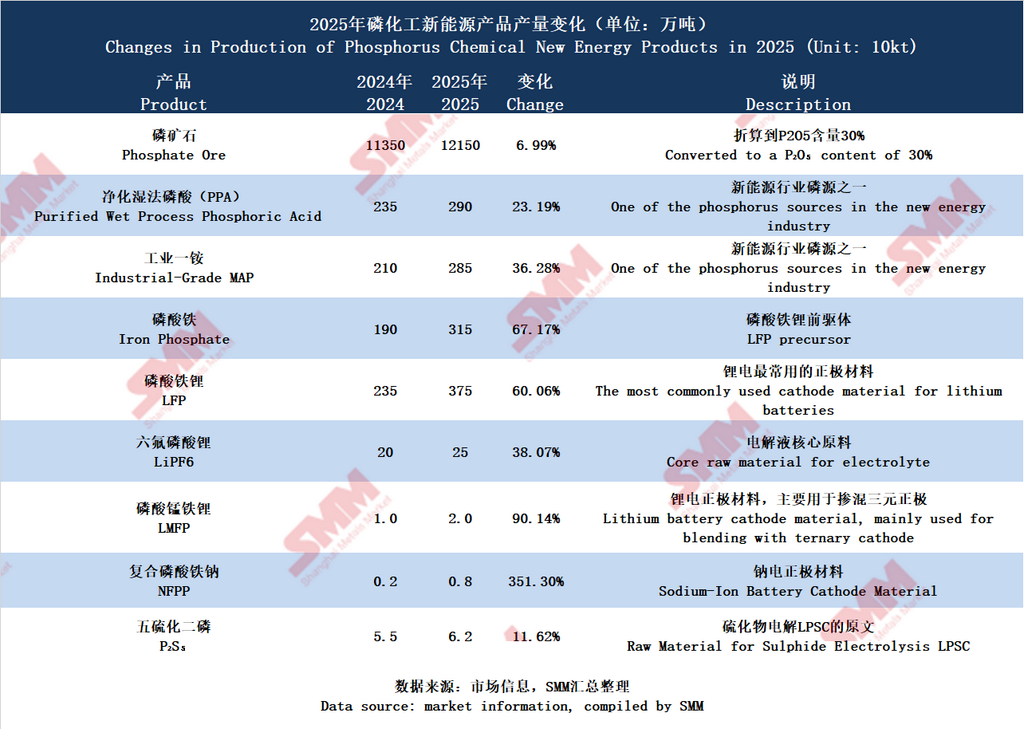
From 2024 to 2025, phosphorus-based chemical products closely linked to the new energy industry generally exhibited rapid growth.

Among them, cathode material and precursor iron phosphate (+67.17%) and LFP (+60.06%) posted the most significant increases, directly reflecting strong demand for LFP cathode materials from the power battery and ESS sectors. Raw materials industrial-grade MAP and purified wet process phosphoric acid grew by 36.28% and 23.19% respectively. As key phosphorus sources for LFP, their growth was broadly in line with the downstream expansion pace. LiPF6 grew by 38.07%, corresponding to the continued expansion of the electrolyte market. Although LMFP and composite sodium iron phosphate had relatively small bases, their growth rates were extremely high (exceeding 90% and 350% respectively), indicating that new-type cathode materials (blended ternary, sodium-ion battery) are entering the commercialisation phase. Solid-state battery side, P₂S₅ production remained stable at around 60,000 mt over the two years, increasing by only 11.62%. As a core raw material for sulphide solid electrolytes (e.g., LPSC), P₂S₅ production did not experience explosive growth, suggesting that sulphide all-solid-state batteries are still in the R&D or pilot-scale stage and have yet to generate large-scale industrialisation demand. Additionally, the growth of P₂S₅ applications in traditional industries was limited. Overall, phosphorus chemicals are accelerating their shift towards the new energy sector, while large-scale volume ramp-up of next-generation battery materials will still take time.

Note: If you have any additions or corrections to the details mentioned in this article, please feel free to contact us at any time. Contact information is as follows:

Tel: 021-20707860 (or add WeChat 13585549799) Yang Chaoxing, thank you!
Data Source Statement: Except for publicly available information, all other data are processed by SMM based on publicly available information, market communication, and relying on SMM‘s internal database model. They are for reference only and do not constitute decision-making recommendations.

For any inquiries or to learn more information, please contact: lemonzhao@smm.cn
For more information on how to access our research reports, please contact:service.en@smm.cn
Related News
BEV Registrations Surge 51% Across Europe in March Amid Geopolitical Tensions
Common.Time.hoursAgo
BEV Registrations Surge 51% Across Europe in March Amid Geopolitical Tensions
Read More
BEV Registrations Surge 51% Across Europe in March Amid Geopolitical Tensions
Battery electric vehicle (BEV) registrations jumped 51% in March across 15 major European markets, as renewed conflict in the Middle East brought renewed attention to oil dependence. According to data from New Automotive and E-Mobility Europe, around 224,000 new electric passenger cars were registered during the month, representing 22% of total sales in the monitored markets.
Common.Time.hoursAgo
Vietnam Proposes EV Tax Incentive Extension to 2030
Common.Time.hoursAgo
Vietnam Proposes EV Tax Incentive Extension to 2030
Read More
Vietnam Proposes EV Tax Incentive Extension to 2030
Vietnam’s Ministry of Finance has proposed extending preferential special consumption tax rates for battery electric vehicles with fewer than 24 seats until the end of 2030, as part of efforts to accelerate the country’s shift away from fossil fuels and support its net-zero emissions target. The ministry said the policy is intended to encourage the adoption of environmentally friendly transport. Currently, electric vehicles are taxed at 1–3%, significantly lower than the 10–150% applied to internal combustion engine vehicles. Under existing plans, EV tax rates are set to rise to 4–11% from March 2027.
Common.Time.hoursAgo
[SMM Analysis] March 2026 NCM Exports Reach All-Time High
Common.Time.hoursAgo
[SMM Analysis] March 2026 NCM Exports Reach All-Time High
Read More
[SMM Analysis] March 2026 NCM Exports Reach All-Time High
[SMM Analysis] March 2026 NCM Exports Reach All-Time High
In March 2026, China's ternary cathode material exports (NCM and NCA combined) reached 21,900 metric tons, representing a 103% MoM increase and a 163% YoY increase.
Common.Time.hoursAgo