March Phosphate Ore Imports 182kt, Up 88.2% MoM; Jordan Halts Exports

Published: Apr 20, 2026 14:07
In March 2026, China’s phosphate ore imports reached 182,000 mt, up 88.2% MoM and 144.4% YoY, with an average price of $79.9/mt, down 7.2% MoM.Affected by Strait of Hormuz disruptions, Jordan halted supplies for the first time since September 2023. Imports mainly came from Egypt (170,000 mt) and Pakistan (12,000 mt), through Guangxi, Hubei and Fujian.

According to customs data, in March 2026, China's phosphate ore imports totaled 182,000 mt, up 88.2% from 97,000 mt in February and up 144.4% compared to the same period last year (75,000 mt). Total import value in March was $14.552 million, up 74.6% MoM from $8.336 million in February. The unit price was $79.9/mt, down 7.2% significantly from $86.1/mt in February.
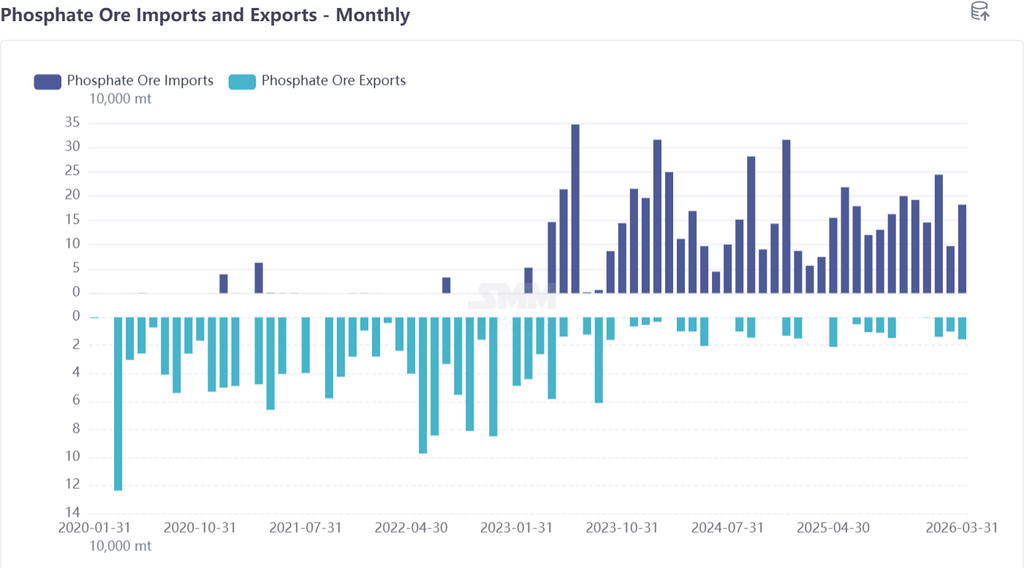
1. Phosphate ore imports: China's traditional major phosphate ore source countries were Egypt, Peru, and Jordan, with major importing provinces being Guangxi and Zhejiang, and major importing enterprises including Chuanjinnuo and other coastal phosphochemical enterprises. However, in March, due to logistics disruptions in the Strait of Hormuz, there were no phosphate ore imports from Jordan — the first time since September 2023 that no phosphate ore was imported from Jordan to China. The major source countries for phosphate ore imports in March were Egypt and Pakistan.
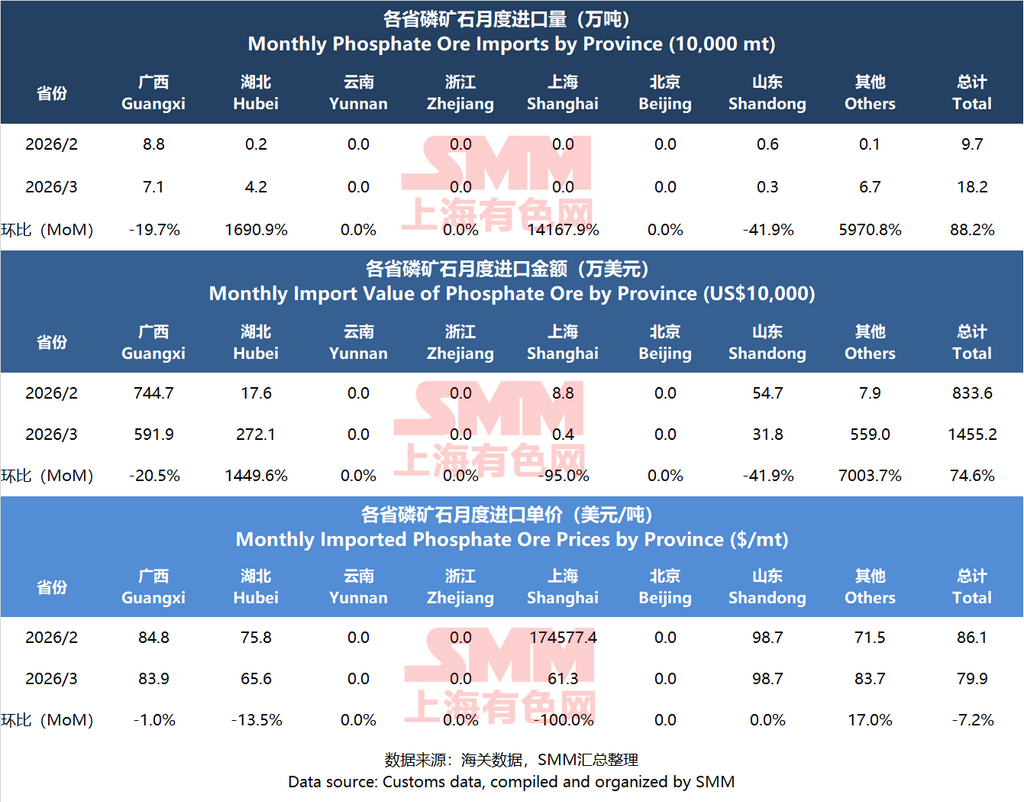
 

The top importing provinces in March were Guangxi (71,000 mt), Hubei (42,000 mt), and other regions such as Fujian (52,000 mt), while in February it was Guangxi (88,000 mt). Price side, the unit price was $79.9 in March versus $86.1 in February, showing a price decline in March.
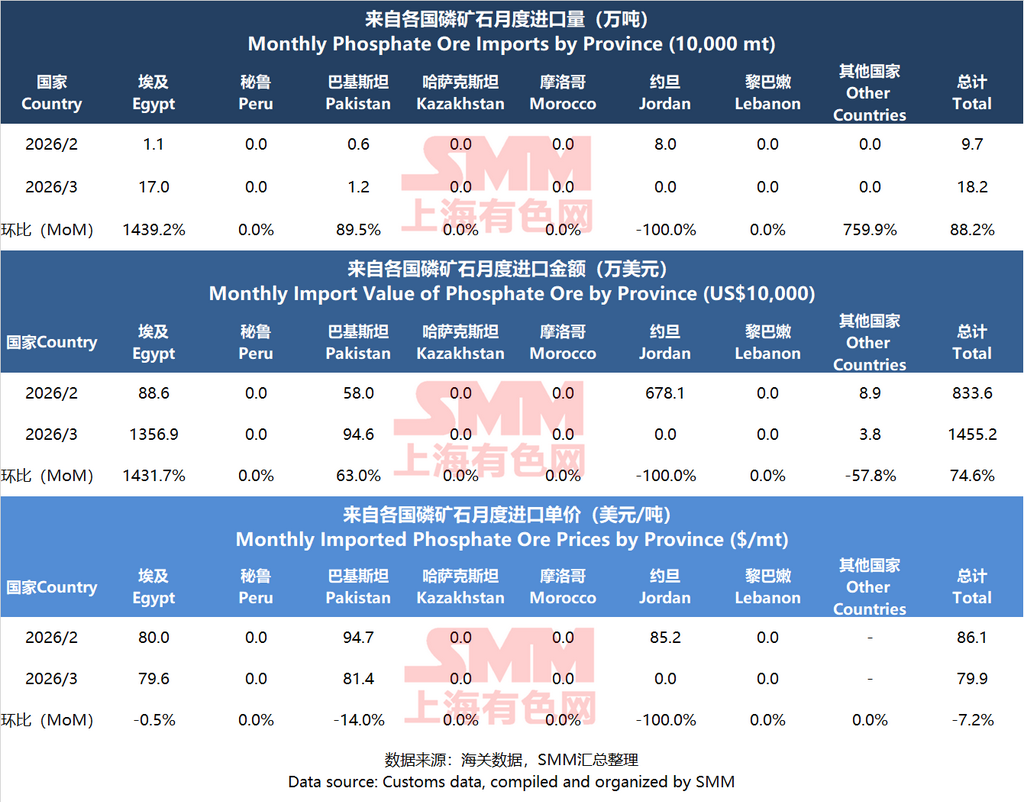
 

In March, China's phosphate ore imports mainly came from Egypt and Pakistan, with imports of 170,000 mt and 12,000 mt respectively. Affected by factors related to the Strait of Hormuz, phosphate ore from Jordan failed to be imported; however, imports from other regions had already filled the gap. As hindered transportation of high-priced Jordanian phosphate ore left no import volume to support prices, the import unit price of phosphate ore in March pulled back from February, falling below $80/mt.

2. Phosphate ore exports: Japan and South Korea became the main export destinations for phosphate ore in March, with shipments from Hubei to South Korea and Guizhou to Japan dominating.
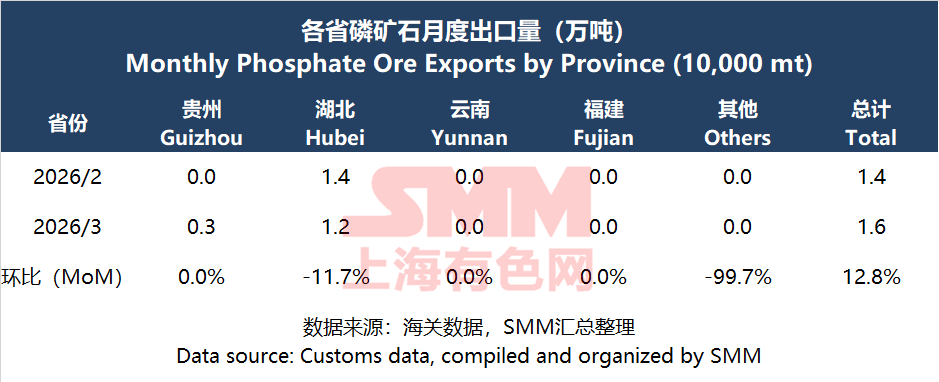
In March 2026, exports totaled 16,000 mt, up 55.7% from February, with the main export flow directed to Japan and South Korea. Hubei to South Korea and Guizhou to Japan accounted for 12,000 mt and 13,000 mt respectively, at unit prices of $185/mt and $328/mt.


Note: If you have any additions or corrections to the details mentioned in this article, please feel free to contact us at any time. Contact information is as follows:

Tel: 021-20707860 (or add WeChat 13585549799) Yang Chaoxing, thank you!
Data Source Statement: Except for publicly available information, all other data are processed by SMM based on publicly available information, market communication, and relying on SMM‘s internal database model. They are for reference only and do not constitute decision-making recommendations.

For any inquiries or to learn more information, please contact: lemonzhao@smm.cn
For more information on how to access our research reports, please contact:service.en@smm.cn
Related News
Sunwoda Unveils “Xingchi Supercharge 2.0” with Ultra-Fast Charging Performance
Common.Time.minsAgo
Sunwoda Unveils “Xingchi Supercharge 2.0” with Ultra-Fast Charging Performance
Read More
Sunwoda Unveils “Xingchi Supercharge 2.0” with Ultra-Fast Charging Performance
Chinese battery maker Sunwoda unveiled its next-generation LFP battery, “Xingchi Supercharge 2.0,” during its Technology Day event. The key highlight of Xingchi 2.0 is its peak charging capability of up to 15C. Based on a 98.8 kWh battery, it can theoretically accept up to 1,482 kW of power. The showcased battery pack, built with 264 prismatic cells, operates under an 844.8V high-voltage system and can handle currents of up to 1,800A. It can charge from 5% to 75% in just 5 minutes and 30 seconds, with an average charging rate of 6.7C.
Common.Time.minsAgo
Hyundai Completes U.S. EV Vertical Integration as Battery Plants Near Launch
Common.Time.minsAgo
Hyundai Completes U.S. EV Vertical Integration as Battery Plants Near Launch
Read More
Hyundai Completes U.S. EV Vertical Integration as Battery Plants Near Launch
Hyundai Motor Group is set to begin operations at battery plants in Georgia, jointly established with LG Energy Solution and SK On, with one facility starting this month and the other later this year. Once fully ramped up, the group will secure annual EV production capacity exceeding 600,000 units in the U.S. LG Energy Solution’s plant will have an annual capacity of 30 GWh, supplying cells for models such as the Ioniq 5 and Ioniq 9 produced at HMGMA. Meanwhile, SK On’s 35 GWh capacity will be converted into battery packs by Hyundai Mobis and fully supplied to Hyundai, Kia, and Genesis EVs manufactured in the U.S.
Common.Time.minsAgo
BEV Registrations Surge 51% Across Europe in March Amid Geopolitical Tensions
Common.Time.hoursAgo
BEV Registrations Surge 51% Across Europe in March Amid Geopolitical Tensions
Read More
BEV Registrations Surge 51% Across Europe in March Amid Geopolitical Tensions
Battery electric vehicle (BEV) registrations jumped 51% in March across 15 major European markets, as renewed conflict in the Middle East brought renewed attention to oil dependence. According to data from New Automotive and E-Mobility Europe, around 224,000 new electric passenger cars were registered during the month, representing 22% of total sales in the monitored markets.
Common.Time.hoursAgo