March Phosphate Ore Imports 182kt, Up 88.2% MoM; Jordan Halts Exports

Published: Apr 20, 2026 14:07
In March 2026, China’s phosphate ore imports reached 182,000 mt, up 88.2% MoM and 144.4% YoY, with an average price of $79.9/mt, down 7.2% MoM.Affected by Strait of Hormuz disruptions, Jordan halted supplies for the first time since September 2023. Imports mainly came from Egypt (170,000 mt) and Pakistan (12,000 mt), through Guangxi, Hubei and Fujian.

According to customs data, in March 2026, China's phosphate ore imports totaled 182,000 mt, up 88.2% from 97,000 mt in February and up 144.4% compared to the same period last year (75,000 mt). Total import value in March was $14.552 million, up 74.6% MoM from $8.336 million in February. The unit price was $79.9/mt, down 7.2% significantly from $86.1/mt in February.
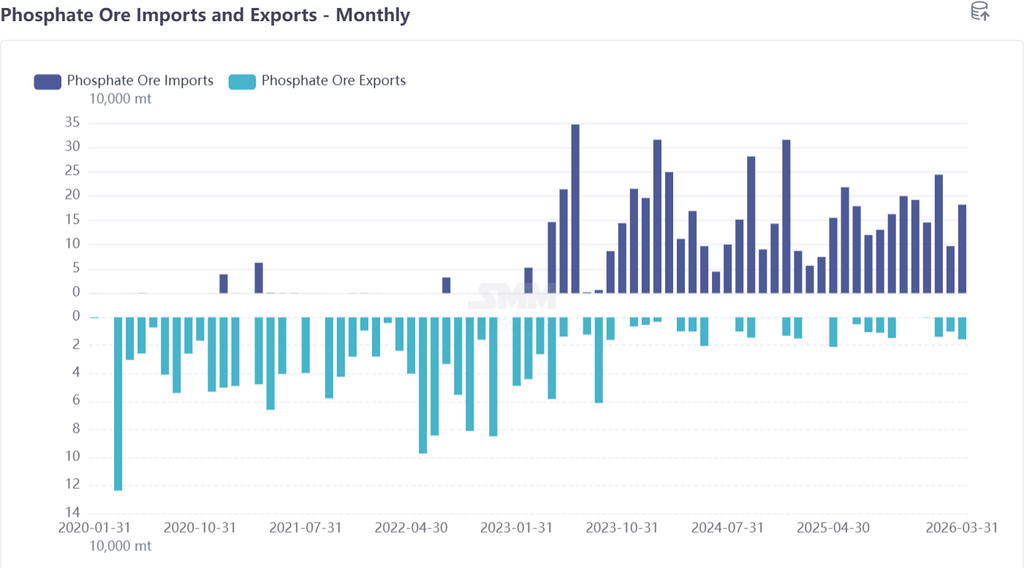
1. Phosphate ore imports: China's traditional major phosphate ore source countries were Egypt, Peru, and Jordan, with major importing provinces being Guangxi and Zhejiang, and major importing enterprises including Chuanjinnuo and other coastal phosphochemical enterprises. However, in March, due to logistics disruptions in the Strait of Hormuz, there were no phosphate ore imports from Jordan — the first time since September 2023 that no phosphate ore was imported from Jordan to China. The major source countries for phosphate ore imports in March were Egypt and Pakistan.
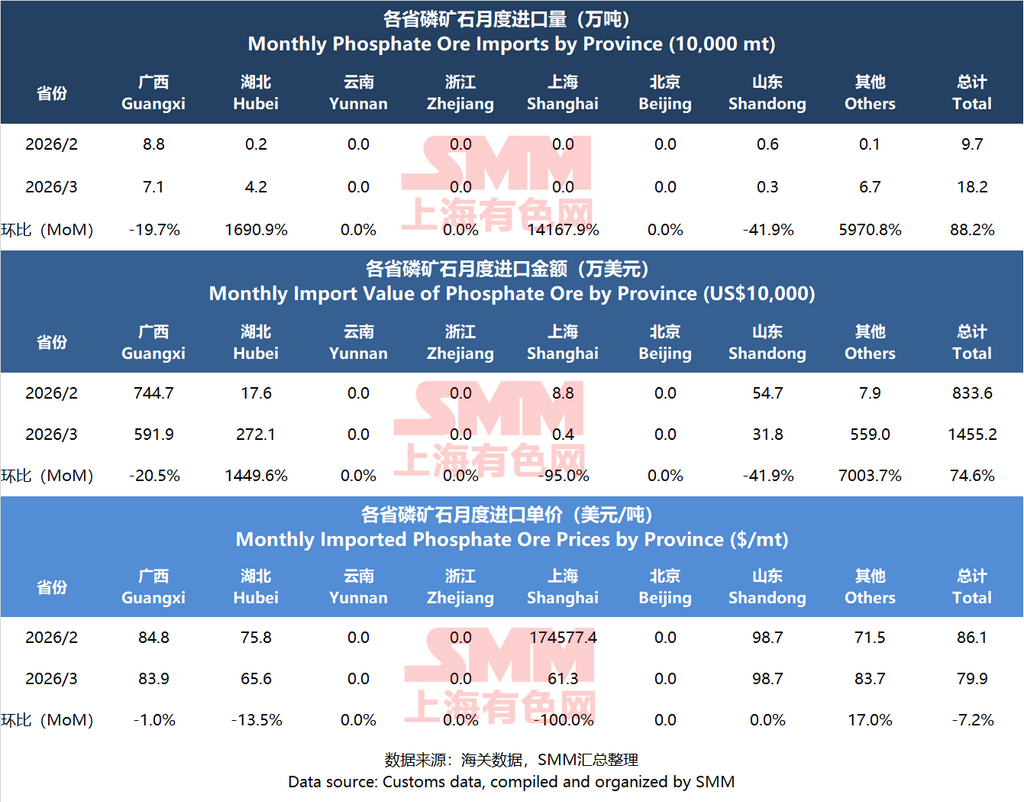
 

The top importing provinces in March were Guangxi (71,000 mt), Hubei (42,000 mt), and other regions such as Fujian (52,000 mt), while in February it was Guangxi (88,000 mt). Price side, the unit price was $79.9 in March versus $86.1 in February, showing a price decline in March.
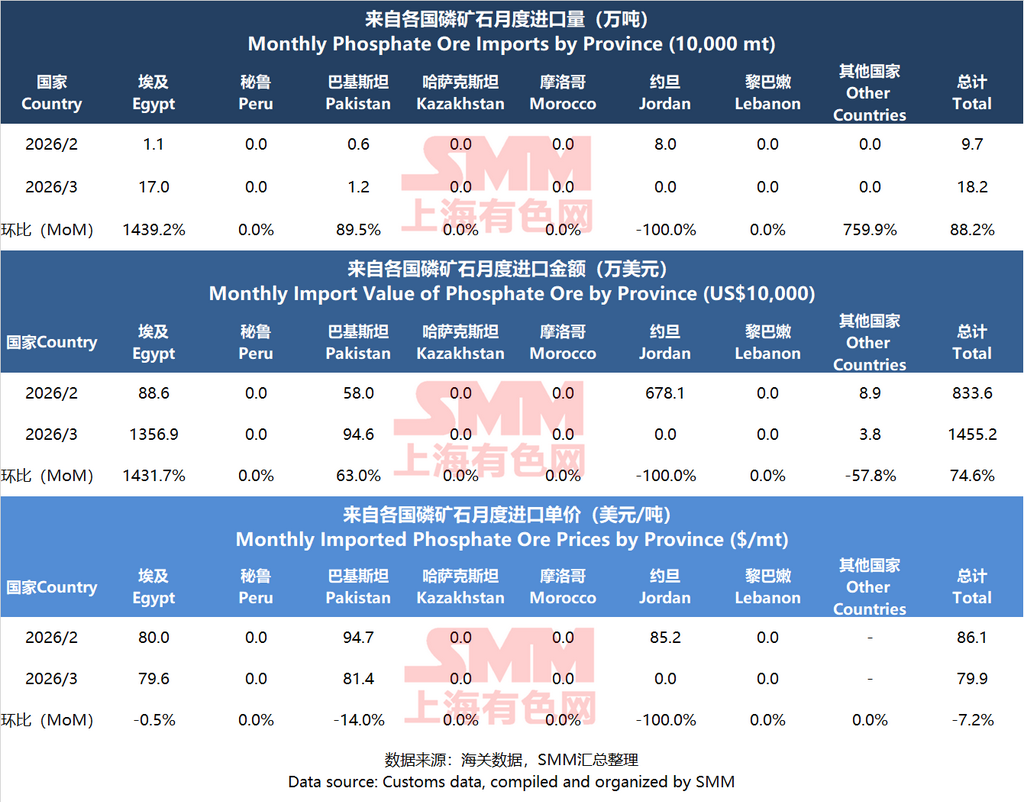
 

In March, China's phosphate ore imports mainly came from Egypt and Pakistan, with imports of 170,000 mt and 12,000 mt respectively. Affected by factors related to the Strait of Hormuz, phosphate ore from Jordan failed to be imported; however, imports from other regions had already filled the gap. As hindered transportation of high-priced Jordanian phosphate ore left no import volume to support prices, the import unit price of phosphate ore in March pulled back from February, falling below $80/mt.

2. Phosphate ore exports: Japan and South Korea became the main export destinations for phosphate ore in March, with shipments from Hubei to South Korea and Guizhou to Japan dominating.
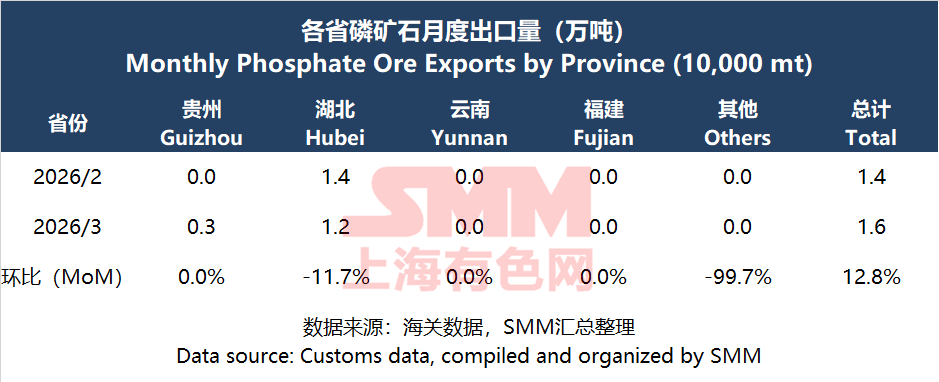
In March 2026, exports totaled 16,000 mt, up 55.7% from February, with the main export flow directed to Japan and South Korea. Hubei to South Korea and Guizhou to Japan accounted for 12,000 mt and 13,000 mt respectively, at unit prices of $185/mt and $328/mt.


Note: If you have any additions or corrections to the details mentioned in this article, please feel free to contact us at any time. Contact information is as follows:

Tel: 021-20707860 (or add WeChat 13585549799) Yang Chaoxing, thank you!

Data Source Statement: Except for publicly available information, all other data are processed by SMM based on publicly available information, market communication, and relying on SMM‘s internal database model. They are for reference only and do not constitute decision-making recommendations.

For any inquiries or to learn more information, please contact: lemonzhao@smm.cn
For more information on how to access our research reports, please contact:service.en@smm.cn
Related News
India to build a six-month strategic stockpile of lithium, cobalt and rare earths as demand rises
Common.Time.hoursAgo
India to build a six-month strategic stockpile of lithium, cobalt and rare earths as demand rises
Read More
India to build a six-month strategic stockpile of lithium, cobalt and rare earths as demand rises
Amid sustained demand growth, India plans to build a strategic reserve of critical minerals including lithium, cobalt, nickel, copper and rare earths. The stockpile will be sized to cover six months of domestic consumption, aiming to guard against risks of global supply disruptions and sharp raw material price volatility. Led by India’s Ministry of Mines and Ministry of Heavy Industries, the reserve covers key raw materials essential for new energy vehicles, energy storage and the electronics sector, fields where India currently relies heavily on imports. At present, the United States, China, South Korea and other countries have already established strategic reserve systems for critical minerals.
Common.Time.hoursAgo
[Geely's Gan Jiayue: Zeekr 9X to enter markets in the Middle East, Central Asia, and Europe from Q3]
Apr 30, 2026 23:00
[Geely's Gan Jiayue: Zeekr 9X to enter markets in the Middle East, Central Asia, and Europe from Q3]
Read More
[Geely's Gan Jiayue: Zeekr 9X to enter markets in the Middle East, Central Asia, and Europe from Q3]
[Geely's Gan Jiayue: Zeekr 9X to enter markets in the Middle East, Central Asia, and Europe from Q3]
On April 29, during Geely's Q1 2026 results conference, Gan Jiayue, CEO of Geely Auto Group, stated that the Zeekr 9X will be exported to the Middle East in June, launched in Central Asia in Q3, and enter the European market in Q4. Gan also revealed that the Zeekr 8X will be promoted in overseas markets from Q4 this year to Q1 next year. Data shows that in the first quarter, deliveries of the Zeekr 9X reached 22,000 units.
Apr 30, 2026 23:00
[LG Energy Solution posts Q1 operating loss of 207.8 billion won]
Apr 30, 2026 22:55
[LG Energy Solution posts Q1 operating loss of 207.8 billion won]
Read More
[LG Energy Solution posts Q1 operating loss of 207.8 billion won]
[LG Energy Solution posts Q1 operating loss of 207.8 billion won]
LG Energy Solution reported consolidated revenue of 6.6 trillion won in the first quarter, up 1.2% quarter-on-quarter (including approximately 189.8 billion won in North American production incentives). During the same period, it recorded an operating loss of 207.8 billion won. Shipments of pouch-type electric vehicle (EV) batteries declined due to inventory adjustments by major North American customers.
Apr 30, 2026 22:55