Key Points: 2026 is widely regarded as the "mass-production year" for semi-solid-state batteries. However, industry experts hold markedly divergent views on the industrial positioning and timeline of semi-solid-state batteries versus all-solid-state batteries. Experts such as Yang Hongxin, Chairman of SVOLT Energy, and Huang Xuejie of the Institute of Physics, Chinese Academy of Sciences, lean toward the view that "semi-solid-state batteries will dominate in the long term," whereas CATL Chairman Zeng Yuqun and Gotion High-tech Chief Scientist Zhu Xingbao remain cautiously optimistic about all-solid-state batteries from the perspectives of technological maturity and cost.
2026 is widely regarded as the "mass-production year" for semi-solid-state batteries. However, industry experts hold markedly divergent views on the industrial positioning and timeline of semi-solid-state batteries versus all-solid-state batteries. Experts such as Yang Hongxin, Chairman of SVOLT Energy, and Huang Xuejie of the Institute of Physics, Chinese Academy of Sciences, lean toward the view that "semi-solid-state batteries will dominate in the long term," whereas CATL Chairman Zeng Yuqun and Gotion High-tech Chief Scientist Zhu Xingbao remain cautiously optimistic about all-solid-state batteries from the perspectives of technological maturity and cost.
1. Semi-Solid-State Batteries: From "Transitional Technology" to "Long-Term Mainstream"
1.1 Huang Xuejie (Institute of Physics, Chinese Academy of Sciences): 2026 Is the Mass-Production Year for Semi-Solid-State Batteries
As one of China's leading lithium battery scientists and head of the power battery roadmap expert group for the Energy-Saving and New Energy Vehicle Roadmap, Huang Xuejie stated explicitly at the "Semi-Solid-State Battery Value Forum": “2026 is the mass-production year for semi-solid-state batteries. Before 2035, all-solid-state batteries still cannot 'overturn the table', so we must attach great importance to semi-solid-state batteries.”
Huang further pointed out that the core advantage of semi-solid-state batteries lies in their high compatibility with existing production lines — "today's liquid battery production lines can basically be used without modification, achieving over 90% compatibility." At present, China's lithium battery industry has invested as much as trillions of yuan in fixed assets; if all-solid-state battery disruptive technology requires the replacement of entire production lines, the economic cost would be enormous. On the materials upgrade front, ternary lithium batteries balance energy density and cost by substituting nickel for cobalt in the cathode material, while the anode combines silicon-based alloys with tin-based alloys to achieve high specific energy and fast charging, and solid-state electrolyte is used to modify the interface, resulting in an overall energy density of 1,050 Wh/L.
1.2 Yang Hongxin (Chairman of SVOLT Energy): Semi-Solid-State Batteries Will Remain Mainstream for the Long Term
Yang Hongxin's view was even more radical. At the partner summit on July 16, 2026, he explicitly stated: “Semi-solid-state batteries are not a transitional technology; they will remain mainstream for the long term, and all-solid-state batteries will still struggle to achieve cost advantages by 2035.”
This judgment is based on SVOLT Energy Technology's industrialisation practices. The company's first medium-nickel mixed solid-liquid battery will officially enter mass production in Q3 2026, with deliveries exceeding 8,000 units that year, and a targeted delivery of over 70,000 units in 2027. The battery uses thermal composite transfer technology, coating a solid-state electrolyte onto the separator before transferring it to the cathode, raising the thermal runaway trigger temperature to above 350°C, reducing fire risk by approximately 90%, achieving an energy density of 245 Wh/kg, and a peak charge rate of 6C. More importantly, this approach reuses existing production lines as much as possible, keeping costs on par with liquid batteries.
Yang Hongxin summarised SVOLT Energy Technology's strategy as "consolidating the foundation with LFP, and fully upgrading ternary to mixed solid-liquid." In his view, liquid batteries will remain the absolute mainstream for the next five years. Mixed solid-liquid batteries will first be applied in high-performance scenarios such as the low-altitude economy and high-end passenger vehicles. All-solid-state batteries are expected to be installed in demonstration vehicles by 2027, enter mass production in high-performance scenarios by 2030, and potentially expand to other fields only after 2035.
1.3 Sun Cailiang (Vice President of SVOLT Energy Technology): Long-term Coexistence of Multiple Systems
Sun Cailiang, Vice President and Director of the Technology Center at SVOLT Energy Technology, stated at the 2026 annual forum of the China Automotive Power Battery Industry Innovation Alliance: "In the short-to-medium term, liquid batteries will still be the absolute mainstream, with multiple systems coexisting over the long term. The small-scale penetration of mixed solid-liquid batteries is an important means to improve the safety and low-temperature performance of liquid batteries, and this route will coexist and develop alongside other technologies for a long time."
II. All-Solid-State Batteries: Dual Challenges of Technology Maturity and Cost
2.1 Zeng Yuqun (Chairman of CATL): Technology at Only TRL 4, "Very Unlikely" to Achieve Million-Unit Installation Before 2030
In an interview with Caijing magazine in May 2026 and at the Summer Davos Forum in June, Zeng Yuqun offered an extremely cautious assessment of the all-solid-state battery industrialisation pace. He clearly stated that solid-state battery technology maturity is only at TRL 4 (laboratory principle verification stage), still far from the TRL 9 required for stable mass production.
When asked whether million-unit vehicle installation could be achieved before 2030, Zeng Yuqun's response was very direct—"very unlikely." The reason given was that "reaching the million-unit level requires the vehicle to be sufficiently affordable, which will present difficulties in both performance and cost."
Zeng Yuqun stressed, innovation "cannot schedule the innovation" (cannot be scheduled in advance), and that technological breakthroughs depend on solving key scientific and engineering problems, not on timetables like 2027 or 2030. Citing the solid-solid interface issue as an example, he noted that the compaction densities of the cathode, anode, and electrolyte are different, and "even using a warm isostatic pressing process at 6,000 atmospheres, misalignment still occurs—and this misalignment cannot be avoided even at the laboratory stage."
He divided the commercialisation path into three routes: the technical route (whether there are technical barriers), the product route (whether mass production can be secured to guarantee supply), and the commodity route (whether cost performance is sufficient).
2.2 Zhu Xingbao (Gotion High-tech Chief Scientist): The solid-liquid battery threshold is extremely high, and solid-state batteries are not naturally tied to high energy density
At the CIBF2026 "Next-Generation Battery Technology for Electric Aviation and Advanced Manufacturing Symposium," Zhu Xingbao systematically deconstructed industry misconceptions. He proposed two key points:
First, solid-state batteries themselves do not have an inherent advantage in fast charging. The ionic conductivity of liquid electrolyte can reach 10⁻² S/cm, while early solid-state electrolytes were only 10⁻⁶ S/cm, a difference of four orders of magnitude.
Second, solid-state batteries are not naturally tied to high energy density. Solid-state electrolytes are denser, and the theoretical specific energy upper limit of a pure solid-state system is lower than that of liquid batteries. The high-energy-density solid-state batteries seen in the market have a "core logic of using solid-state technology to reinforce safety weaknesses, making them compatible with high-energy-density materials like high-nickel and lithium metal—the high energy density comes from the upgrade of electrode materials, and the core value of solid-state batteries is to solve the pain point of high thermal runaway risk in high-nickel systems, rather than achieving a leap in energy density themselves."
Zhu Xingbao also pointed out that merely reducing the proportion of electrolyte cannot change the thermal runaway mechanism, and the technical threshold for solid-liquid batteries is extremely high. The six existing solid-state battery technology routes in the industry each have obvious shortcomings, with only sulphide all-solid-state and solid-liquid hybrid possessing commercialisation potential.
2.3 Sun Shigang (Academician of the Chinese Academy of Sciences): All-Solid-State Batteries Face Three Core Challenges
Sun Shigang, academician of the Chinese Academy of Sciences and professor at Xiamen University, pointed out at the 14th Energy Storage International Conference and Expo that the industrialisation of all-solid-state batteries still faces three major challenges: electrolyte performance, solid-solid interface compatibility, and matching of high-specific-energy electrodes. The industry is achieving breakthroughs in reducing interface impedance, improving electrolyte performance, and suppressing lithium dendrites through methods such as interface design and molecular engineering, but there remains a gap from true industrialisation.
2.4 Ouyang Minggao (Academician of the Chinese Academy of Sciences): Mass Production Still 3 to 5 Years Away
At the CV100 Research Institute Expert Media Exchange in March 2026, Ouyang Minggao predicted: "By the end of this year and next year, there will definitely be some test vehicles equipped with all-solid-state batteries appearing, but for mass production, I personally feel it will most likely take another 3 to 5 years." He divided all-solid-state batteries into three generations of technology routes: First generation (2025-2027) graphite/low-silicon anode sulphide batteries (200-300 Wh/kg); second generation (2027-2030) high-silicon anode sulphide batteries (400 Wh/kg); third generation (2030-2035) lithium anode sulphide batteries (500 Wh/kg). Ouyang Minggao also advised consumers "not to wait for all-solid-state battery vehicles to come out" and cautioned that "automakers had better not sell them in these two years either."
III. The Debate on the Cost Inflection Point: 2030 or 2035?
There are significant disagreements within the industry on when all-solid-state batteries will become market-competitive.
SVOLT Energy Technology's Yang Hongxin believes that all-solid-state batteries will still struggle to achieve cost advantages by 2035.
Pan Ruijun of Gotion High-tech, however, holds a different view. At the company’s 2026 Global Technology Conference, he stated, “When the cost of lithium sulfide drops to 500,000 yuan/mt and the cost of solid-state electrolyte drops to 300,000 yuan/mt, solid-state batteries will usher in their era of 1 Yuan/Wh.” Gotion High-tech plans to build a 2,000 mt/year lithium sulfide capacity in 2026, increase it to 10,000 mt/year in 2027, and further to 100,000 mt/year in 2030.
SMM (Shanghai Metals Market) forecasts that the all-solid-state battery will see its Wh cost fall below 1 Yuan from 2030 to 2031, matching the current cost of high-nickel ternary batteries, and will thus become competitive in the market. This forecast is largely consistent with TrendForce’s assessment—after 2030, when the application scale of all-solid-state batteries exceeds 10 GWh, battery cell prices are expected to drop to around 1 Yuan/Wh.
IV. Summary
Based on the views of numerous experts, a relatively clear consensus framework has emerged in the industry on the industrialisation pace of solid-liquid hybrid and all-solid-state batteries.
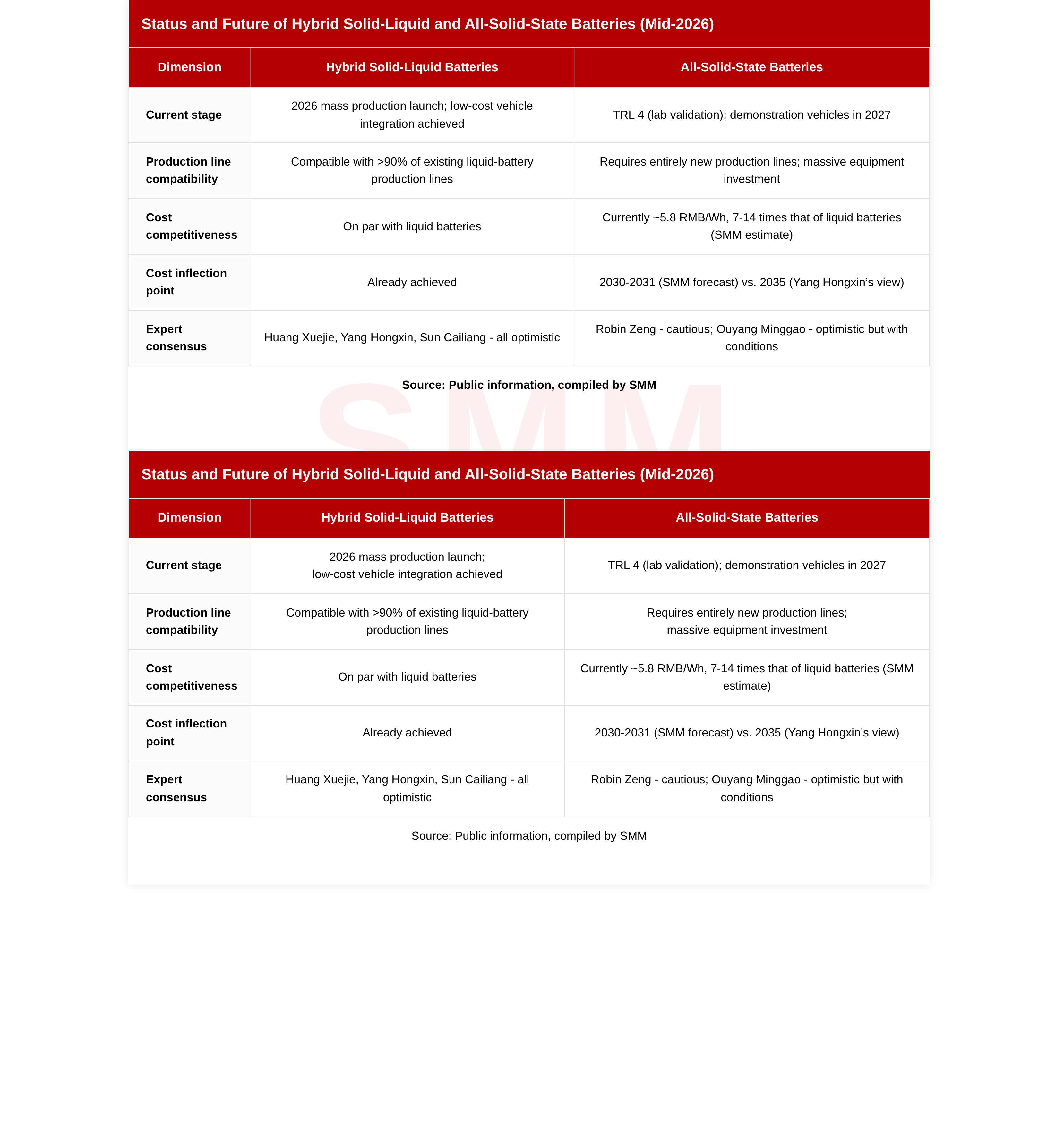
Solid-liquid hybrid batteries, leveraging their high compatibility with existing production lines and already achieved cost competitiveness, are taking the lead in entering the mass production stage in 2026. Although all-solid-state batteries are regarded by the industry as the “ultimate form,” they are still a considerable distance from true large-scale production, considering factors such as technology maturity (TRL Level 4), solid-solid interface challenges, core material costs, and supply chain support.
As Zeng Yuqun has stated, technological innovation is “event-driven” rather than “time-driven.” Timetables such as those for 2027 and 2030 ultimately depend on actual breakthroughs in key scientific and engineering issues, not on calendar periods. Before that, solid-liquid hybrid batteries will play a transitional “bridging” role from liquid to all-solid-state over an extended period—and may even become the mainstream in the market over the long term, as Yang Hongxin has predicted.
Phone: 021-20707860 (or add WeChat: 13585549799) Yang Chaoxing, thank you!
Related Information
![[SMM Analysis] Korea’s NEV Domestic Sales and Exports Rebound in June, Led by HEVs](https://imgqn.smm.cn/usercenter/fblvS20251217171729.png)
![[Lithium Battery: Furih Group Plans To Acquire Former US Subsidiary To Boost Silicon-Based Anode Materials]](https://imgqn.smm.cn/usercenter/AmiJU20251217171730.jpg)
![[Lithium Battery: Zhiliang New Materials' 30,000-Ton Lithium Iron Manganese Phosphate Project]](https://imgqn.smm.cn/usercenter/QXufg20251217171730.jpg)