SMM July 23 News:
I. Black Mass Price Trends: LFP Oscillating, Ternary High-then-Low, LCO in Persistent Decline
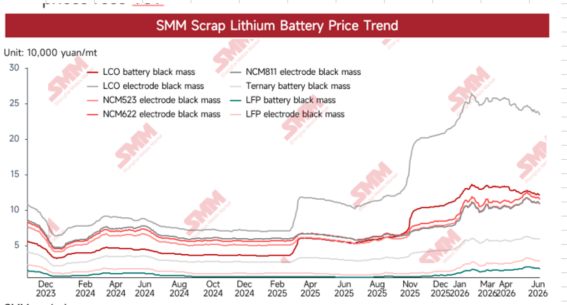
In the first half of 2026, the price trends of the three major black mass categories diverged significantly. LFP black mass was highly correlated with the spot and futures prices of lithium carbonate. Ternary battery powder, supported by the multi-metal value of nickel, cobalt, and lithium, exhibited a "high-then-low, wide-range oscillation" pattern. LCO battery powder, suppressed by a one-sided weakening of cobalt prices, showed a "high-level consolidation followed by accelerated decline." The divergent trajectories of the three categories profoundly shaped the profitability structure of different hydrometallurgical enterprises.
The LFP electrode powder lithium-point price was driven by pre-Lunar New Year stockpiling and rising lithium carbonate, surging rapidly to RMB 16,350/tonne by end-January. After the holiday, it followed lithium carbonate's correction to RMB 6,850/lithium-point, oscillating overall in March, then reaching a year-to-date high of RMB 8,775/lithium-point on May 13. Thereafter, as lithium carbonate retreated from highs, LFP black mass declined in tandem to RMB 6,725/lithium-point on June 30. The H1 average price was approximately RMB 6,971/lithium-point, with the price center shifting notably upward compared to the same period in 2025. Furthermore, the recent ramp-up in production activity among LFP repair enterprises broadened demand for spent LFP electrode sheets, widening the price spread between electrode black mass and battery black mass. Some hydrometallurgical enterprises were forced to switch to battery black mass or competitively bid up electrode black mass at premium prices.
The ternary electrode powder nickel-cobalt-lithium coefficient opened the year at 76.5%–78.5%, surging rapidly to 78%–80.5% in late January on the back of pre-holiday restocking. After a brief post-holiday pullback to 78%–80%, it drifted gradually lower amid oscillating nickel-cobalt-lithium prices. By end-June, as nickel-cobalt-lithium prices collectively weakened, the coefficient fell to 77%–79%, with an H1 average of approximately 78%–80%. The average price of ternary 523 electrode black mass in H1 was RMB 105,845/tonne.
II. Black Mass Market Landscape: Output Climbing Monthly, LFP Firmly in First Place
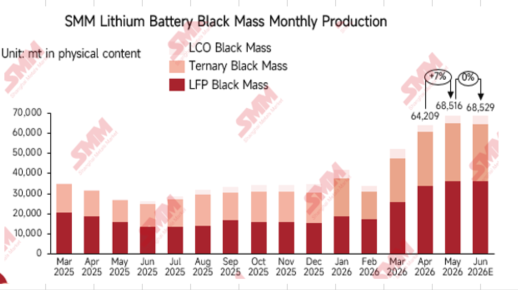
In H1 2026, total lithium battery black mass output rose significantly year-on-year, with monthly production generally trending upward amid fluctuations.
According to SMM statistics, monthly total crushing-stage recovery volume climbed from 41,614 tonnes in January to 72,651 tonnes in June, totaling approximately 333,000 tonnes for H1. Each month in Q2 maintained a range of 64,000–73,000 tonnes. Recovered-material lithium carbonate output grew in tandem, rising from 9,480 tonnes in January to 14,190 tonnes in June, totaling approximately 67,000 tonnes for H1. Recovered-material cobalt sulfate output totaled approximately 9,000 metal tonnes. Recovered-material nickel sulfate output totaled approximately 33,000 metal tonnes.
By category structure, LFP black mass, leveraging its massive production-scrap base and support, firmly held the top position in black mass output. Ternary black mass hydrometallurgical capacity utilization also recovered, and with the opening of black mass import and export channels, monthly output continued to increase on a sequential basis. LCO black mass production pace slowed in Q2 due to tepid downstream demand and phased procurement suspensions by leading enterprises, with monthly output fluctuating downward.
III. Hydrometallurgical Recycling Operations: Profitability Divergence Across Categories, Cost Transmission Mechanism Differences Highlighted
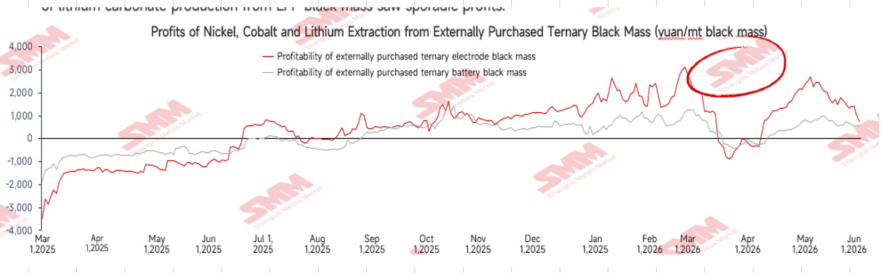
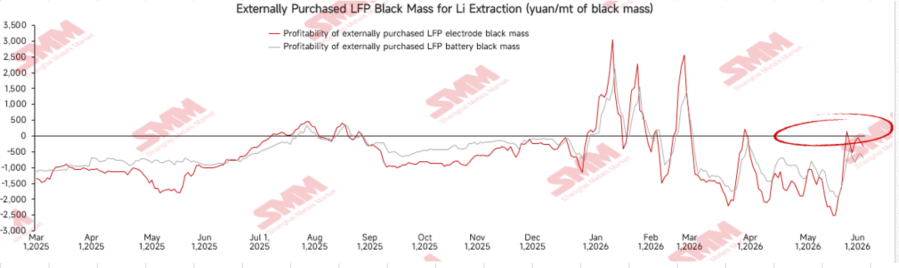
In H1 2026, the profitability of externally procured lithium battery black mass showed clear structural divergence, with market dynamics driven jointly by upstream raw material fluctuations and the mismatch in price transmission between scrap and powder materials.
Ternary hydrometallurgical segment: Ternary black mass prices declined relatively moderately, primarily because the multi-metal value of nickel, cobalt, and lithium provided a hedge — weakness in any single metal would not directly breach the breakeven threshold. However, since external-procurement processing enterprises have a high passive tolerance for nickel-cobalt salt price volatility, their profit recovery elasticity was notably weaker than that of integrated enterprises with their own recovery channels.
In the LCO electrode powder cobalt-lithium coefficient, the cobalt coefficient was notably elevated while the lithium coefficient was low. At the start of the year, the cobalt coefficient was 88%–89% and the lithium coefficient was 77%–79%, followed by high-level consolidation lasting nearly three months. From late May, under the pressure of persistent cobalt sulfate price declines and lukewarm procurement by downstream LCO cathode manufacturers, the coefficients accelerated their decline. By June 30, the cobalt coefficient fell to 78%–80% and the lithium coefficient to 75%–77%. The average price of LCO electrode black mass in H1 was approximately RMB 245,415/tonne. Upstream hydrometallurgical enterprises' procurement enthusiasm declined again, and market transactions remained thin.
Core conclusion: LFP black mass was the category with the greatest volatility elasticity in H1, with a wide intra-year high-low price spread and increasingly tight correlation with lithium carbonate futures — some LFP recovery enterprises have already adopted a "futures-minus-processing-fee" pricing model. Ternary battery powder, hedged by the multi-metal value of nickel, cobalt, and lithium, was primarily oscillatory in H1 with relatively moderate volatility. LCO battery powder, suppressed by both one-sided cobalt price declines and weak downstream demand, declined cumulatively from its year-to-date high, under pressure throughout. The divergence in these three trajectories intensified profitability differentiation across categories.
LCO hydrometallurgical segment: Pure cobalt and high-cobalt scrap profitability was under pressure throughout. Sustained declines in cobalt sulfate prices combined with tepid demand from downstream LCO cathode manufacturers led to continuous downward revisions of cobalt-lithium coefficients. In April, as the price spread between cobalt salt and electrolytic cobalt narrowed — rendering the dissolution of electrolytic cobalt back into cobalt sulfate economically unviable — and as leading enterprises resumed procurement after destocking, prices rose modestly. However, after cobalt prices accelerated their decline in May–June, upstream hydrometallurgical enterprises' procurement enthusiasm declined again, and market transactions remained thin.
Overall, in H1 2026, leading enterprises with their own recovery channels showed significantly better profit stability than external-procurement processing enterprises, and the industry's profitability divergence pattern is unlikely to narrow in the near term.
IV. Policy and Compliance: New Regulations Reshape Industry Landscape, Special Campaigns Accelerate Consolidation
On January 16, 2026, six ministries including the MIIT jointly issued the Interim Measures for the Administration of Recycling and Comprehensive Utilization of Spent Power Batteries from New Energy Vehicles, establishing a "full-channel, full-chain, full-lifecycle" management framework, which officially took effect on April 1, marking the upgrade of industry regulation from guidance documents to mandatory legal constraints. At end-April, five ministries further launched a joint enforcement special campaign, focusing on prominent issues such as unauthorized sales, illegal dismantling, and unlicensed operations, intensifying supervision across the entire chain.
The impact of the new regulations on the recycling industry has gradually manifested in H1: on one hand, the "vehicle-battery integrated scrappage" system and digital identity management have made battery flows more transparent, marginally improving the procurement environment for compliant recycling enterprises; on the other hand, the regulations have accelerated the clearing of non-compliant capacity, and industry concentration is expected to further increase.
V. Outlook for H2
Looking ahead to H2 2026, the lithium battery recycling industry is expected to sustain its output growth momentum, but the core contradiction will shift from "volume growth" to "profitability stabilization."
From the supply-demand perspective, post-2026 remains the traditional peak season for power battery retirement, and combined with the continued ramp-up of end-user demand, the supply of spent battery cells is expected to increase sequentially. However, the trend of in-house circulation diversion by battery cell manufacturers has become irreversible, and the tightness of market-circulated material supply will persist. "Quality-based pricing" and high-premium transactions for premium battery cells will continue to be the primary operating logic of the industry.
![Sigma Lithium: Limited Near-Term Supply Impact, but Greater Uncertainty Around Phase 2 Expansion[SMM Analysis]](https://imgqn.smm.cn/usercenter/ZLcBf20251217171731.jpg)
![[Lithium Battery: Ronbay Technology Reports H1 2026 Net Profit Of 109 Million Yuan, Up 259.95% YoY]](https://imgqn.smm.cn/usercenter/BmqWy20251217171726.jpg)