[SMM Analysis] Off-Season Impact Intensifies; Non-Oriented Silicon Steel Prices Likely to Edge Lower in July

Published: Jul 17, 2026 16:36

June Price Review:

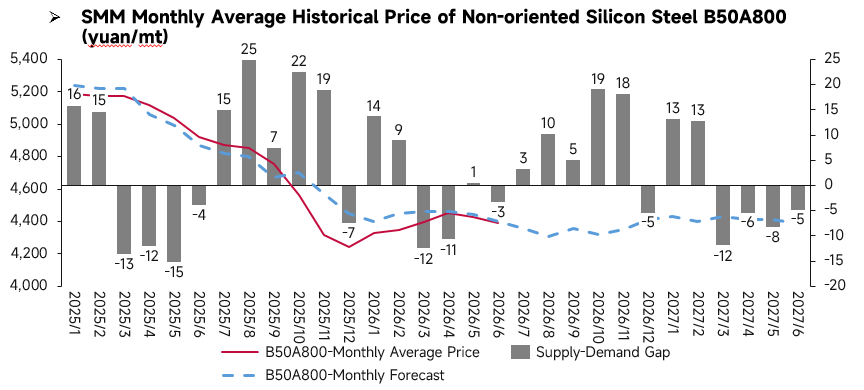
The monthly average price of non-oriented silicon steel exhibited a bottoming-out decline in June. On the supply-demand front, the market shifted from a slight balance to a narrow undersupply, with fundamentals continuing to improve marginally. The oversupply that previously weighed on the market gradually eased, providing price support. Spot prices performed stronger than expected, edging down only slightly. As a transitional month shifting from off-season to peak season, the supply-demand pattern improved in June.

Fundamental Analysis:
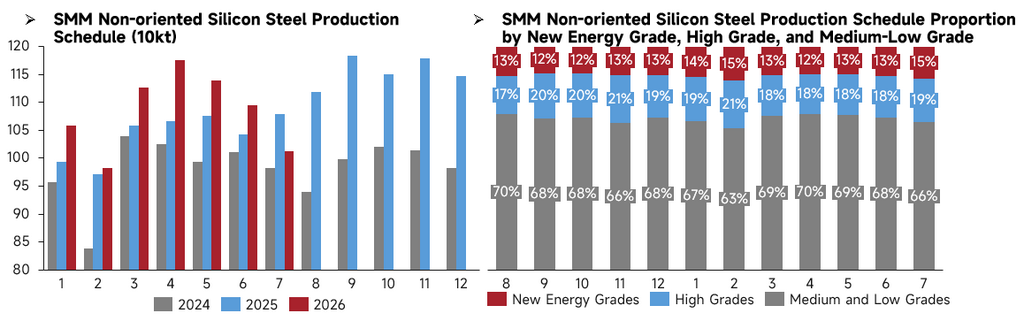
China's production schedule for non-oriented silicon steel continued to decline in July. Comparing with the same period in previous years, the scheduled production in July 2026 was lower than that of July 2025. Analyzing by grade, the proportion of NEV grades in the July production schedule rebounded to 15%, high grades accounted for 19%, while the proportion of low and mid-end grades pulled back to 66%. Steel mills continued to adjust their product mix, with the scheduled production of conventional low and mid-end grades shrinking accordingly. While total scheduled production continued to contract, supply-side pressure persisted. Maintaining original production levels for NEV and high-grade resources while significantly reducing low and mid-end grades optimized the supply structure to some extent, supporting market resilience.
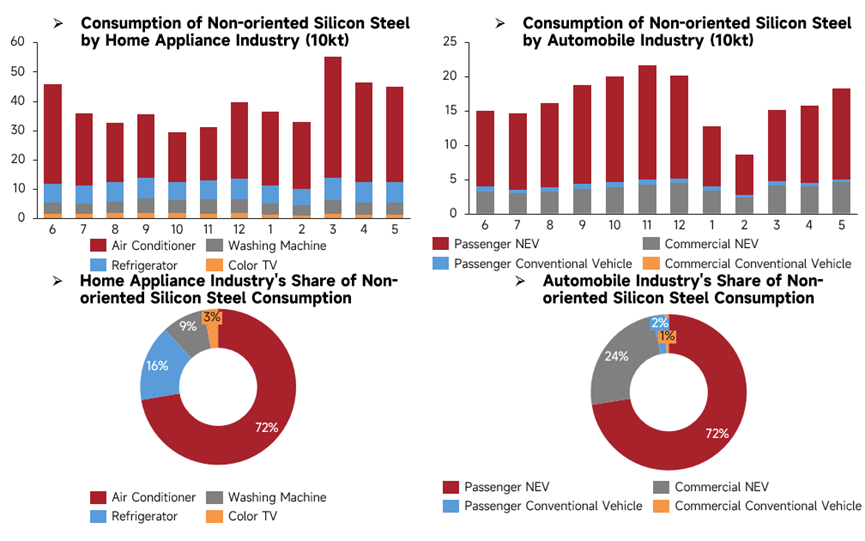
Downstream demand for non-oriented silicon steel showed structural divergence in May. In the home appliance sector, total silicon steel consumption pulled back MoM, with air conditioners remaining the core demand driver. Demand from the automotive sector was strong, with silicon steel consumption climbing to a high level for the period in May. Specifically, passenger NEVs provided the largest support for automotive silicon steel demand. Overall, traditional demand from home appliances weakened marginally, while NEV demand continued to strengthen. The demand center shifted toward the automotive sector, generating structural benefits for high-grade and NEV-grade non-oriented silicon steel.

July Price Outlook:

Supply side, China's planned production schedule for non-oriented silicon steel continued to decrease in July 2026, with reductions primarily focused on low and mid-end grades. On one hand, the off-season impact became more pronounced, downstream demand was soft, and purchasing interest declined, curbing production activity. On the other hand, industry leaders like Baowu and Shougang kept base prices unchanged in July, prioritizing price stability, but bearish sentiment persisted, making prices more likely to fall than rise. Most producers were loss-making and cut production autonomously. Demand side, in the home appliance sector, enterprises slowed their production pace, with orders falling MoM. The 618 shopping festival provided no significant order stimulus. Affected by low demand, high inventory, and high costs, some enterprises cut their production schedules ahead of schedule, and the implementation of new energy efficiency standards for some appliance products led to model upgrades that restricted production. In the automotive sector, automakers generally maintained normal production paces, with some increasing production schedules this month to meet mid-year targets. However, the sales promotions of the 618 festival and policies yielded limited boosting effects, and sales pressure persisted. Breaking it down, NEVs remained the main sales driver this month, orders for internal combustion engine vehicles showed no significant improvement, and exports were mainly directed to markets such as Russia, South America, and Southeast Asia, with the industry's full-year export volume expected to reach 12 million units. Cost side, with steel mill profits continuing to shrink and expectations of normalized local environmental protection-driven production restrictions, hot metal production is expected to continue to pull back. But as the off-season impact expands, the average hot-rolled coil price in July is expected to decline further MoM from June, though the extent of the decline will narrow. In summary, SMM expects that prices for low and mid-end non-oriented silicon steel will drift lower overall in July 2026, with some room for price reductions.

 

Data Source Statement: Except for publicly available information, all other data are processed by SMM based on publicly available information, market communication, and relying on SMM's internal database model. They are for reference only and do not constitute decision-making recommendations.

For any inquiries or for more information, please contact: lemonzhao@smm.cn
For more information on how to access our research reports, please contact:service.en@smm.cn
Related News
MMi Daily Iron Ore Report (July 17)
Common.Time.minsAgo
MMi Daily Iron Ore Report (July 17)
Read More
MMi Daily Iron Ore Report (July 17)
The iron ore market traded sideways today, with the DCE main contract I2609 eventually closing at 762 RMB/ton, up 0.53% from the previous day's closing price. Spot prices mostly followed with gains of 0–2 RMB/ton.
Common.Time.minsAgo
7.17 SMM Global Steel Daily Report
Common.Time.minsAgo
7.17 SMM Global Steel Daily Report
Read More
7.17 SMM Global Steel Daily Report
[Plate/HRC]HRC export deals at 488-494 USD, flat d/d; overseas fears further downside and delays buying HRC and other flat-product export prices were flat day on day, with HRC export deals in the 488-494 USD/tonne range. Overseas buyers reckon prices may still have room to fall and prefer to delay purchasing and watch the market even when holding orders, so little actual volume was released. [Billet]Export billet FOB steady at 458-460 USD ex-Jiangyin; mills hold firm, deals face resistance Export billet FOB held steady, quoted at 458-460 USD/tonne ex-Jiangyin. Domestic mills held offers firm, while importers' essential demand was soft and buyers' bids sat below sellers' floor, leaving spot deals hard to close and actual trade limited. [Rebar]Rebar export flat at 480-485 USD; buyers press price and wait, trade thin Rebar export prices were flat day on day, with deals at 480-485 USD/tonne. Some buyers pressed hard on price and stayed cautious, while domestic sellers, mindful of margins, were unwilling to sell low, so trade saw no meaningful release. [India]India Mumbai HRC down ~3 USD w/w to 602 USD, monsoon curbs demand Mumbai HRC fell about 3 USD/tonne week on week to 602 USD/tonne EXW, with transacted prices around 571-611 USD/tonne. Monsoon weather curbed construction and infrastructure demand, keeping spot buying and restocking weak while low-priced cargoes intensified competition; a soft, sideways tone is expected near term. [Black Sea/CIS]Black Sea billet quiet and steady; Russian mills front-load for Q4 EU tariff-free quota Black Sea billet trade was quiet with FOB offers steadying and to-Turkey quotes around 495-500 USD/tonne CFR; holidays plus soft demand slowed buyers' pace. Russian mills, racing to secure Q4 EU tariff-free quota, have brought some production forward. [Indonesia]Indonesia SAE1008 wire rod at 485 USD, below China; SE-Asia off-season keeps trade thin Indonesia's SAE1008 wire rod export offers held at 485 USD/tonne FOB, clearly below China's comparable ~509 USD/tonne FOB. With Southeast Asia in its seasonal lull, buyers' restocking appetite was limited and, despite the competitive price, actual deals stayed thin. [Brazil/Vietnam]Brazil HRC import quotes down to 600-610 USD; Vietnam cuts prices, ~20kt booked Brazil HRC import quotes slipped to 600-610 USD/tonne CFR, with about 20,000 tonnes of flat-product imports booked recently. Vietnam, the core supplier, was forced to cut offers to win orders against low-priced Indonesian and Indian material, while Brazil's strict import quotas and domestic credit tightening capped restocking.
Common.Time.minsAgo
[Al Yamamah Steel Advances Steel Billet Project]
Common.Time.minsAgo
[Al Yamamah Steel Advances Steel Billet Project]
Read More
[Al Yamamah Steel Advances Steel Billet Project]
[Al Yamamah Steel Advances Steel Billet Project]
Saudi Arabia’s Al Yamamah Steel Industries Co. announced that its subsidiary, Al Yamamah for Reinforcing Steel Bars, has signed a contract worth 270 million Saudi riyals ($72 million) with a European specialized company for the manufacture, supply, and installation of equipment for its steel billet production plant. The contract was signed on July 14 and spans two and a half years, with its financial impact expected to materialize in H2 2028. This equipment contract is part of Al Yamamah’s steel billet production project, aimed at strengthening backward integration and securing the raw material supply needed for its long product manufacturing. Al Yamamah Steel specializes in producing and selling a variety of products, including welded pipes, sheets & plates, rebar, and three-dimensional space structures, primarily serving the construction and infrastructure sectors. The company also produces galvanized steel lighting and distribution poles, high-mast structures, and galvanized steel lattice towers for the power and electricity distribution industry. Its production facilities are strategically located in Jeddah, Dammam, and Yanbu.
Common.Time.minsAgo