June magnesium product exports up MoM, Q2 foreign trade market narrowly in the doldrums.
In June 2026, China's magnesium product exports reached 39,400 mt, up 4.8% MoM from May and up 10.9% YoY. Cumulative exports over January-June totaled 239,100 mt, up 8% YoY.
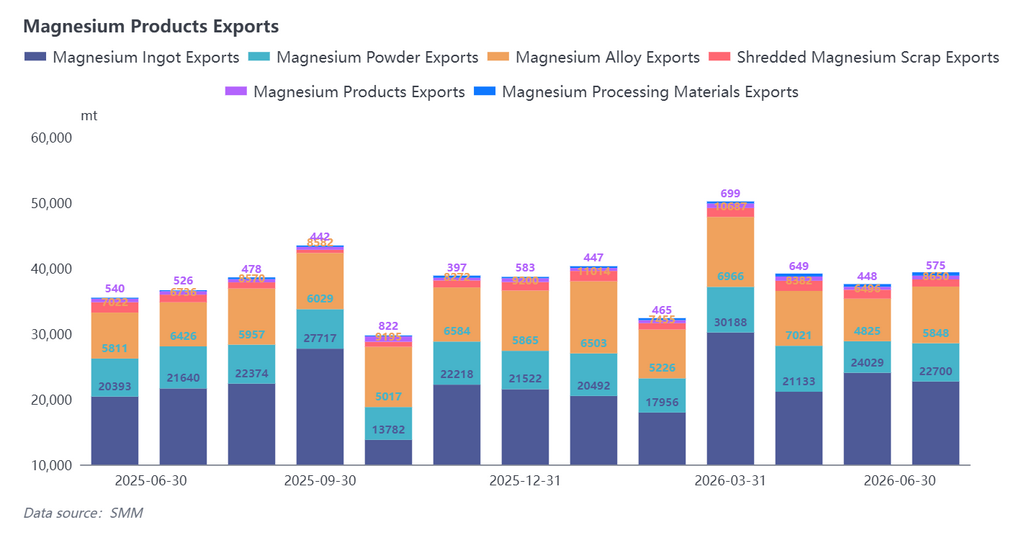
Overall, magnesium exports were in the doldrums in Q2 2026. The main reasons are as follows
First, a mismatch between continuously released supply and weakening demand. Earlier market optimism spurred production enthusiasm, driving total supply steadily higher. However, the demand side gradually entered the traditional off-season, compounded by the gradual realization of overseas summer breaks, and overall demand weakened. This became the fundamental cause of the current situation.
Second, the concentrated release of exports in March preempted subsequent demand. Magnesium product exports fell significantly MoM in April and declined further in May. Although total exports in June rebounded 4.8% MoM to 39,400 mt, this was mainly driven by magnesium powder and magnesium alloy; magnesium ingot exports still declined MoM.
Third, external geopolitical conflicts continuously disrupted exports. In early March, the escalation of the US-Iran conflict led to a surge in ocean freight rates and the suspension of some shipping routes, with new purchases and tenders in the Middle East largely stalling. In June, the US and Iran signed a temporary ceasefire memorandum; the market briefly expected an easing of navigation conditions. However, the ceasefire lasted less than ten days before breaking down, and the repeated instability has left the foundation for export recovery fragile. High ocean freight rates continued to suppress buyers' purchase willingness.
June magnesium exports diverged: magnesium ingot edged down, while magnesium powder and alloy recovered
By product, magnesium ingot exports pulled back slightly, while magnesium powder and magnesium alloy saw sound growth.
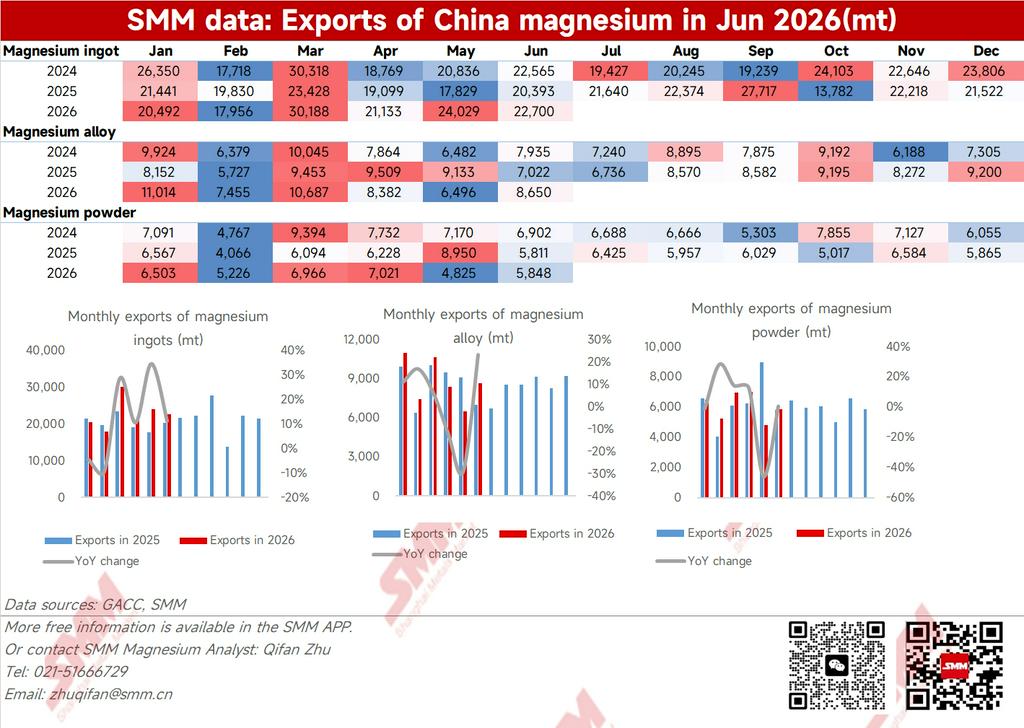
In June 2026, magnesium ingot exports were 22,700 mt, down 5.5% MoM, with cumulative YoY growth of 11.3%. The slight weakening in magnesium ingot exports directly reflects weak foreign trade demand. On overseas demand side, a sharp increase in international ocean freight rates, combined with the strengthening of the RMB exchange rate, significantly weakened the export competitiveness of China's magnesium ingot. Overseas buyers' wait-and-see sentiment intensified and new orders were scarce. Since magnesium ingot is most directly affected by macro factors, exports declined MoM in June amid the off-season demand and high ocean freight costs.
In June 2026, magnesium powder exports were 5,848 mt, up 21.2% MoM, with a cumulative YoY decrease of 0.64%. The growth in magnesium powder exports mainly benefited from a recovery in orders after a period of decline. Magnesium powder exports in May were at a historical low. The growth in June was more of a corrective rebound from the previous low base, representing a concentrated release of backlog orders, rather than a fundamental improvement in downstream demand.
In June 2026, magnesium alloy exports were 8,650 mt, up 33.2% MoM, with a cumulative YoY increase of 23.2%. On one hand, the increase reflects sustained demand for automotive lightweighting in markets outside China, with some earlier orders shipped in a concentrated manner in June, and some overseas enterprises restocking in advance ahead of the summer break, boosting magnesium alloy exports. On the other hand, magnesium alloy has substitution advantages over aluminum alloy, and the widening magnesium-aluminum price spread directly stimulated magnesium alloy sales. These combined factors made magnesium alloy the main engine of export growth.
Magnesium Exports in June: Netherlands Remained Top Magnesium Ingot Exporter but Demand Fell, Canada Ranked First in Magnesium Powder and Alloy Demand
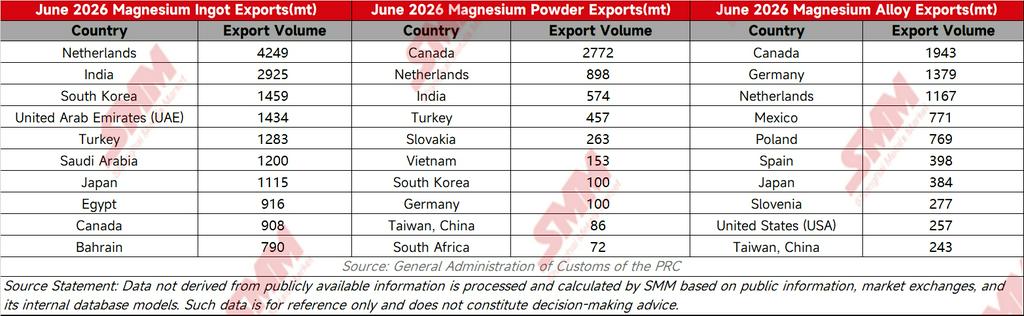
Looking at export data by destination, for magnesium ingot, the Netherlands remained in first place, but exports fell 29.8% MoM; India’s demand remained robust but also pulled back slightly MoM. Notably, the persistent contraction in magnesium ingot exports to the Middle East since the outbreak of the US-Iran war saw a slight recovery in June due to a temporary ceasefire, with total regional demand rebounding somewhat. However, the ceasefire lasted less than ten days before collapsing, plunging the situation back into turmoil, and export volumes could face sharp short-term fluctuations. Demand from other major destinations was basically stable, though total volumes edged down slightly.
For magnesium alloy and powder, Canada and the Netherlands remained the main export destinations, but this month the Netherlands’ total volumes edged down slightly while Canada’s surged. At the end of Q2, downstream die-casting boosted the phased release of magnesium alloy demand. Backlog orders were shipped in a concentrated manner, and the pace of arrivals to Canada recovered. However, the surge in Canada’s June exports resulted from a short-term concentrated release, and subsequent fluctuations still warrant caution.
H2 Magnesium Export Outlook: Multiple Risks Intertwined, Slight Growth Still Possible for the Full Year
Main risks for H2 exports: local conflicts lead to reduced shipping routes and tight capacity; ocean freight rate fluctuations combined with a stronger exchange rate continue to squeeze export margins, dampening export incentives; frequent news of production halts and maintenance at primary magnesium producers raises supply contraction expectations and pushes up offers, suppressing transactions; the overseas summer break from July to August weakens foreign trade orders, and market activity declines.
Overall, the industry pattern of strong supply and weak demand has yet to see substantive improvement. Although multiple magnesium plants have started production halts and maintenance since July, causing the industry operating rate to pull back, the scale of production cuts is not enough to reverse the fundamentally strong supply and weak demand, and the support for prices is limited. Exports are expected to remain in the doldrums in July-August. Whether a concentrated release of orders materializes after the summer break ends in September will depend on demand-side improvement signals. Full-year exports may still edge up, driven by deep-processed products such as magnesium alloys, but the path is likely to be bumpy.
![North American Magnesium Industry Resource Development, Technology Breakthroughs and Commercialization Advance Hand in Hand [SMM survey]](https://imgqn.smm.cn/usercenter/rUQIB20251217171723.jpeg)
![Held Up Well Then Consolidated at Highs; Strong Supply, Weak Demand Pattern Unchanged [SMM Magnesium Weekly Review]](https://imgqn.smm.cn/usercenter/YhgvU20251217171725.jpg)