Rare Earth Scrap Recycling Slows as Tax Compliance Tightens, Impacting Production Rates[SMM Analysis]

Published: Jun 9, 2026 20:21
[SMM Analysis:Rare Earth Scrap Recycling Slows as Tax Compliance Tightens, Impacting Production Rates]Recently, multiple rare earth scrap recycling enterprises reported that operating rates may decline in June-July. Large enterprises, with a higher proportion of self-procurement, are seeing more significant production reductions; small and medium-sized enterprises, relying less on self-procurement and more on processing orders, are relatively less affected.
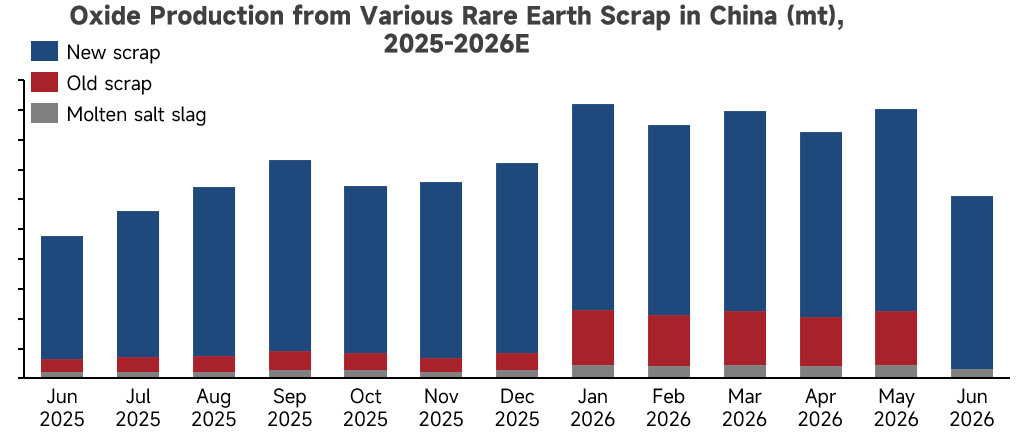
SMM June 9: Recently, multiple rare earth scrap recycling enterprises reported that operating rates may decline in June-July. Large enterprises, with a higher proportion of self-procurement, are seeing more significant production reductions; small and medium-sized enterprises, relying less on self-procurement and more on processing orders, are relatively less affected.

The main reason for these production cuts is a shortage of taxed scrap supply, making it difficult to sustain high operating rates at recycling enterprises. Behind this situation is the ongoing tightening of tax compliance reviews, which has somewhat constrained scrap procurement. Specifically, from H2 2025, local fiscal rebate policies were successively abolished. Entering 2026, invoice-related tax compliance audits intensified further, prompting rare earth scrap recycling enterprises to essentially suspend the quoting and purchasing of untaxed scrap for compliance reasons.
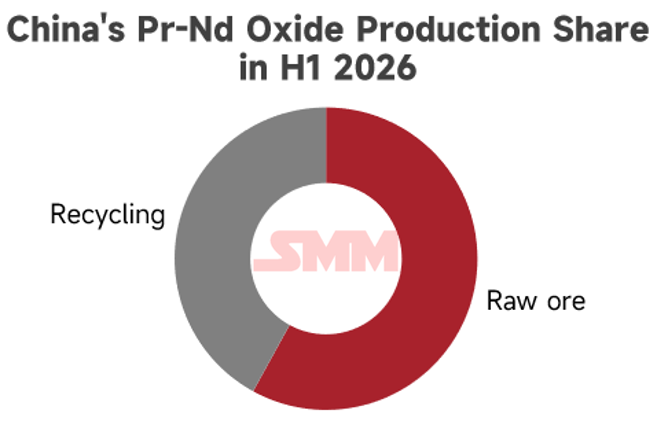
Before this, untaxed scrap  mainly comprising old scrap, scrap generated by small and medium-sized NdFeB enterprises and downstream processors, as well as material held by scrap traders. The remainder was taxed scrap, mainly sourced from large magnetic material enterprises, commanding a relatively higher purchase price due to compliance costs. Currently, recycling enterprises face an inability to obtain invoiced material, and as inventory continues to be consumed, recycling and separation enterprises are generally under pressure to cut production.

Affected by recycling enterprises' effective suspension of untaxed scrap purchases, small and medium-sized NdFeB enterprises, downstream processors, and scrap traders face two choices: convert untaxed scrap into taxed scrap for normal trading; or stockpile inventory and hold off shipments. Either option will impose significant financial pressure on small and medium-sized enterprises and traders. Intense NdFeB market competition means scrap sales are a primary profit source for some smaller enterprises; rising scrap shipment costs will further squeeze their profit margins, potentially leading to losses. In the long term, if SME profitability fails to improve, their market share will gradually shrink, large magnetic material plants will increase their capacity concentration, and the supply of taxed scrap in the market may eventually move toward a relatively orderly and controllable landscape. 
Data Source Statement: Except for publicly available information, all other data are processed by SMM based on publicly available information, market communication, and relying on SMM's internal database model. They are for reference only and do not constitute decision-making recommendations.

For any inquiries or for more information, please contact: lemonzhao@smm.cn
For more information on how to access our research reports, please contact:service.en@smm.cn
Related News
US House Passes Bill to Strengthen Energy Security and Supply Chain Resilience
Jun 12, 2026 09:16
US House Passes Bill to Strengthen Energy Security and Supply Chain Resilience
Read More
US House Passes Bill to Strengthen Energy Security and Supply Chain Resilience
Recently, the U.S. House of Representatives passed the H.R.7037 bill, known as the Developing Overseas Mineral Investments and New Allied Networks for Critical Energies Act (DOMINANCE ACT, referred to as the "Domination Act"). The bill was jointly introduced by California Representatives Ami Bera and Young Kim, aiming to strengthen U.S. energy security and build a more resilient supply chain with trusted allies and partners.
Jun 12, 2026 09:16
Aldoro Resources Reports Promising Results from Kameelburg Niobium and Rare Earth Deposit Testing
Jun 12, 2026 09:13
Aldoro Resources Reports Promising Results from Kameelburg Niobium and Rare Earth Deposit Testing
Read More
Aldoro Resources Reports Promising Results from Kameelburg Niobium and Rare Earth Deposit Testing
Aldoro Resources reported that hydrometallurgical testing of the Kameelburg niobium and rare earth deposit in Namibia yielded encouraging results, with a simple process but relatively high recoveries of rare earths and strontium, while drilling also intersected high-grade niobium ore. Tests commissioned by the company and conducted by ALS Metallurgy Services in Western Australia showed that Kameelburg can be treated using a direct acid leaching method, eliminating the need for flotation or magnetic separation processes used at MP Materials' Mountain Pass operation in the US and Lynas Rare Earth's Mt Weld rare earth mine in Western Australia. The hydrochloric acid leaching process can be carried out at ambient temperature and pressure, and if scaled up, is expected to significantly reduce development costs.
Jun 12, 2026 09:13
Pensana Advances $250M Rare Earth Mine in Angola, Targets 2027 Production
Jun 12, 2026 09:12
Pensana Advances $250M Rare Earth Mine in Angola, Targets 2027 Production
Read More
Pensana Advances $250M Rare Earth Mine in Angola, Targets 2027 Production
According to overseas media reports, London-listed Pensana announced that construction of the Longonjo rare earth mine in Angola is progressing as planned, with a total investment of $250 million, targeting first commissioning and production of mixed rare earth carbonate (MREC) in 2027. The mine has a life of 20 years, with initial annual production of 20,000 mt of mixed rare earth carbonate, expanding to 40,000 mt in the fourth year. $36 million has been invested in the development of the mine and beneficiation plant, and main construction works are 22% complete. Manufacturing of long-lead equipment is progressing well, with committed procurement capital expenditure of approximately $135 million. The company is optimizing the heavy rare earth recovery circuit, targeting over 122 mt per year of dysprosium and terbium, positioning Longonjo as one of the largest heavy rare earth producers in the Western world. The modular separation facility can be expanded with mine expansion and includes a metallization circuit. Pensana has signed a non-binding memorandum of understanding with Toyota Tsusho for the offtake of up to 20,000 mt per year of mixed rare earth carbonate from Longonjo for a five-year term. The company has established a multi-partner offtake framework covering Japan's Toyota Tsusho, US-based ReElement Technologies, and US/Germany-based VAC/eVAC Magnetics. The project has received a $165 million strategic investment from Cascade Natural Resources and debt financing from ABSA, with political and commercial risk insurance provided by the US Export-Import Bank.
Jun 12, 2026 09:12
Register to Continue Reading
Gain access to the latest insights in metals and new energy
Already have an account?Sign in here
Rare Earth Scrap Recycling Slows as Tax Compliance Tightens, Impacting Production Rates[SMM Analysis] - Shanghai Metals Market (SMM)