Concept Note: One Day Conference on Critical Minerals Recycling Landscape

Published: May 25, 2026 17:14

Material Recycling Association of India

Voice of the Indian Recycling Industry

Concept Note

ONE DAY CONFERENCE ON CRITICAL MINERALS RECYCLING LANDSCAPE
 

1. Background & Context
India’s transition towards clean energy, electric mobility, and advanced manufacturing is driving an unprecedented demand for critical minerals such as lithium, cobalt, nickel, rare earth elements, and platinum group metals. However, India remains highly import dependent (over 80–90%) for several critical minerals (Ministry of Mines, NITI Aayog), making supply chains vulnerable to geopolitical disruptions and price volatility.
Recognizing this, the Government of India has launched the National Critical Mineral Mission (NCMM) to strengthen domestic capabilities across the value chain: from exploration and mining to processing and recycling.
While mining is inherently capital-intensive and long-gestation, recycling of critical minerals offers a near-term, scalable, and sustainable pathway with significant economic and environmental benefits:

  • Import Substitution: Estimates suggest recycling could contribute a meaningful share (30-40%) of future demand, subject to collection efficiency and technology scale-up (NITI Aayog, CII)
  • Carbon Emission Reduction: Recycling critical minerals can reduce emissions by 30–70% compared to primary mining, particularly for metals like aluminum, nickel, and cobalt (Global Studies)
  • Energy Savings: Secondary production of metals can save up to 60–90% of energy compared to virgin extraction (IEA)
  • Livelihood Generation: A formalized recycling ecosystem can generate large-scale employment, particularly by integrating India’s informal sector, which currently handles 80–90% of waste collection
  • Climate & Net-Zero Goals: Recycling will play a critical role in supporting India’s commitment to net-zero emissions by 2070 and achieving 500 GW of non-fossil fuel capacity by 2030

In this context, there is a strong need for a multi-stakeholder policy dialogue to align government vision, technological capabilities, and industry realities, and to accelerate the development of a robust recycling ecosystem under NCMM.
2. Objective
This conference is designed as a high-level stakeholder consultation platform to deliberate on the role of recycling within India’s critical mineral strategy and to identify actionable interventions across policy, technology, and market development.
Key Objectives:

  • Assess the role of recycling in achieving supply security under NCMM
  • Evaluate the effectiveness of existing and proposed policy and incentive frameworks
  • Identify gaps in regulatory frameworks and institutional coordination
  • Examine challenges in technology development, commercialization, and scaling
  • Capture industry perspectives on market mechanisms, feedstock availability, and financing
  • Assess the current black mass landscape in India and pathways for domestic value recovery
  • Develop a roadmap for building a resilient and competitive critical mineral recycling ecosystem

3. Conference Structure
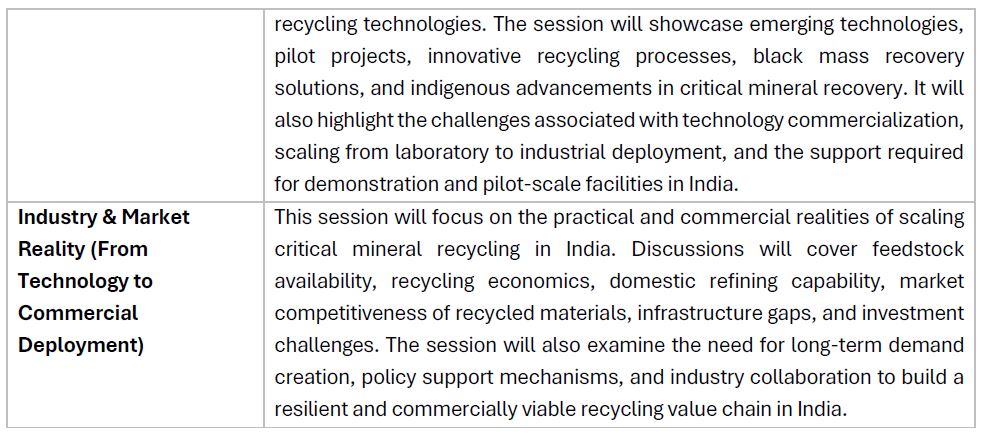
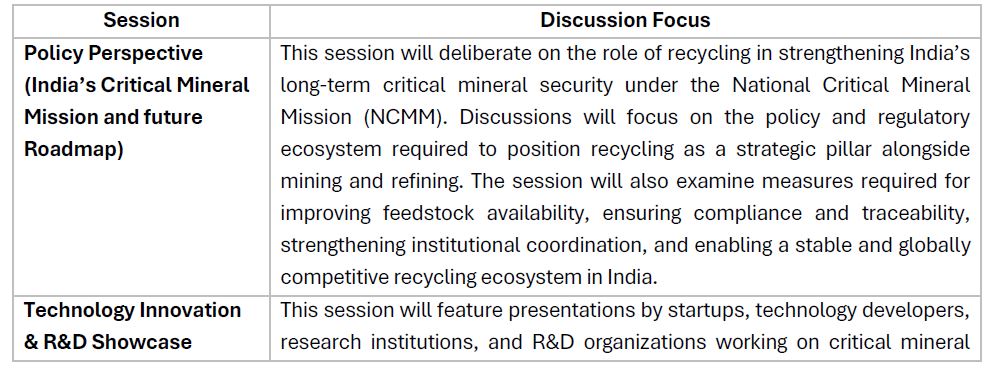
The conference is structured across three key pillars:

4. Expected Outcomes

  • Development of a “Conference Recommendations Report” for submission to relevant ministries
  • Identification of priority policy interventions to strengthen recycling under NCMM
  • Recommendations on technology scaling, funding mechanisms, and industry support
  • Actionable inputs for improving feedstock availability, market development, and regulatory alignment

5. Conclusion
As India positions itself as a global leader in clean energy and advanced manufacturing, critical mineral security will be a defining factor in sustaining this growth. Recycling presents a strategic opportunity to complement primary resource development while advancing sustainability and circular economy objectives.
This consultation aims to catalyze policy action, technological innovation, and industry alignment, enabling India to build a resilient, self-reliant, and circular critical mineral ecosystem.

Data Source Statement: Except for publicly available information, all other data are processed by SMM based on publicly available information, market communication, and relying on SMM‘s internal database model. They are for reference only and do not constitute decision-making recommendations.

For any inquiries or to learn more information, please contact: lemonzhao@smm.cn
For more information on how to access our research reports, please contact:service.en@smm.cn
Related News
Ferrous Metals May Rebound Slightly Next Week [SMM Steel Industry Chain Weekly Report]
9 hours ago
Ferrous Metals May Rebound Slightly Next Week [SMM Steel Industry Chain Weekly Report]
Read More
Ferrous Metals May Rebound Slightly Next Week [SMM Steel Industry Chain Weekly Report]
This week, ferrous metals mostly retreated after rapid rises, with only coking coal and coke standing out, briefly hitting the daily limit up at the open. Early in the week, the market was primarily characterized by coking coal and coke leading the gains across ferrous metals. A coal mine accident occurred in Shanxi over the previous weekend, strengthening market expectations of tighter supply driven by stricter subsequent regulatory oversight and increased production shutdowns at coal mines. Ferrous metals rebounded on cost support. However, some coal mines quickly resumed production afterward, and combined with the prospect of a US-Iran deal being reached, crude oil declines dragged iron ore prices lower, loosening cost support. Most products except coking coal and coke retreated from highs. In the latter half of the week, data on the five major steel products were released, showing continued inventory destocking but marginally weakening apparent demand, with supply-demand pressure rising somewhat. Spot market side, spot prices remained relatively firm this week, with the spot-futures price spreads for both hot-rolled coil and rebar widening, providing shipment opportunities for basis traders, while end-users continued to restock on a need-based, low-price approach...
9 hours ago
Copper Scrap Payability Coefficients Hold Exceptionally Firm as Supply-Demand Mismatch Defies Traditional Market Logic
9 hours ago
Copper Scrap Payability Coefficients Hold Exceptionally Firm as Supply-Demand Mismatch Defies Traditional Market Logic
Read More
Copper Scrap Payability Coefficients Hold Exceptionally Firm as Supply-Demand Mismatch Defies Traditional Market Logic
In May, copper prices surged before retracing, yet copper scrap payability coefficients remained exceptionally firm. Transactions for Millberry stabilized at a high level of 98.5%, while No. 2 copper became the market highlight, with its coefficient climbing from around 95% to 96%–97% due to the premium upside of its gold and silver by-products. Driven by stricter domestic policies and tax compliance, China demand remained robust. Conversely, tight overseas scrap supply persisted, and this structural mismatch kept import payability coefficients elevated and sticky for the short term. Under the current landscape of tight global supply and resilient demand, the traditional market logic of "surging copper prices driving down payability coefficients" has effectively become obsolete.
9 hours ago
ADC12 Aluminum Alloy Market Sees Slight Rise Amid Cost Pressures and Tight Scrap Supply
14 hours ago
ADC12 Aluminum Alloy Market Sees Slight Rise Amid Cost Pressures and Tight Scrap Supply
Read More
ADC12 Aluminum Alloy Market Sees Slight Rise Amid Cost Pressures and Tight Scrap Supply
[SMM Aluminum Alloy Daily Review] The ADC12 aluminum alloy market was generally stable with slight rise today. Driven by cost pressure, some enterprises raised their quotes slightly by 100 yuan/mt, while most manufacturers remained steady and took a wait-and-see approach. Currently, invoiced aluminum scrap resources remained persistently tight, pushing up procurement costs, and some manufacturers were concerned about potential production reduction risk. However, downstream demand remained mediocre, with limited end-user order release, which constrained price increases.
14 hours ago
Concept Note: One Day Conference on Critical Minerals Recycling Landscape - Shanghai Metals Market (SMM)