SMM April 17:
Metals market:
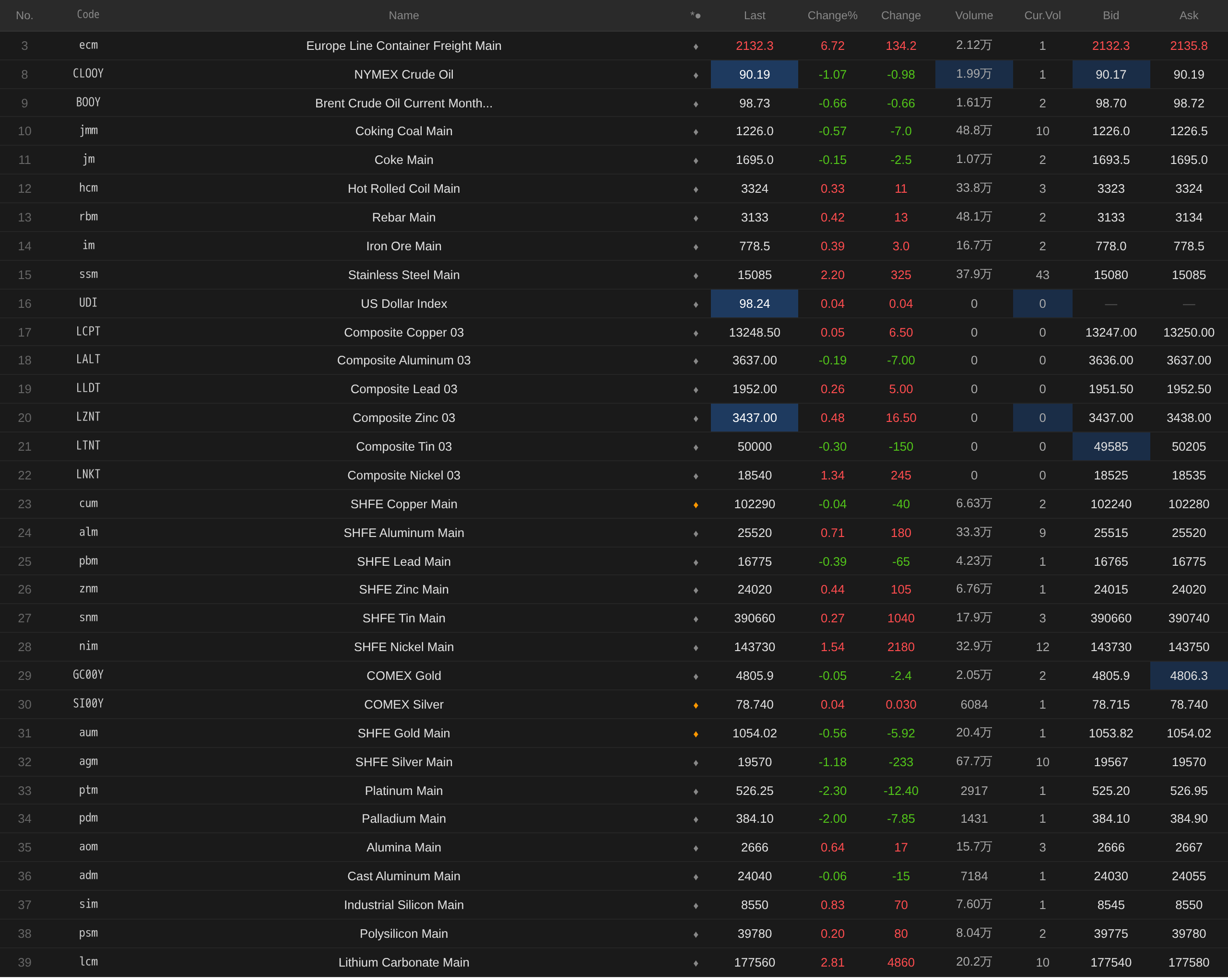
As of the daytime close, most base metals on the domestic market rose, with only SHFE copper and SHFE lead declining together. SHFE copper fell 0.04% and SHFE lead dropped 0.39%. SHFE nickel gained 1.54%, while the remaining metals posted gains of less than 1%. The alumina front-month contract rose 0.64%, and the foundry aluminum front-month contract fell 0.06%.
In addition, the lithium carbonate front-month contract rose 2.81%, the polysilicon front-month contract gained 0.2%, and the silicon metal front-month contract rose 0.83%. The Europe containerized freight front-month contract surged 6.72% to close at 2,132.3.
Ferrous metals mostly rose, with stainless steel leading the gains at 2.2%, while the remaining metals posted gains of less than 1%. Coking coal and coke side, coking coal fell 0.57% and coke dropped 0.15%.
Overseas market, as of 15:03, overseas base metals showed mixed performance. LME nickel led the gains at 1.34%, while the % change of the remaining metals fluctuated within 1%.
Precious metals, as of 15:03, COMEX gold fell 0.05% and COMEX silver rose 0.04%. In China, SHFE gold dropped 0.56% and SHFE silver fell 1.18%.
In addition, the platinum front-month contract fell 2.3% and the palladium front-month contract dropped 2%.
Market data as of 15:03 today
Macro Front
China:
[NDRC: This year will focus on launching a series of actions to expand effective investment in areas such as "AI+" infrastructure]The State Council Information Office held a press conference on the morning of April 17 under the series theme of "Getting Off to a Good Start for the 15th Five-Year Plan." Wang Changlin, Deputy Director of the NDRC, stated that this year the focus will be on launching a series of actions to expand effective investment in areas such as "AI+" infrastructure, urban renewal, the national water network, and new-type energy systems, to promote the optimization of supply structure and the expansion of market demand. In terms of institutional and mechanism innovation, comprehensive "soft construction" efforts will be carried out across central government investment projects to foster long-term mechanisms for project construction, implementation, operation, and maintenance. Meanwhile, the national venture capital guidance fund will be leveraged to guide and drive social capital to support technological innovation and the development of emerging industries. Wang Changlin noted that recently, in response to the impact of changes in the international situation on China's oil and gas imports, the government adopted comprehensive measures to effectively ensure sufficient domestic oil product supply and stable market operations, fully demonstrating the achievements of China's new-type energy system development. Going forward, efforts will be made to accelerate the high-quality development of non-fossil energy, coordinate centralized and distributed clean energy development, and make every effort to increase the scale of non-fossil energy power production and consumption. Through the above efforts, it is expected that by 2030, the supply scale of non-fossil energy will grow significantly compared to 2025, and by 2035, it will double compared to 2025.
[NDRC: Efforts to Expand Effective Domestic Demand, with a Plan to Formulate the 2026–2030 Implementation Plan for the Strategy of Expanding Domestic Demand] The State Council Information Office held a press conference in the series themed "Getting Off to a Good Start in the 15th Five-Year Plan Period," introducing the relevant situation of promoting high-quality economic and social development during the 15th Five-Year Plan period. Wang Changlin, Deputy Director of the National Development and Reform Commission (NDRC), stated that since the beginning of this year, positive changes had emerged in economic performance, with notable improvements on both the supply and demand sides, better serving as a stabilizer for the global economy, and outperforming the expectations of many institutions and experts in and outside China. Going forward, efforts should focus on five key areas of work.
[Pan Gongsheng: Implementing a Moderately Accommodative Monetary Policy and Measures to Boost Consumption] Pan Gongsheng stated that during the 15th Five-Year Plan period, China will adhere to a domestic demand-driven approach, implement policy measures to boost consumption, vigorously develop the service sector, closely integrate investment in physical assets with investment in human capital, promote productivity growth, accelerate green transformation and sustainable development, unswervingly advance high-level opening-up, and drive high-quality development. The People's Bank of China will implement a moderately accommodative monetary policy, support Chinese-style modernization with high-quality financial services, and contribute China's strength to global economic growth. (People's Bank of China)
[MIIT and Four Other Departments Jointly Issued the Guidelines for Green Design of Industrial Products (2026 Edition)] MIIT and four other departments jointly issued the Guidelines for Green Design of Industrial Products (2026 Edition). The Guidelines adapt to new changes and requirements in the green and low-carbon development landscape in and outside China, build consensus on green design across industries, and outline 11 key directions, namely long-life design, non-toxic design, lightweight design, energy-saving design, water-saving design, material-saving design, noise reduction design, space-saving design, easy-to-recycle design, reusable design, and zero-carbon design. The Guidelines further closely integrate the 11 key green design directions with practical industry applications, using 15 key industries as typical examples, and refine them into 126 solutions to guide product R&D personnel in practicing green design concepts and methods. (MIIT WeChat Account)
[PBOC Achieved a Net Withdrawal of 1.5 Billion Yuan Through Reverse Repo Operations] The PBOC conducted 500 million yuan of 7-day reverse repo operations today. As 2 billion yuan of 7-day reverse repos matured today, a net withdrawal of 1.5 billion yuan was achieved. This week, the PBOC conducted a total of 3 billion yuan in 7-day reverse repo operations. As 3.5 billion yuan in 7-day reverse repos matured this week, a net withdrawal of 500 million yuan was achieved. (Jin10 Data)
US dollar:
As of 15:03, the US dollar index rose 0.04% to 98.24. Data side, the number of initial jobless claims in the US declined last week, indicating that labour market conditions remained stable, even though employers were cautious about hiring new workers as the Middle East conflict cast a shadow over the economy. The latest data showed that US initial jobless claims for the week ending April 11 fell by 11,000 to 207,000, below market expectations of 215,000. Initial jobless claims this year have remained within the range of 201,000 to 230,000. While layoffs remained relatively low, the oil price shock from the US-Israel war against Iran may have hindered hiring. Economists noted that the labour market had already been in a state of stagnation before the war broke out, attributable to the uncertainty brought by Trump's sweeping import tariffs and mass deportations. Economists said the Middle East conflict was just another layer of uncertainty for enterprises. (Jin10 Data)
The chief rates strategist at SEB said that the 10-year US Treasury yield had been closely tracking market reactions to expectations for US Fed policy rate cuts. Further downward revisions in US Fed rate expectations could push the 10-year Treasury yield slightly lower in the near term, but not by much, with yields expected to remain largely within the 4.10%–4.30% range over the coming months. Deutsche Bank expects the US Fed to keep rates unchanged in 2026, compared with its previous forecast of an interest rate cut in September. (Jin10 Data APP)
According to the CME "FedWatch" tool: the probability of a 25-basis-point rate hike by the US Fed in April was 0.5%, while the probability of holding rates unchanged was 99.5%. The probability of a cumulative 25-basis-point interest rate cut by the US Fed through June was 1.4%, the probability of holding rates unchanged was 98%, and the probability of a cumulative 25-basis-point rate hike was 0.5%. (Jin10 Data APP)
On the macro front:
The eurozone February seasonally adjusted current account and eurozone February seasonally adjusted trade balance data will be released today. Also worth watching: 2027 FOMC voter and San Francisco Fed President Daly is scheduled to deliver a speech.
Crude oil:
As of 15:03, oil prices on both markets fell, with WTI down 1.07% and Brent down 0.66%. The market was optimistic that the Middle East conflict is about to end.
A Pakistan-flagged oil tanker entered the Persian Gulf over the weekend, becoming the first vessel to transport crude oil cargo through the Strait of Hormuz since the US imposed a blockade on Monday. Traffic through this critical waterway remained at extremely low levels. According to ship-tracking data, late on Thursday, the tanker "Shalamar" departed from south of Iran's Larak Island and entered the Gulf of Oman, carrying approximately 450,000 barrels of crude oil loaded at Das Island in the UAE. The Aframax tanker was currently only half-loaded, with its destination signal indicating Karachi. (Jin10 Data APP)
Ryoji Musha, president of Japan's Musha Research, stated that the gap between the pessimistic sentiment reported by the media and actual market behavior was too large to ignore. Since the Iran conflict broke out on February 28, the S&P 500 had recovered all its losses and returned to within just 1% of its all-time high. While near-term crude oil futures prices remained elevated, contracts for delivery six months out had already pulled back to the $70 range. Therefore, the market was not assuming a prolonged closure of the Strait of Hormuz, nor was it assuming a third oil crisis would occur. Furthermore, Musha pointed out that the global economy's dependence on crude oil was no longer as high as it was in the 1970s, and oil's share in Japan's energy mix had declined from 76% during the first oil crisis to 35% in 2024. Alternative routes such as pipelines in Saudi Arabia and the UAE already existed, and a prolonged closure of the Strait of Hormuz would not serve Iran's own interests either, as the strait was also a lifeline for Iran's trade. Japan remained vulnerable to renewed increases in imported energy and transportation costs, but the market was no longer trading as if a full-blown oil crisis were about to erupt. (Jin10 Data APP)
SMM Daily Reviews
►
►
►
►
►
►
►
►
►
►
►
►
![Market Gradually Digested Bearish Sentiment, Steel Prices May Hold Up Well Following Costs [SMM Steel Industry Chain Weekly Report]](https://imgqn.smm.cn/usercenter/lIGxY20251217171747.jpg)
![Aluminum Prices Stay High, Downstream Price Acceptance Remains Weak [SMM Spot Aluminum Midday Review]](https://imgqn.smm.cn/usercenter/jWDCu20251217171653.jpg)
![Geopolitical Risk Uncertainty Persisted, the Most-Traded BC Copper Contract Stabilized [SMM BC Copper Commentary]](https://imgqn.smm.cn/usercenter/FERSF20251217171712.jpg)