[SMM Analysis] China’s December Petroleum Coke Imports Peak, Driven by Tariff Policy and Pre-Holiday Stockpiling

Published: Jan 21, 2026 17:41
Source: SMM
Entering Q1 2026, as domestic refineries gradually resume operations after maintenance, the supply side is expected to steadily improve. Coupled with the commissioning of new delayed coking units in 2026, domestic petroleum coke production will increase, squeezing the space for imported coke. Overall, influenced by seasonal fluctuations during the Chinese New Year, the pace of resumption of downstream enterprises, the release of new domestic capacity, and the continuation of Sino-US tariff policies, petroleum coke imports in Q1 are expected to follow a "high in January, pull back in February, rebound in March" pattern, with the total import volume projected to remain at 3.5-3.7 million mt, basically flat compared to the same period last year.

SMM January 21st Report:

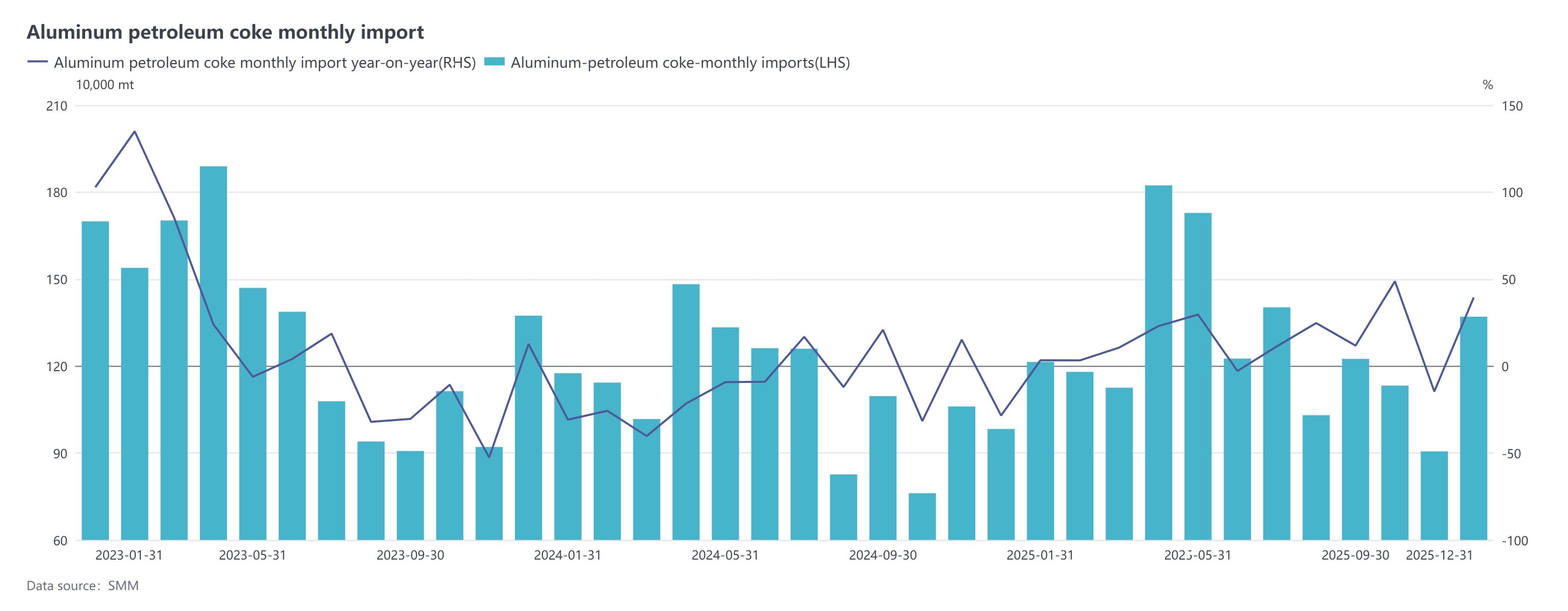
According to customs data, China's petroleum coke imports in December 2025 reached 1.3702 million mt, up 51.32% MoM and 39.41% YoY; the estimated import price for petroleum coke in December was $229.34/mt, down 1.68% MoM but up 67.60% YoY. The total cumulative imports of petroleum coke in China for 2025 were approximately 15.3618 million mt, up 14.65% YoY.

In terms of import sources, the main countries/regions from which China imported petroleum coke in December 2025 were the US, Russia, and Saudi Arabia, with import volumes (import share) of 379,100 mt (28%), 250,500 mt (18%), and 184,600 mt (13%) respectively.

Regarding import price performance, petroleum coke import prices in December 2025 showed a pattern of more increases than decreases. The average import price for the month was $229.34/mt, a slight pull back of 1.68% MoM, but a significant rise of 67.60% YoY, demonstrating strong annual growth momentum. By country, Indonesia, Belgium, and Canada saw the most notable price increases, all above $66/mt, with Indonesian imports showing particularly significant gains, driving the overall upward trend in import prices. Meanwhile, Argentina, the US, and Russia experienced noticeable declines in petroleum coke import prices, but these drops were relatively mild, all within $40/mt, and did not significantly impact the overall "more increases than decreases" pattern.

In December 2025, China's petroleum coke imports showed a wide-ranging increase, becoming a key period for high import volumes and a peak for the year. The core drivers were twofold: on one hand, in November 2025, China and the US clearly stated that a 13% tariff on US petroleum coke would be implemented for one year, eliminating the wait-and-see sentiment and order delays among traders. The cost advantages of importing high-sulphur sponge coke from the US became evident, and previously accumulated orders were released, arriving in large numbers in December, forming the core of the monthly import increase. On the other hand, as the Chinese New Year holiday approached, domestic traders and downstream enterprises initiated early stockpiling plans, further boosting import volumes. At the same time, the surge in imports also led to a concurrent rise in domestic port inventories, with an increase in high-sulphur coke supply, causing prices to experience a slight correction.

Entering Q1 2026, as domestic refineries gradually resume operations after maintenance, the supply side is expected to steadily improve. Coupled with the commissioning of new delayed coking units in 2026, domestic petroleum coke production will increase, squeezing the space for imported coke. Overall, influenced by seasonal fluctuations during the Chinese New Year, the pace of resumption of downstream enterprises, the release of new domestic capacity, and the continuation of Sino-US tariff policies, petroleum coke imports in Q1 are expected to follow a "high in January, pull back in February, rebound in March" pattern, with the total import volume projected to remain at 3.5-3.7 million mt, basically flat compared to the same period last year. In the future, the commissioning progress of new delayed coking units, changes in Sino-US tariff policies, and the resumption of operations in downstream industries will be the core variables determining the actual trend of petroleum coke imports in Q1 and maintaining the supply-demand balance, requiring close and continuous attention.
Data Source Statement: Except for publicly available information, all other data are processed by SMM based on publicly available information, market communication, and relying on SMM‘s internal database model. They are for reference only and do not constitute decision-making recommendations.

For any inquiries or to learn more information, please contact: lemonzhao@smm.cn
For more information on how to access our research reports, please contact:service.en@smm.cn
Related News
[SMM Analysis] Global Scrap Aluminum Resource Retention Trend Gains Momentum: EU, US, Japan, UAE & South Africa Policies
9 hours ago
[SMM Analysis] Global Scrap Aluminum Resource Retention Trend Gains Momentum: EU, US, Japan, UAE & South Africa Policies
Read More
[SMM Analysis] Global Scrap Aluminum Resource Retention Trend Gains Momentum: EU, US, Japan, UAE & South Africa Policies
[SMM Analysis] Global Scrap Aluminum Resource Retention Trend Gains Momentum: EU, US, Japan, UAE & South Africa Policies
As resource security and decarbonization become increasingly important, major economies are strengthening efforts to retain aluminum scrap. From the EU's review of export controls and the U.S. strategic asset proposal to Japan's circular economy initiatives and policies in the UAE and South Africa, these developments could reshape global scrap flows and affect secondary aluminum markets.
9 hours ago
Chalco's $1.82B Aluminum Foil Project 40% Complete, Aims for 2027 Operation and $4B Output
12 hours ago
Chalco's $1.82B Aluminum Foil Project 40% Complete, Aims for 2027 Operation and $4B Output
Read More
Chalco's $1.82B Aluminum Foil Project 40% Complete, Aims for 2027 Operation and $4B Output
The total investment of the Chalco Aluminum Foil New Energy High-Precision Plate, Sheet, Strip and Foil Project is RMB 1.82 billion, and physical progress has currently reached 40%. The roofing of the factory building will be completed by June 30 this year, and equipment commissioning and acceptance will be finished by month-end December, followed by trial production. It is understood that the project is expected to be officially completed and put into operation on May 31, 2027. After commissioning, it will achieve an annual output of 170,000 mt of high-precision aluminum plate/sheet, strip and foil, primarily used for the positive electrode current collectors of high-end power batteries, with an output value projected to reach 4 billion yuan.
12 hours ago
Huaibei High-tech Zone Signs Deal for Advanced Aluminum Composite Materials Project
12 hours ago
Huaibei High-tech Zone Signs Deal for Advanced Aluminum Composite Materials Project
Read More
Huaibei High-tech Zone Signs Deal for Advanced Aluminum Composite Materials Project
On the morning of June 2, a project with an annual capacity of 30,000 mt of aluminum-based metal composite materials and 5 million pieces of deep-processed material products was signed in Huaibei High-tech Zone. The project integrates new material R&D, intelligent manufacturing, and precision deep processing. Its products are mainly applied in NEVs, energy storage equipment, PV, wind power, and other fields.
12 hours ago
[SMM Analysis] China’s December Petroleum Coke Imports Peak, Driven by Tariff Policy and Pre-Holiday Stockpiling - Shanghai Metals Market (SMM)