SHANGHAI, Aug 16 (SMM) - In the latest SMM online video live broadcast SMM TOP Talk, Yi Yanting, the director of SMM's Big Data Department, provided a detailed analysis of the trending topic about the lithium recovered from scraps amid high lithium prices. Yi said that the volume of lithium recovered from scraps in June accounted for about 12% of the total lithium supply. According to SMM estimation, that figure is likely to stand at around 10% throughout year 2022. Moreover, the ratio is expected to improve considerably next year.
In the first half of the year, with the prices of nickel, cobalt and lithium hovering at high levels, the recycling volume of NMC batteries and LFP batteries both increased steadily. According to SMM statistics, the recycling volume of domestic waste lithium batteries in January was as high as 32,000 mt. In February, the recycling volume shrank to 13,000 mt under the impact of Spring Festival holiday and pandemic outbreaks, which led to a relatively quiet market. As the pandemic was gradually under control in June, the sales and recycling volume of automobiles recovered significantly, and the recycling volume of lithium also surged. Specifically, the volume of lithium recovered from scraps such as batteries, black mass and pole plate stood at 29,000 mt in physical content in June, up 62% month-on-month, which basically returned to the high point in January.
SMM data also shows that the recycling volume of domestic waste lithium batteries (including scraps such as batteries, black mass and pole plate) remained high in July, totalling 29,750 mt, a slight increase of 2% compared with June.
In addition, the recycling volume of nickel, cobalt and lithium in July amounted to 3,127 mt, 3,180 mt and 1,279 mt in metal content respectively. In details, 3,127 mt in metal content of nickel sulphate, 3,100 mt in metal content of cobalt sulphate, 80 mt in metal content of cobalt oxide, 2,941 mt of industrial-grade lithium carbonate, 2,837 mt of battery-grade lithium carbonate, and 1,329 mt of crude lithium carbonate were recovered.
Q: What is the ratio of lithium recovered from scraps to the total lithium supply amid high lithium prices?
A: As mentioned before, the ratio was 12% in July, and according to SMM estimation, that figure is likely to stand at around 10% throughout year 2022, which is expected to improve considerably next year.
Q: The recycling industry is increasingly popular with its so-called prominent cost efficiency. So how to calculate the cost of recycling lithium batteries?
A: Taking the mainstream NCM523 pole piece as an example, here is the formula of its recycling cost: the total cost = (SMM refined cobalt price x cobalt content + SMM refined nickel price x nickel content) x SMM price coefficient of nickel and cobalt + processing fees. More details are shown in the picture below.
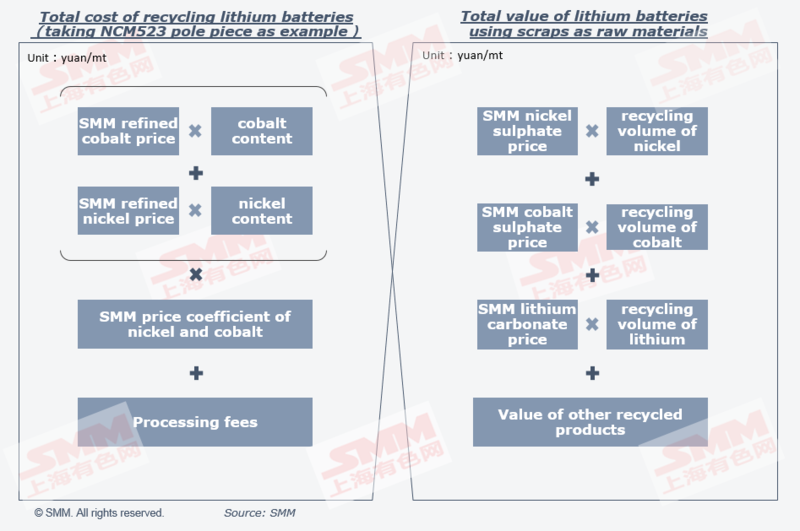
As for the sales after recycling, on the right side of the picture displays the formula of calculating the total value of lithium battery using scraps as raw materials. Total value = SMM nickel sulphate price x recycling volume of nickel + SMM cobalt sulphate price x recycling volume of cobalt + SMM lithium carbonate price x recycling volume of lithium + value of other recycled products (such as copper, aluminium, manganese and other metals that are worth recycling).
Therefore, SMM price is more stable and can avoid the inaccuracy of information and price fluctuation.
Q: How will the proportion of NMC batteries and LFP batteries change in the future?
A: In mid-2021, the proportion of LFP batteries overtook that of NMC batteries for the first time. In 2022, the proportion of LFP still further increased, even in the second quarter, which was seriously affected by the pandemic. Since June, as the impact of the pandemic eased, the recovery of LFP batteries far exceeded expectations. Therefore, many new chemical and ternary companies tended to deploy LFP battery.
Overall, SMM expects that the proportion of LFP batteries will reach 60%-65% this year, and the proportion of NMC batteries will be 35%-40%. The proportion of LFP batteries will continue to increase until 2023. In 2024 and 2025, with the emergence of solid-state batteries, the NMC batteries are expected to be used in mid and high-end vehicles in the future, and LFP batteries will be used in low-end vehicles and energy storage. In the long run, NMC batteries and LFP batteries will be used in different subdivisions.
Q: What is the outlook on the prices of batteries in the future?
A: The battery prices depends on the cost, and the supply and demand. The cost of battery cells increased by nearly 100% last year, but due to the untimely transmission, the battery cells companies and leading battery companies did not raise the prices until Q1 and Q2, 2022. Therefore, although the lithium carbonate prices fell in 2022, the battery cells prices still increased.
In Q3 and Q4, the prices of battery cells are expected to further increase and the price increase in 2022 is expected to rise by 20%~30% on the year.
According to SMM research, many battery cells and car companies gradually use the linkage pricing model instead of “Buy it Now” pricing model. Currently, the new pricing model is used more in the pricing process of lithium. Some enterprises intend to use the new model to determine the prices of nickel sulphate, cobalt sulphate, and even the prices of anode, separator, and electrolytes.
On the whole, as the price increase of battery cells has not been transmitted in place, SMM predicts that the prices of battery cells will stabilise in Q3 amid the fierce competition. In terms of energy storage cells, the lithium carbonate prices are expected to increase more significantly, and the competition among battery companies will become more intense. In this scenario, the prices of energy storage cells are expected to increase.
![[Lithium battery: Foshan Plastics plans over RMB 7bn for high-end separator capacity]](https://imgqn.smm.cn/usercenter/aXRJI20251217171728.jpg)
![[Solid-state: ProLogium starts mass production of Gen 3.5 all-solid-state cells at 381 Wh/kg]](https://imgqn.smm.cn/usercenter/mpqgn20251217171727.jpg)
![[Твердотельный аккумулятор: производство сульфидного электролита 70 тонн, январь-август]](https://imgqn.smm.cn/usercenter/Bwmed20251217171726.jpg)