The improvement on the fundamentals of aluminum and zinc is very limited.
Over the past decade, photovoltaic and wind power have become the world's fast-growing energy types, the core factor is the rapid decline in costs. But this growth trend is likely to be reversed by the rise in raw materials.
Calculation of global wind power installation capacity
Data show that the global cumulative wind power installed capacity in 2020 is 733GW, while that in China is 282GW; in 2020, the global new wind power installation capacity is 111GW, and its China is 72GW. According to Bloomberg's forecast, the cumulative new wind power installed in the world will be 969GW from 2021 to 2030, with 447GW in China. At the "2020 Beijing Wind Energy Conference", more than 400 wind power enterprises launched a joint declaration for the first time, guaranteeing that more than 50GW of wind power will be installed annually. After 2025, the average annual installed capacity of wind power in China should not be less than 60GW, and by 2030 at least 800GW. Based on this, it is estimated that the cumulative new installed capacity of wind power in China between 2021 and 2030 is 518GW, which is higher than the forecast of Bloomberg. By adjusting the new installed capacity of wind power in China in Bloomberg data, it is estimated that the global cumulative installed capacity of wind power will be 1040GW between 2021 and 2030.
Forecast of photovoltaic installed capacity in the global market
The data show that the cumulative installed capacity of photovoltaic in 2019 is 693GW, while that in China is 225GW. In 2020, the installed capacity of photovoltaic in China will be increased by 48GW. According to Bloomberg data, it is estimated that the global cumulative photovoltaic installed capacity in 2020 is 833GW, which is higher than the new global cumulative photovoltaic installed capacity published by the European Photovoltaic Industry Association. The overall judgment is that the global photovoltaic installed capacity in 2020 is near 800GW.
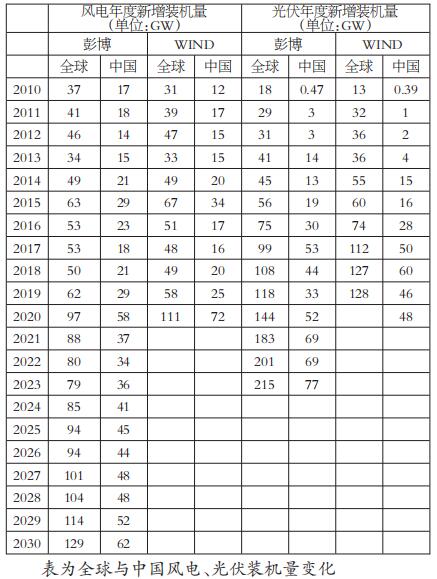
For the future, the China Photovoltaic Industry Association predicts that during the 14th five-year Plan period, the domestic average annual photovoltaic installed scale is generally expected to be 70GW, optimistically expected to be 90GW. Bloomberg predicts that the global average annual installed capacity of photovoltaic will be 200GW from 2021 to 2023, based on which we estimate that we can launch the new installed capacity of global power generation 1000GW from 2021 to 2025. According to the Global Market Outlook released by the European Photovoltaic Industry Association on September 1, 2021, the cumulative new photovoltaic capacity 1097GW in 2021 will be added in 2025. Under good conditions, the cumulative new photovoltaic capacity of 2021 will reach 1374GW in 2025. Under medium conditions, the total installed capacity of global photovoltaic is expected to reach the following milestones in the next five years: 900GW in 2021, 1100GW in 2022, 1300GW in 2023, 1600GW in 2024 and 1800GW in 2025. Overall, it is estimated that the global photovoltaic installed capacity 1000-1374GW will be increased from 2021 to 2025.
New copper consumption of wind power and photovoltaic in the world
Application of Copper in Wind Power and Photovoltaic
The specific application components of copper in wind power are tower tube cable, unit internal booster, unit external booster, wind farm internal cable, motor, switchgear, control wire and cable, grounding wire and cable and so on. For offshore wind power, the copper use intensity of each component is higher than that of onshore wind power, especially for cables, which account for up to 59% of the total copper consumption. Although different technologies have a slight impact on the strength of copper use, the overall impact is limited due to the low proportion of copper used by motors and gearboxes in the overall wind farm (8% 21%).
Photovoltaic power generation system is composed of solar cell array, battery pack, charge and discharge controller, inverter, AC distribution cabinet, solar tracking control system and other equipment, in which bus box, transformer, copper wire and other components contain more copper.
Copper consumption per GW
The factor that has a great influence on the copper use intensity in wind power is the choice of new units installed on land and at sea. According to the Wood Mackenzie report, onshore wind power consumes 5400 tons of copper per GW installed, offshore wind power consumes 15300 tons of copper per GW installed, and photovoltaic systems consume 5000 tons of copper per GW installed. Data from DBS Bank show that onshore wind power consumes 4000 tons of copper per GW installed, offshore wind power consumes 10000 tons of copper per GW installed, and photovoltaic systems consume 5500 tons of copper per GW installed.
Combined with the average of the two statistics, it is estimated that offshore wind power needs to consume 12650 tons of copper per GW installation, onshore wind power needs to consume 4700 tons of copper per GW installation, and photovoltaic systems need to consume 5250 tons of copper per GW installation.
Global annual wind and photovoltaic copper consumption from 2021 to 2025
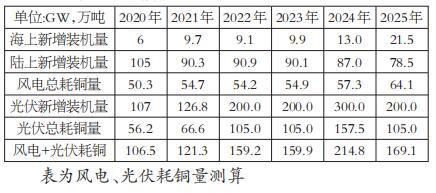
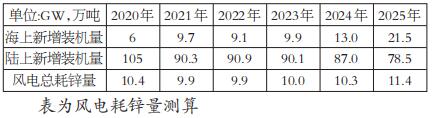
According to the above estimate, the new installed capacity of global wind power in 2021-2030 is 1040GW. Considering the acceleration of wind power construction in 2025-2030, the average annual wind power increment in 2021-2025 is expected to be 100GW. In 2020, the Global Wind Energy Council ((GWEC)) forecasts that the new installed capacity on land in 2021-2025 will be 9.7GW, 9.1GW, 9.9GW, 13GW and 21.5 GW, respectively. Based on this, it is estimated that the average annual copper consumption of wind power in 2021 will be 570000 tons in 2025. According to the above estimates, under medium conditions from 2021 to 2025, the total installed capacity of global photovoltaic will reach the following milestones: 900GW in 2021, 1100GW in 2022, 1300GW in 2023, 1600GW in 2024 and 1800GW in 2025. It is estimated that the average annual copper consumption of photovoltaic is 1.08 million tons, while under good conditions, the average annual copper consumption of photovoltaic will reach 1.44 million tons.
Overall, in the general case of photovoltaic growth, the copper consumption of wind power + photovoltaic is 1.65 million tons / year from 2021 to 2025, and the average annual copper consumption of wind power + photovoltaic energy reaches 2 million tons in the case of optimistic photovoltaic growth. In 2020, wind power plus photovoltaic copper consumption is only 1.065 million tons, compared with the average annual marginal increment of 585000-935000 tons in 2020, according to the global copper demand of 23 million tons in 2020, the marginal growth rate is 2.5% 4.1%.
New aluminum consumption of wind power and photovoltaic in the world
Driven by the goal of "carbon neutralization", emission reduction is the top priority. Solar energy, wind energy, tides and other natural energy to replace traditional fossil energy, and then reduce carbon emissions will become the main trend in the future. Corresponding to the application of aluminum demand, it is mainly reflected in the demand of aluminum for photovoltaic installation, and the amount of aluminum for wind power installation is relatively limited. The calculation of aluminum increment for photovoltaic installation is mainly divided into two parts: one is the aluminum consumption per unit GW installation, and the other is the prediction of photovoltaic installation increment in the future.
Calculation of aluminum consumption per unit GW photovoltaic installation
Aluminum profiles are mainly used in the manufacture of voltaic frames and brackets in the photovoltaic field.
Aluminum consumption per unit GW of photovoltaic frame
The size of the photovoltaic frame is mainly affected by the total size of the silicon wafer cell in the module, the total size = the number of cells × the size of a single silicon wafer cell, the actual situation is that the size and quantity of the silicon wafer are arranged and combined more, so refer to the main products of the component enterprises and their dimensions as the size standard of the aluminum frame. At present, there are mainly three types of aluminum alloys used in photovoltaic frames: 6061, 6063 and 6082, and their densities are 2.75g/cm3, 2.69g/cm3 and 2.71g/cm3, respectively. Therefore, the aluminum consumption of photovoltaic frame is (cross-sectional area × assembly size length-width × alloy density). Finally, it is concluded that the aluminum consumption per unit GW photovoltaic frame is about 9000-11000 tons.
Aluminum consumption per unit GW of photovoltaic bracket
According to the different construction methods, photovoltaic power stations can be divided into distributed photovoltaic power stations and centralized photovoltaic power stations, while aluminum alloy brackets are more used in distributed photovoltaic power stations. Refer to the article "Economic Comparative Analysis and Research of Aluminum Alloy support and Steel support" published by National Nuclear Power Planning and Design Institute in 2016, and take a 20MWp distributed photovoltaic power generation project in Huainan as a reference. The basic wind pressure and snow pressure of the project are 0.35kN and 0.60kN, respectively. The design life of the bracket is 25 years. The monocrystalline silicon 270wp module is adopted. The size of the battery board assembly is 1650 × 990 × 40mm. Each module is an array of 19.5kg. The fixed type is adopted, and the tilt angle of the support is 23 °. All battery assembly brackets are composed of columns, inclined beams, inclined braces, purlins and connecting accessories. The main material of the selected aluminum alloy is 6063-T6, the surface is anodized, and the connecting bolts and nut gaskets are C-grade ordinary bolts. It is estimated that the aluminum consumption of the bracket used in the GW distributed photovoltaic power station is about 19000 tons.
Forecast of average annual demand of aluminum for photovoltaic at home and abroad
According to the above calculation of aluminum consumption per unit GW photovoltaic installation, combined with China Photovoltaic Industry Association, European Photovoltaic Industry Association and Bloomberg data forecast, that is, during the "14th five-year Plan" period, the domestic average annual installed size of photovoltaic is generally estimated at 70GW, optimistically estimated at 90GW, and the average annual installed scale of global photovoltaic is 200GW.
Then the domestic aluminum consumption of photovoltaic frame is 70 × 10 000 tons-90 × 10 000 tons, that is, 700000-900000 tons; the aluminum consumption of photovoltaic brackets is mainly concentrated in the newly installed distributed photovoltaic, which accounts for 32% of the total installed capacity in China. that is, 70 × 32 × 1.9 = 425600 tons-90 × 32 × 1.9 = 547200 tons, that is, the average annual demand for aluminum is about 500000 tons.
Comprehensive analysis, the average annual demand of domestic photovoltaic aluminum is about 1.2 million-1.4 million tons; overseas photovoltaic aluminum demand is about (200 million 80) × 1.9 = 2.28 million tons.

New Zinc consumption in Global Wind Power and Photovoltaic
The main function of zinc in the wind power and photovoltaic industry is to attach to the outer surface of steel in the form of galvanized or zinc-rich primer to prevent corrosion. In the photovoltaic industry, zinc is mainly used in the anti-corrosion of carbon steel photovoltaic brackets. It is understood that the thickness of the stent is generally more than 2mm, and the thickness of special parts should not be less than 2.5mm. According to the requirements of the national standard, for 2mm substrate, the thickness of local galvanization should not be less than 45 μ m, and the average thickness should not be less than 55 μ m.
The research of relevant institutions shows that the average annual range of zinc used in photovoltaic in the next five years is 0-40,000 tons, and the overall new increment is relatively small. In the wind power industry, zinc consumption is mainly in wind power towers and bolts, and the galvanized coating in inland dry areas is less than that in offshore and offshore wind farms and other serious corrosion environments. it is estimated that the unit zinc consumption of onshore wind power is about 1 million-1.5 million tons (average 1.25 million tons), and that of offshore wind power is about 1.2 million-1.8 million tons. According to IRENA estimates, the demand for plain carbon steel in onshore power generation airports is about 100000-140000 tons / GW, the average is 70, 000 tons / GW; offshore wind farm carbon steel demand is about 110000-170000 tons / GW, the average is 140000 tons / GW. According to the above forecast of offshore and onshore wind power installation in 2021-2025, it is estimated that the annual average annual zinc consumption of new wind power installation in 2021-2025 is 103000 tons, which is not much different from that in 2020, so the marginal growth of wind power zinc consumption in 2021-2025 is very limited to the improvement of zinc fundamentals.
Summary
Copper: under the general situation of photovoltaic growth, the average annual copper consumption of wind power + photovoltaic is 1.65 million tons from 2021 to 2025, and under the optimistic situation of photovoltaic growth, the average annual copper consumption of wind power + photovoltaic energy reaches 2 million tons. In 2020, the wind power plus photovoltaic copper consumption is only 1.065 million tons, compared with only 585000-935000 tons in 2020. According to the global copper demand of 23 million tons in 2020, the marginal growth rate is 2.5% 4.1%.
Aluminum: in the general case of photovoltaic growth, the average annual photovoltaic aluminum consumption will be 3.48 million tons in 2021-2025. Under the optimistic situation of photovoltaic growth, the average annual photovoltaic aluminum consumption will reach 3.78 million tons, and the global photovoltaic aluminum consumption will be 2.033 million tons in 2020. Compared with the increment of 1.5 million tons in 2020, the global aluminum demand in 2020 is nearly 60 million tons, and the marginal growth rate is 2.5%. The impact is relatively limited.
Zinc: zinc is used very little in the photovoltaic field, with an average annual consumption of only 10-50, 000 tons in the next five years; 103000 tons in the wind power sector from 2021 to 2025, and 104000 tons in the wind power sector in 2020, so the marginal growth of wind power zinc consumption in 2021 and 2025 is very limited to the improvement of zinc fundamentals.