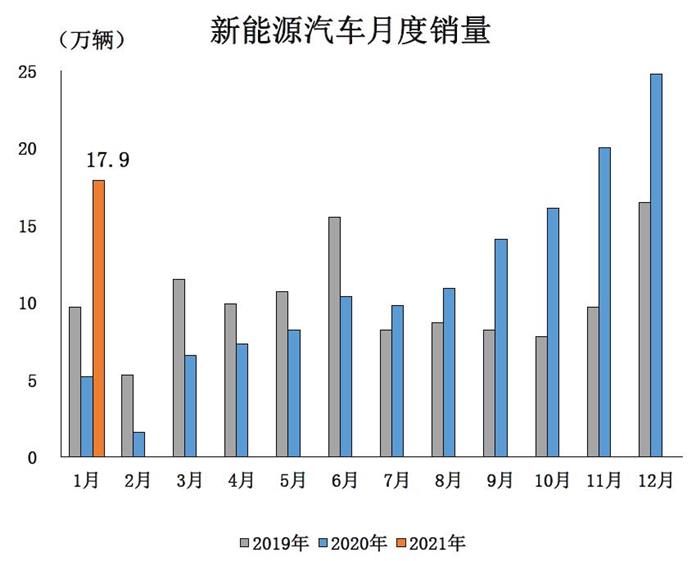
SMM, Feb. 26: according to data from the China Automobile Association, in January 2021, the production and sales of new energy vehicles completed 194000 and 179000 respectively, down 17.8% and 27.8% respectively from the previous month, and an increase of 285.8% and 238.5% respectively over the same period last year. New energy vehicles have set a new monthly sales record for seven months in a row.
The month-on-month decline in January is basically similar to that in previous years. After 20% of the subsidy for new energy vehicles was determined in 2021, the market snapped up at the end of December, coupled with the fact that the countries that caused the epidemic at the beginning of this year advocated the local Spring Festival. Many consumers have also reduced their desire to buy new cars in the New year. The month-on-month decline in January is relatively small compared with previous years, and sales of new energy vehicles are still growing this year.
Source: China Automobile Association
According to the analysis of the China Automobile Association, there are two reasons for the sharp increase in production and sales year-on-year this month, one is that the current market demand is still recovering, and the other is that the 2020 Spring Festival holiday is in January, coupled with the impact of the epidemic at the beginning of last year, so the base level is low. From a month-on-month point of view, the rapid decline in production reflects that the insufficient supply of automotive chips affects the production rhythm of enterprises.
Power battery
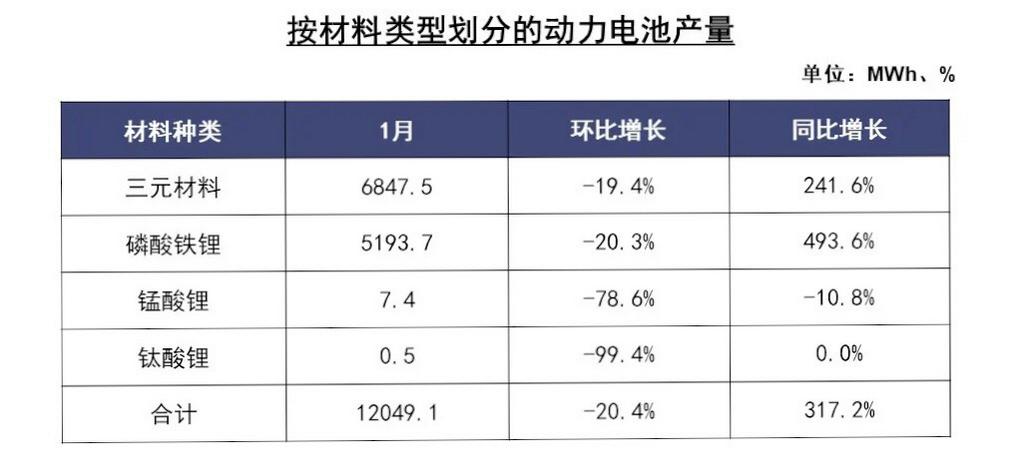
According to the power battery installation data of the China Automotive Power Battery Industry Innovation Alliance, the output of the power battery industry was 12.0 GWH in January, an increase of 317.2% over the same period last year and a month-on-month decline of 20.4%. The output of ternary lithium battery was 6.8GWh, accounting for 56.8% of the total output, an increase of 241.6% over the same period last year; the output of lithium iron phosphate battery was 5.2GWh, accounting for 43.1% of the total output, up 493.6% from the same period last year. The decline in the output of battery enterprises in January was mainly due to the approach of the Spring Festival, the weakening of downstream market demand, coupled with a partial shortage of battery materials, and a month-on-month decline in output.
China's power battery output in January 2021
Source: China Automotive Power Battery Industry Innovation Alliance
In January, the installed capacity of power batteries in China was 8.7GWH, an increase of 273.9% over the same period last year and a decrease of 33.1% from the previous month. The installed capacity of ternary lithium batteries was 5.4GWh, an increase of 241.9 percent over the same period last year, while that of lithium iron phosphate batteries was 3.3GWh, an increase of 349.8 percent over the same period last year. The month-on-month decline in installed capacity in January was mainly due to a decline in production by car companies. In January, the installed capacity of iron and lithium decreased by 52.8% from the previous month, and the month-on-month decline was much more than three yuan. This was mainly due to the rush installation strategy adopted by new energy commercial vehicles at the end of last year, which led to a sharp increase in iron and lithium installation in December and exceeded three yuan. In January, the installed capacity of new energy commercial vehicles decreased significantly, while the installed capacity of new energy passenger vehicles decreased slightly. New energy commercial vehicles are mainly equipped with iron lithium batteries, while passenger vehicles with ternary batteries account for a higher proportion.
Power battery installed capacity in January 2021
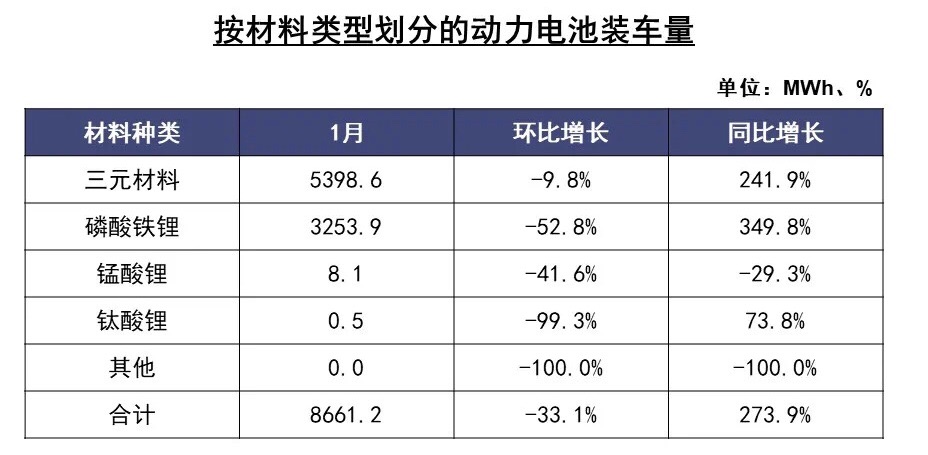
Installed capacity of power batteries in China in 2019-2021
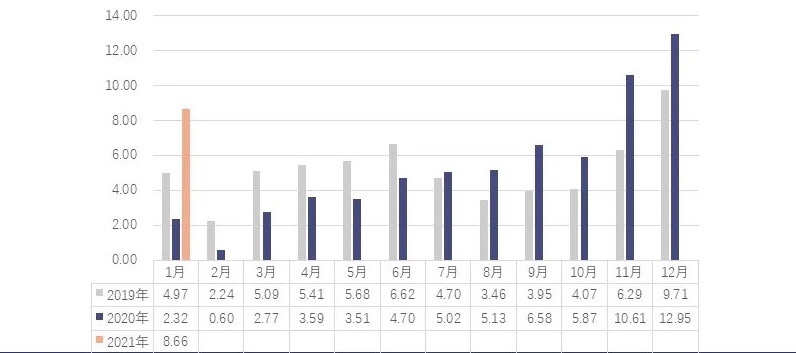
Source: China Automotive Power Battery Industry Innovation Alliance
SMM believes that although sales of new energy vehicles decreased month-on-month in January this year, there was a significant increase compared with the beginning of previous years. It is expected that the Spring Festival factors will lead to a slight decrease in February, and the market will gradually recover in March. Coupled with the gradual climbing of Tesla Model Y production capacity and gradually meeting consumer demand, BYD released new plug-in models Qin and Tang in March to drive market demand, coupled with local policy support, the production and sales of new energy vehicles in the future are still good. The installed capacity of power batteries is also expected to increase with the demand of the car market, among which many iron lithium and ternary matching new models will be on the market this year. Iron lithium has BYD's new model, Tesla Model 3, Hongguang MINI upgrade model, and so on. It is expected that iron lithium will maintain last year's rising demand and continue to increase its share in the passenger car market.
SMM battery materials research team
Mei Wangqin 021-51666759
Huo Yuan 021-51666898
Liu Xiaoyi 021-51666716
Yuan Ye 021-51595792
![[Опровержение слухов о твердотельных аккумуляторах: Ван Фан из CATARC заявил, что решение о соответствии для предприятий по производству твердотельных аккумуляторов не принималось]](https://imgqn.smm.cn/usercenter/JSjkr20251217171728.jpg)
![[Литиевые батареи: Foshan Plastics планирует вложить более 7 млрд юаней в производство высококачественных сепараторов]](https://imgqn.smm.cn/usercenter/aXRJI20251217171728.jpg)
![[Твердотельные аккумуляторы: ProLogium начинает массовое производство полностью твердотельных элементов Gen 3.5 с плотностью энергии 381 Вт·ч/кг]](https://imgqn.smm.cn/usercenter/mpqgn20251217171727.jpg)