SMM: recently, the European Union announced that it would establish a "raw materials alliance" by the end of 2020 to "enhance the EU's resilience in the value chain of rare earths and magnets", which are important for industries from renewable energy to space. The alliance, which will be made up of industrial companies, European governments, civil society and investors, will focus first on the supply of rare earth permanent magnet raw materials and then on other key raw materials.
"We cannot afford to rely entirely on third countries," Thierry Bretton, a member of the European Industry Commission, said in a statement on Sept. 10. " "by diversifying supplies from third countries and developing the EU's own rare earth extraction, processing, recovery, refining and separation capabilities, we can become more resilient and sustainable."
This shows that the EU is stepping up its efforts to reduce its dependence on imported raw materials such as rare earths and lithium. Since 2011, the EU has updated its list of key raw materials every three years. Compared with the list updated in September 2017 (a total of 27 raw materials), the updated list on September 3 removed helium, retained the remaining 26 raw materials, and added four raw materials: lithium, strontium, titanium and bauxite.
More than 90% of the rare earth permanent magnet materials used in the European Union to make electric cars and wind engines come from China, according to a report by Fortune magazine. This is the reason why the EU plans to establish a "raw materials alliance". However, it is not easy for the EU to localize the rare earth supply chain and be self-sufficient in key raw materials.
People in the industry believe that cost, access to raw materials and environmental issues may be the biggest obstacles to the EU building an independent supply chain. This independent supply chain is very difficult to maintain and the cost is high. When establishing a complete local supply chain, if these raw materials and labor are not supplied locally, the costs and expenses of training labor and obtaining raw materials should be taken into account.
From an economic point of view, the EU needs to make a budget for annual loss subsidies while building rare earth separation and purification plants. China has been in the leading position in the world since the development of rare earth separation and purification technology in the early 1970s. If the European Union establishes a new rare earth supply chain, its production cost can not be compared with that of China.
Objectively speaking, China's rare earth processing capacity is five times that of other countries in the world combined. If the EU is to reach the level of rare earth processing in China, it will take years or even more than a decade to build rare earth processing plants. In addition, China's rare earth processing technology is high and the cost is low, so it is difficult to compete with other channels.
Of course, the European Union makes China's rare earth products "expensive", which is exactly what China's rare earth enterprises like to hear and see. You know, 10 years ago, rare earths in China were once sold at the price of "Chinese cabbage". At that time, companies in some EU member states took the opportunity to hoard rare earths. Although there are some reasons for the disordered management of some rare earth enterprises in China, this "lesson from the past" undoubtedly tells us to take the initiative in rare earth resources.
In the current era of economic globalization, no country's industrial system can be completely independent of other countries. The real threat to the EU rare earth industry comes from a shortage of resources. At the same time, the EU rare earth industry is also faced with problems such as brain drain, lack of competitiveness and financial difficulties, which have seriously affected the EU's future rare earth development plan.
In fact, it is meaningless for the European Union to hype to reduce its dependence on Chinese rare earths, because rare earth trade is only a commercial act between the European Union and China. China provides rare earth products to the European Union without attaching any conditions to the European Union. To say the least, if the EU wants to reduce its dependence on China's rare earths, it will have a certain impact on China's rare earth industry in the short term, but in the long run, reducing China's total rare earth exports will be conducive to the adjustment of the domestic rare earth industry.
Notice of meeting
Sponsored by SMM, Dongguan Magnetic Materials Industry Association, Ganzhou rare Earth Industry Association jointly sponsored the 2020 China rare Earth permanent Magnet Industry Market Application Development Forum will be held in Ganzhou, Jiangxi Province on October 15-16, when industry experts, business leaders, industry elites, investment circles and other people will gather together to explore the development trend of the rare earth industry and explore potential business opportunities in the industry. SMM sincerely invites you to join us for innovation and resplendence!
"Click to learn more and sign up online
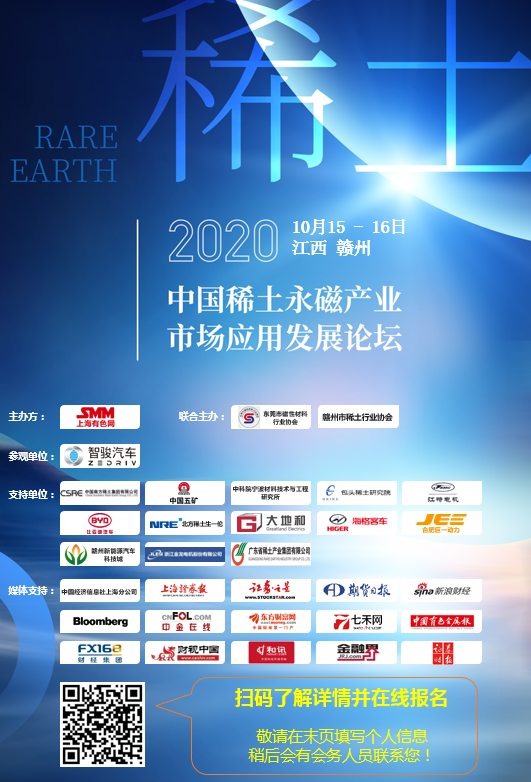
Please fill in your personal information on the last page and the meeting staff will contact you later!

Scan the QR code and apply to join the SMM rare earth industry exchange group
![Improved Trading Boosted Tungsten Market Volume and Price Rebound, Post-Market Still Needs to Focus on End-Use Demand Follow-Through [SMM Tungsten Daily Review]](https://imgqn.smm.cn/usercenter/aNMzb20251217171724.jpg)