SHANGHAI, Apr 2 (SMM) – The coronavirus crisis is providing Chinese manufacturers of electric vehicles and EV batteries with more time to brace for competition from foreign rivals, as factories outside China are shuttered and Beijing would extend subsidies for new energy vehicles to 2022.
The State Council, China’s cabinet, on Tuesday announced the two-year extension, among other measures, aimed at reviving its car market which has been hit hard by the pandemic outbreak and slumping demand. Originally, the subsidies were to be terminated at the end of this year.
In February, retail sales of passenger vehicles in China plummeted 78.5% year on year in February, while wholesale sales of new energy passenger vehicles tumbled 77.7%, according to data from the China Passenger Car Association (CPCA).
The government will also compensate for the replacement of diesel vehicles in major population centers like Beijing, Hebei and Tianjin and impose a 0.5% value-added-tax (VAT) waiver for used cars between May 1 to end of 2023.
Aside from efforts by the central government, local governments, including Foshan, Xiangtan, Guangzhou, Zhejiang, Nanchang and Chongqing, have already introduced a raft of measures to support the car market.
For the NEV sector, Tuesday’s announcement came after the Minister of Industry and Information Technology said January that China will not make significant cuts in subsidies for NEVs this year.
Those support measures can no doubt provide some relief to Chinese EV and battery makers, especially those on the verge of collapse following a significant cut to government subsidies and grants last year.
Meanwhile, foreign rivals, with advanced technology, may have to delay new EV model launch and slow their business expansion in the vast Chinese market, as their factories in Europe and the US have been shuttered with the pandemic raging on.
Chinese EV giant BYD is expected to launch its Han flagship sedan model, which will be equipped with the closely-watched Blade Battery, in June. The new model will lead the brand's Dynasty Family, boasting a cruising range of 605 kilometers and an acceleration of 0 to 100km/h in just 3.9 seconds, while the blade-shaped battery is said to solve the safety hazards associated with electric cars.
Other Chinese EV makers including NIO, Xiaopeng Motors and Weltmeister (WM Motor) will also launch new models in the second half of this year.
China’s EV sales look set to pick up in H2, on policy support, performance advances and launch of new models, and as the economy will recover from the pandemic and deployment of charging infrastructure accelerates.
Despite a temporary shutdown because of the pandemic, Tesla’s Shanghai Gigafactory reportedly did not miss its original plan for the first quarter. The factory currently has a production capacity of 3,000 units per week, and foundation buildout for the Phase 2 area has been completed.
The US EV maker cut the starting price of its Shanghai-built Model 3 sedans by 9% at the beginning of the year, and a further cut is expected in H2 as adoption of cobalt-free lithium-iron-phosphate (LFP) batteries and improved supply chain operations will bring costs down. That is expected to attract more buyers and help boost EV sales in China.
With the pandemic raging on and hitting global economy, Chinese consumers’ outlay on big-ticket items like cars is expected to remain subdued into at least the second quarter, trumping policy support and deterring EV sales from substantially picking up before H2.
Compared to individual buyers, taxi and ride-hailing are expected to remain the stronger driver of EV sales in China this year. In the first three quarters of 2019, EV sales in taxi and ride-hailing sector jumped 213% year on year, much stronger than a 35% increase in sales in individual buyers.
China wants all taxis on its roads to be electrified by 2023, with large cities such as Beijing, Shanghai and Guangdong aiming for a 2020 deadline.
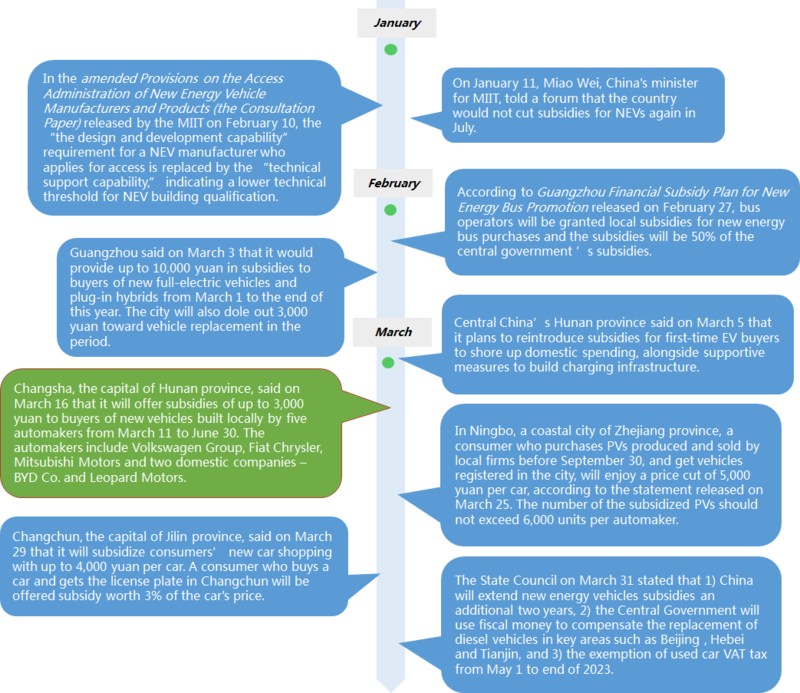
Timeline—China’s stimulus policies for the auto sector in 2020
![[SMM Новости нержавеющей стали] Индия продлевает антидемпинговое расследование в отношении холоднокатаного проката из нержавеющей стали из Китая, Индонезии и Вьетнама на 6 месяцев](https://imgqn.smm.cn/usercenter/CWsEw20251217171732.jpeg)
![[Анализ SMM] Сокращение производства в Индонезии и предпраздничная осторожность замедляют снижение цен на никельсодержащий чугун](https://imgqn.smm.cn/usercenter/Btmsv20251217171733.jpg)
![[Анализ SMM] Никелевые промежуточные продукты: спрос со стороны переработчиков не улучшается, цены расходятся](https://imgqn.smm.cn/usercenter/OjGlE20251217171734.jpg)