SMM2, Feb. 11: as of February 9, Shanghai copper closed at 51560 yuan / ton, down-3.66 percent from last Friday's close of 53520 yuan / ton.
What will happen to the day-to-day closing price on the first day of trading after the Spring Festival holiday, which will usher in China's New year holiday next week?
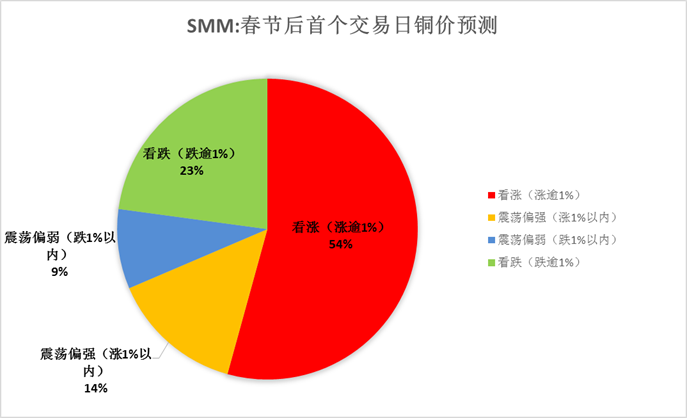
According to a SMM survey of domestic industry figures, 54 per cent of participants were short-term bullish on copper prices (up more than 1 per cent) on the first trading day after the Spring Festival holiday, compared with 51560 yuan a tonne on Feb. 9. Fourteen per cent of participants saw strong shocks (up less than 1 per cent); Nine per cent of participants saw the volatility weak (down less than 1 per cent) and 23 per cent saw copper prices fall (down more than 1 per cent).
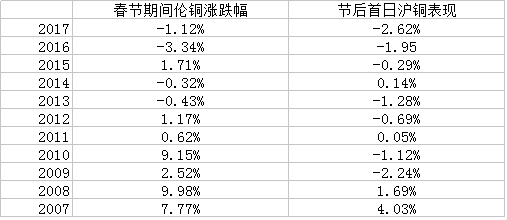
In previous years, copper prices rose and fell during the Lunar New year and on the first trading day after the Spring Festival in Shanghai.
SMM exclusive interview: outlook for Copper Price trend next week
Zhongda futures Jingchuan: it is expected that the inner plate of Shanghai copper will continue to adjust before the Spring Festival, after the Spring Festival may have the potential to pick up again; during the Spring Festival, the outer plate of LM copper may enter the trend of accumulation.
Everbright futures Xu Maili: recently, domestic and foreign financial markets have fluctuated violently, global stock markets have plummeted, crude oil has been hit hard, the US dollar has rebounded, and copper prices have also obviously declined. Despite the recent sharp increase in market volatility, we expect copper to be calmer during the Spring Festival. First, the downside risk of copper prices has been unleashed at the moment. It is mainly reflected in the release of financial market risk, the release of inventory increase risk and the release of crowded long position compensation risk. Second, overseas funds are also less likely to use the Spring Festival to boost copper prices sharply, mainly because of the turmoil in the surrounding market environment, which makes their operations more cautious. Therefore, we believe that copper price fluctuations may tend to be flat during the Spring Festival, but there is still some uncertainty, mainly due to financial market risks, changes in the price of crude oil in the United States dollar. After the festival, Shanghai copper trend is not light, whether speculative funds or physical enterprises will slowly return to the market, the supporting role of copper prices will be gradually reflected.
Zhong Yuan, a researcher on futures strategy at Anliang: copper changed its market structure to a positive market structure in November 2017, a month earlier than I expected, which means that the overall inventory cycle has entered the cumulative inventory phase. The general inventory accumulation will begin to reflect in the market after 1 or 3 months, which is very disadvantageous to the price. Futures trading data is true, which is the most effective for the market and price judgment.
Lu Zhen futures Liu Peng: in the short term, China's Spring Festival sentiment led to weak supply and demand, while LME copper stocks continued to soar, combined with the global stock bond panic caused by Japan's sell-off of US debt, which dragged down the copper price trend. In the face of the short blank period of basic supply and demand market information, the fluctuation of LME inventory and the sell-off of stocks and bonds will be the main factors affecting the trend of copper prices during the Spring Festival. It is important to note, however, that while prices or overall weakness are weak in the short term, the fundamentals of the copper industry have not changed much and there may not be much room for decline. Copper prices may now continue to fluctuate around the 51000-53000 range in early March, pushing up mood to return to work after the festival, or reviving demand, pushing copper prices higher again.
McCormick futures Deng Hong: the recent stock market plummeted, deleveraging led to corporate capital constraints, a short-term spiral decline, if not stopped in time, liquidity exhausted commodities will also be dragged down there is room for decline. However, the macroeconomic stability expectations of the major economies remain unchanged, the demand for non-ferrous metals as a whole remains stable, demand picks up in the peak season after the festival, the supply-side reduction is still expected, and it is estimated that there is little room for copper prices to fall and will still pick up gradually after the festival. In the short term, it was mainly dragged down by severe shocks in financial markets and remained weak.
Guotai Junan season first fly: copper prices below the support, after the Lunar New year or stabilised recovery. The sharp decline in the US stock market led to the decline in stock markets such as Europe, Japan and China, and market fears spread to commodity markets, and basic commodity prices were weak. However, from a macro point of view, the momentum of the US economic recovery has not changed, the eurozone economic growth forecast has been raised continuously, and China's economy has stabilized, which will form a support for basic commodity prices. Judging from the fundamentals of copper, copper production disturbances in Chile, Peru, and other South American countries, as well as China's scrap copper import policy, will affect the supply of copper in the future. after the Lunar New year, downstream enterprises will face the demand to replenish their warehouses during the peak consumption season. Copper prices are more likely to stabilise and pick up.
Soochow futures Zhang Huawei: copper prices fell sharply last week. Risk aversion was further heightened by the continued sharp decline in global stock markets last week. The Dow Jones Industrial average fell 5.21% last week after tumbling 4.12% the previous week. The Shanghai Composite Index fell nearly 10% in a week, its biggest since the fuse broke in early 2016, and the Shenzhen Composite Index fell into a bear market range. Investor risk aversion has risen and industrial products have suffered a sell-off. At the same time, the dollar index rose, crude oil fell sharply, and a sharp rise in global explicit inventories also contributed to the decline in copper prices. Since the 2008 financial crisis, the world's major economies have maintained low interest rates for a long time. while driving the global economic recovery, there has also been a bubble in the financial sector. One of the priorities of domestic economic work this year is financial deleveraging, and asset prices are under pressure. After the stock fell sharply in the past two weeks, the risk of forced liquidation of equity pledge loomed, the risk of the stock market has not been completely lifted, and market confidence is still insufficient. In addition, this year's local government debt reduction will also affect the level of infrastructure investment to the demand side of copper. In the United States, US stock markets have suffered as the market expects the US government to significantly increase fiscal spending and lead to a sharp increase in the federal deficit and soaring US bond interest rates. The market had already had full expectations of the Trump administration's tax cuts and infrastructure plans and had responded to asset prices. Copper prices have long benefited from expectations that US economic growth and increased infrastructure spending will drive demand for copper since the end of 2016, while concerns about the future direction of the US economy have risen as the stock market has plummeted. Copper prices are under pressure for a further correction. Recent data show that the global economy is still recovering strongly, but the short-term shocks and spillover effects of the stock market crash are still not over. At the same time, the off-season domestic consumption tired of inventory stage, in the context of rising risk in the peripheral market, the probability of a strong rebound in copper prices is small. It is suggested that copper bulls reduce their positions and avoid risks before the festival, waiting for the market to stabilise and re-intervene.
Shanjin Financial Control Luo Liang: next week's macro data need to focus on the February CPI data in the United States, which will be one of the key indicators of whether to raise interest rates in March. At the same time, the announced EIA inventory will also have a significant impact on crude oil prices. Recently, the US dollar index has rebounded, and the decline in crude oil prices has put relatively great downward pressure on commodity prices. coupled with the sharp drop in global stocks and the short financial atmosphere, due to the short domestic trading time before the Spring Festival, physical enterprises have basically suspended production. Copper prices are expected to be weak and volatile. During the Spring Festival, domestic trading is suspended, China's external logistics is restricted, the recent centralized delivery will be alleviated, lme copper prices are expected to bottom consolidation. After the Spring Festival, although domestic enterprises gradually start work, but still need to pay attention to the impact of the overall macro environment.
Guoyuan futures Wang Jiajun: overall bearish copper, this Shanghai copper adjustment may not end until around 48500 yuan / ton; the trend of foreign copper will also be weak, or will be adjusted to $6600 / ton.
SMM exclusive prediction
Next week focus on the year-on-year core CPI in the United States in January and the initial year-on-year GDP in the eurozone in the fourth quarter. Zhou Nailun copper fell, LME copper stocks increased by another 25000 tons on Thursday, off-season accumulation of pressure highlighted; the day's position increased by more than 6, 000 hands, short took the opportunity to come into pressure. From the disk point of view, the current Lun copper has fallen below all EMA support, the bottom or look to the previous platform position of $6650 / ton. As trading in the Chinese market will stop next Thursday, the dollar index is stuck in a range of 90 to 91, concerned about whether Luncun can return to its 60-day moving average, and next week may precede $6,730 by a wide shock, and during the Spring Festival holiday, it will be concerned about whether external bears will continue to exert their power. Luncun is expected to continue to fluctuate at low levels, waiting for a return to trend.
Domestically, there are only three trading days next week and face nearly two weeks of Spring Festival holidays. According to SMM research, downstream consumption in January is still steadily improving, but as the Spring Festival approaches, domestic consumption will enter a one-year freezing point. because of the late Chinese New year this year, coming back after the festival is about to gradually enter the consumption peak season, so in the medium term, consumer support is still the same. It's just that in the short term, it's not clear what's going on before the festival. On the supply side, the labor contract at the mine end and the shortage of waste copper may continue to ferment after the festival, and the pattern of near-space and far-off will remain unchanged. This week, short positions increased in large numbers, mainly by 50, 000 hands, and the inventory in the previous period increased by more than 10, 000 tons. it is expected that the risk volatility of Shanghai copper before the festival will still be relatively large, low or will sink again, with a low of 50900 yuan to 52200 yuan per ton, but the final trading cycle. The short may leave the market at a profit, and it will be safe to fall into the bag. When he returns from the festival, he waits for Luncun's guidance.
On the spot side, New Year's Eve will be ushered in next Thursday. today's market has gradually shown the Spring Festival atmosphere. next week, downstream processing has basically ended production and procurement, and traders' trade has gradually come to an end. there are only a small number of market participants, and the willingness to ship goods has weakened. Logistics restrictions limit market buyers to trade speculators, if the discount expands greatly, or can attract the bold cross-year speculation of individual traders, but the market is more valuable but not market state. Material spot quotation will be 250 ≤ 150 yuan / ton.
Macroscopic interpretation
China
China's data, released this week for the first month in 18 years, show that the economy is off to a good start. With the steady rise of PMI in China's Caixin service industry, the manufacturing industry needs to pay attention to the stability of the demand side, while the service industry needs to pay attention to the impact of rising input costs on the profitability of enterprises.
China's foreign exchange reserves are generally stable, mainly non-US dollar currency appreciation and asset price changes and other factors work together, the scale of foreign exchange reserves rose slightly. On the other hand, China's trade surplus shrank by more than 50 percent, imports exceeded expectations, and the overall data performed well, mainly affected by the appreciation of the renminbi, the Chinese Spring Festival, and the recovery in global demand. The weaker data are largely constrained by uncertainty about the prospects for a global economic recovery and by the possibility that international trade and investment behaviour will become more cautious as international financial markets fluctuate.
China's PPI and CPI show that the overall trend of CPI and PPI is consistent, but also basically in line with expectations, inflation is stable at the beginning of the year, the probability of a mild upward increase in the whole year. Historically, with CPI no more than 2.5 per cent compared with the same period a year earlier, central banks will not tighten money because of inflationary pressures.
America
The dollar rebounded sharply this week, with the index rising as low as 89.02 to 90.56, up about 150 points. Against the backdrop of the Fed's accelerated rate rise, the dollar has performed strongly and all non-US currencies have come under pressure. The US index rebounded strongly this week, thanks mainly to the prospect of an accelerated rate rise by the Fed.
The outlook for the U. S. economy is strong, and the Fed is expected to raise interest rates three to four times this year. Analysts believe the economy will gain momentum this year and that the Fed will raise interest rates three or perhaps four times by the end of the year. Economists expect the Fed to raise interest rates at its next meeting on March 20-21 and again on June 12-13.
Moreover, this week's collapse in US stocks will not disrupt the Fed's plans to raise interest rates. The plunge in US stocks on Monday strained investors' nerves, but analysts said it was not enough to change the Fed's plans to continue raising interest rates in 2018 as the economy continued to function smoothly.
At a time when the United States and many economies are on track for simultaneous growth, the collective plunge in global stock markets has caused the market capitalization to shrink by $4 trillion from the record high reached eight days ago, raising concerns. Such a rapid loss of wealth could affect business investment and consumer spending.
For the recent stock market earthquake, most of the view is that this is more of a long-term bull market adjustment, there is no significant bear market characteristics or even the risk of capital market crisis. Analysts point out that unless the market falls sharply and hurts the economy, Fed policymakers are unlikely to change their plans to raise interest rates three times this year.
The reason is, on the one hand, the current global macro-economy is still good, the United States, the euro zone, China and other major economies are doing well, the fundamentals have not changed significantly; On the other hand, with the accelerated recovery of the world economy, corporate earnings have improved significantly, providing strong support for the long-term improvement of the stock market.
Kansas City Fed Chairman John George reiterated his position on Thursday to raise interest rates three times this year. Dudley, chairman of the New York Fed, even said it was not impossible to raise interest rates four times if the economic outlook improved further.
"I don't think what we're seeing will change their view of the path of interest rate hikes," said Daragh Maher, head of US currency strategy at HSBC Securities USA in New York. "Financial market conditions are part of the consideration," said Kristina Hooper, a strategist. "I haven't seen anything that would prompt the Fed to change its position at the moment."
Trump signed the bill to increase pressure on the Fed to raise interest rates. The U. S. economy has already benefited from tax cuts, and President Trump signed another agreement on Friday that will generate nearly $300 billion in spending, meaning the Fed will come under increasing pressure to speed up its rate hikes.
Mark Zandi, chief economist at Moody's, believes the new budget deal will boost growth by up to 0.4 percentage points in 2018, saying it is time for the economy to work at its limits.
In a report to clients on Friday, JPMorgan raised its growth forecast for the US economy to 2.6 per cent this year from 2.2 per cent and 1.9 per cent next year from 1.6 per cent.
Europe
The euro zone this week focused on the political situation in Germany, but the German cabinet reached a preliminary agreement, but this has limited support for the euro. Germany's political leaders made a breakthrough this week in negotiations to form a new coalition government.
According to media reports, German Chancellor Angela Merkel's coalition party and Schultz's Social Democratic Party (SPD) have reached an agreement. Under the deal, Merkel's CDU will reportedly get the posts of economy minister and defense minister, while the SPD will get the post of finance minister. Ms Merkel's victory last September was described by many as a "tragic victory". For although the veteran of politics was re-elected, it was the worst election since she led the CDU, and the right-wing nationalist party became part of the German establishment for the first time. As soon as the news came out that Germany had reached an agreement on the formation of a cabinet, the market expected that a new German government would soon be formed. Political uncertainty has fallen, which is good for the euro, but it has received little support because of a strong dollar.
Italy's general election could become a black swan under pressure on the euro. Polls may underestimate the chances that the right-wing coalition backed by former Prime Minister Silvio Berlusconi will win a majority in Italy's general election on March 4. This week, the centre-right coalition, led by Silvio Berlusconi's Italian Power Party and conservative parties such as the Northern Alliance, won a key local election. So far, analysts expect suspended parliament and a grand coalition government to be the two most likely outcomes. Bloomberg's January poll average showed 37 per cent of the vote for Italy's centre-right, 27 per cent for the centre-left and 27.7 per cent for the five-star movement.
If there is an accident in Italy's general election next March, the euro is likely to come under greater pressure. Investors need to keep a close eye on the latest developments in the news.
British side
Markets remain concerned about Brexit talks. On Friday, the chief representative of the EU's Brexit negotiations, Barnier, pointed out that there are substantive differences in the transition period and that if the differences continue, there will be no transition agreement.
Barnier, chief representative of the EU Brexit negotiations, also said that some of Britain's positions are not very clear to me, and some of the elements of the transition period are non-negotiable because they involve the core rules of the single market. During the Brexit transition period, the UK must accept any new EU rules; the EU does not have the will to punish the UK during the Brexit transition period.
The hawkish tone of the Bank of England this week is likely to support the pound's medium-term rise. The Bank of England this week released its first interest rate resolution for 2018, keeping the benchmark interest rate unchanged at 0.50 per cent, while maintaining £435 billion in asset purchases and £10 billion in corporate bond purchases, in line with market expectations. But the Bank of England said in a statement that interest rates may need to be raised in advance because the economy is growing faster than expected.
Market participants rekindled hawkish signals from the Bank of England's language, in which the Bank of England raised its growth forecast and said the committee believed the economy was broadly in line with the February inflation report and that monetary policy needed to tighten earlier. In order for inflation to continue to return to its target, interest rates may rise earlier than expected in November.
Crude oil market
The crude oil market fell sharply this week, with US crude oil prices tumbling nearly 10 per cent to close below the $60 mark. Oil prices tumbled this week mainly because of growing concerns about a surge in US production, coupled with a stronger dollar and a sharp fall in US stocks, which reversed their previous daily gains and fell this week.
A sharp increase in production in the United States is a major factor in putting pressure on oil prices
The Baker Hughes rig increased the number of rigs by 26, and the United States is expected to increase production strongly. The number of U. S. oil rigs rose 26 to 791, the highest level since April 2015, according to data released by Baker Hughes.
The Energy Information Administration (EIA) reported this week that U.S. crude inventories rose 1.9 million barrels in the week to Feb. 2, but the American Petroleum Institute API reported on Tuesday that U.S. crude fell 1.1 million barrels last week. Meanwhile, U.S. crude oil reserves rose for the second week in a row.
In addition, EIA reported Wednesday that U.S. crude oil production rose 332000 barrels last week to a total of 10.251 million barrels a day. This is the EIA's highest level since 1983, when it reported data on U. S. crude oil production.
Analysts said the United States produced an average of 10.2 million barrels of crude oil on Sunday, overtaking Saudi Arabia as the world's second-largest oil producer after Russia. Analysts still expect U. S. crude oil production to soar, just as "all hibernating bears wake up."
"it now appears that oil prices in late January are clearly too high to maintain a long-term balance in the crude oil market," Commerzbank's commodities analysis team said in a research paper. This is because of the extremely rapid increase in crude oil production in the United States, and if OPEC does not voluntarily give up some market share, the crude oil market will once again be oversupplied. "
Next, the market may speculate on when OPEC will withdraw from the production cut.
OPEC's plan to cut production has continued to support higher oil prices. But expectations that OPEC will continue to cut production have recently fallen, and investors are beginning to worry that OPEC may start thinking about when to exit the cut and that OPEC will increase production again, which is bad for oil prices.
John Kilduff, founder of the energy hedge fund, said there was growing concern that OPEC's agreements to cut production with Russia and other major oil producers could come under pressure as US production rose.
The head of Gazprom, the Russian energy giant, said on Friday that producers could adjust their production cuts by next quarter. They hope that oil-producing countries will agree to increase production because the market has reached a balance after years of oversupply.
"We are committed to increasing crude oil production by 700000 barrels per day to 4.7 million barrels per day over the next three to four years," Iranian Deputy Oil Minister Zamaniya said at a meeting in Paris on Thursday. Such a plan is cautious rather than ambitious. "
Iran's deputy oil chief added that if the country could reach cooperative development agreements with overseas energy companies on four oil fields in the country, crude oil production could even increase by up to 1 million barrels a day. Angola and Nigeria, on the other hand, are also likely to reasonably increase crude oil supplies by 430000 barrels per day in 2018.
Speculative long positions in crude Oil overcrowded to accelerate Oil Price decline
Net long positions in crude oil futures contracts also hit record highs, suggesting that many speculators remain optimistic about oil prices. And when these speculators are optimistic about the future of oil prices, the decline in oil prices is not far off.
The number of long positions has risen in recent months, while short positions have fallen sharply, creating opportunities for long profit-taking. Because speculators already have long positions, no one is going to be long on oil prices anymore. once oil prices fall, long closing is bound to lead to a long stampede.
Traders are hardly optimistic about the future of oil prices. John Kilduff, founding partner of the energy hedge fund, said the decline in crude oil prices would continue, with US crude prices likely to fall below $58 a barrel. Increased production, a stronger dollar and a massive sell-off in financial assets have weighed on the market.

![Supply-Demand Structural Tightening, the Most-Traded BC Copper Contract Has Bottom Support [SMM BC Copper Commentary]](https://imgqn.smm.cn/usercenter/qcyEh20251217171709.jpg)