Our previous piece ran on 20th August. At that point the Commission had 11 days left against its own statutory deadline and nothing had appeared in the Official Journal.
The rules are now out. Commission Implementing Regulation (EU) 2026/1963 was adopted on 31st August, unanimously backed by Member States on 19th August — landing precisely on the legal deadline.
From 1st October, every consignment of stainless entering the EU must state where the steel was melted and which heat it came from.
I. Two fields, and neither is optional
Importers must declare the country of melt and pour on the customs declaration and substantiate it.
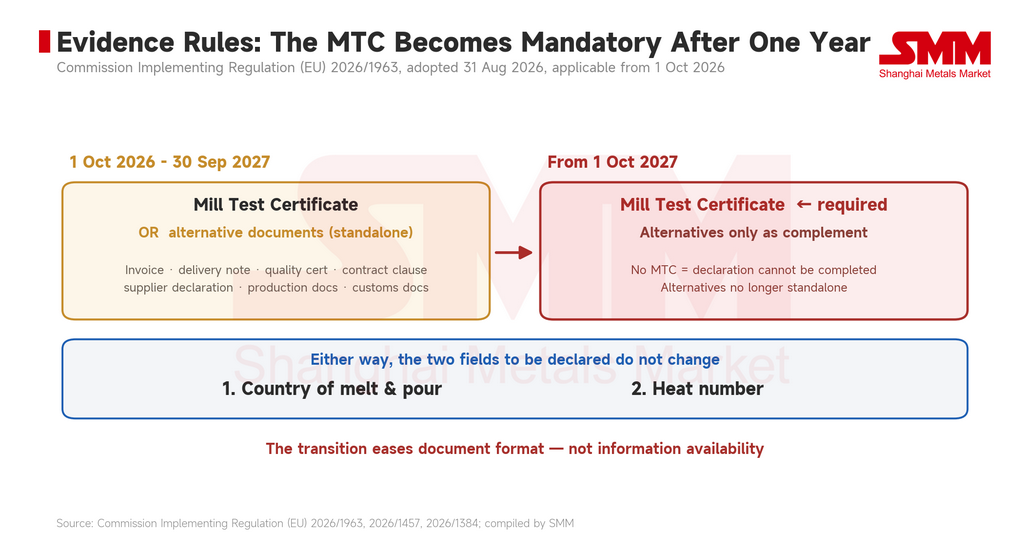
The primary evidence is the Mill Test Certificate (MTC), which must carry both the country of melt and pour and the heat number.
Where the MTC lacks either field, or cannot be produced at all, customs may accept the following as complementary or standalone evidence, provided they convey the same two data points: invoices, delivery notes, quality certificates, clauses in implemented purchase orders or contracts, long-term supplier declarations, cost accounting and production documents, customs documents from the exporting country, commercial correspondence, and production descriptions.
The list is long; the threshold is single. Can you name the melt country and the heat? Document format is flexible. The information is not.
The Commission states the act was shaped by feedback from nearly 170 stakeholders in a targeted consultation, with the aim of achieving traceability without imposing unnecessary compliance burden.
II. A one-year transition that eases paperwork, not data availability
Until 30th September 2027, the alternative documents may serve as standalone evidence. A shipment with no MTC at all can still clear on a combination of invoices, supplier declarations and production records.
From 1st October 2027, those documents are accepted only as a complement to the MTC — never on their own.
What the year relieves is the question of what to do without an MTC. It does not relieve the question of where the melt country and heat number come from. Those two fields are unchanged throughout.
For stainless exporters, this year is for opening up upstream supply relationships. It is not a year to wait out.
III. The heat number is the real difficulty — and stainless has it worse
Country of melt is straightforward for anyone with integrated crude stainless capacity. You melted it; the country is fixed.
The heat number is the hard part, and stainless is harder than carbon steel.
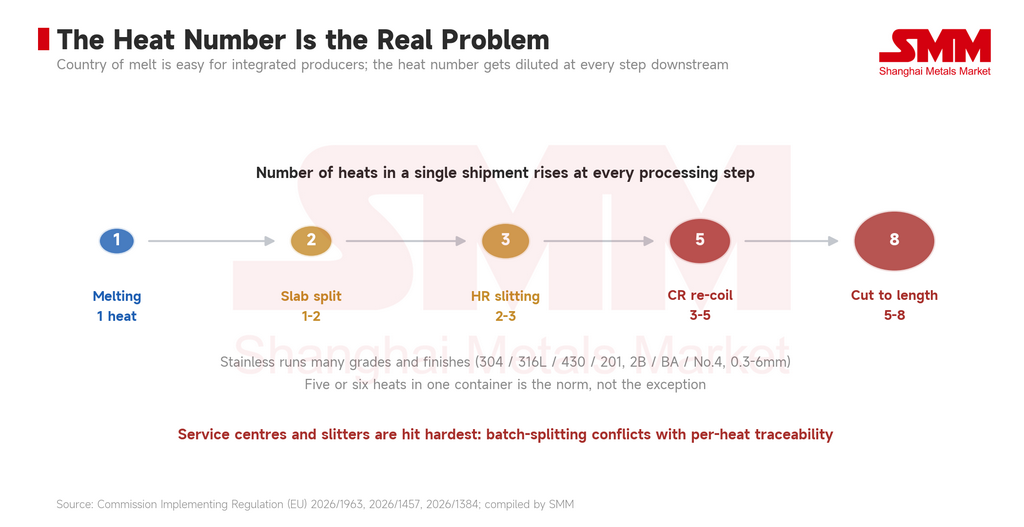
A heat number identifies one furnace charge. It exists natively at the mill, but it gets diluted at every step downstream: slab splitting, hot-rolled slitting, cold-rolled re-coiling, narrow-strip slitting, cut-to-length. Stainless compounds this with grade and finish proliferation — 304, 316L, 430, 201; 2B, BA, No. 4; thicknesses from 0.3mm to 6mm. A single order is routinely assembled from several heats.
Five or six heats in one container is the norm in stainless trade, not the exception.
From 1st October, each of those heats must map back to an upstream melting record. That is a ledger problem, not a paperwork problem.
Processing and slitting operations are most exposed. Their business model — break down large coils, combine multiple sources into one order — sits in direct tension with per-heat traceability.
IV. Four groups, sorted by two variables
Layering the melt-and-pour rules onto the country quota allocation, exporters divide along two axes: whether they have domestic crude stainless melting capacity, and whether their quota runs on the MFN single track or the FTA dual track.
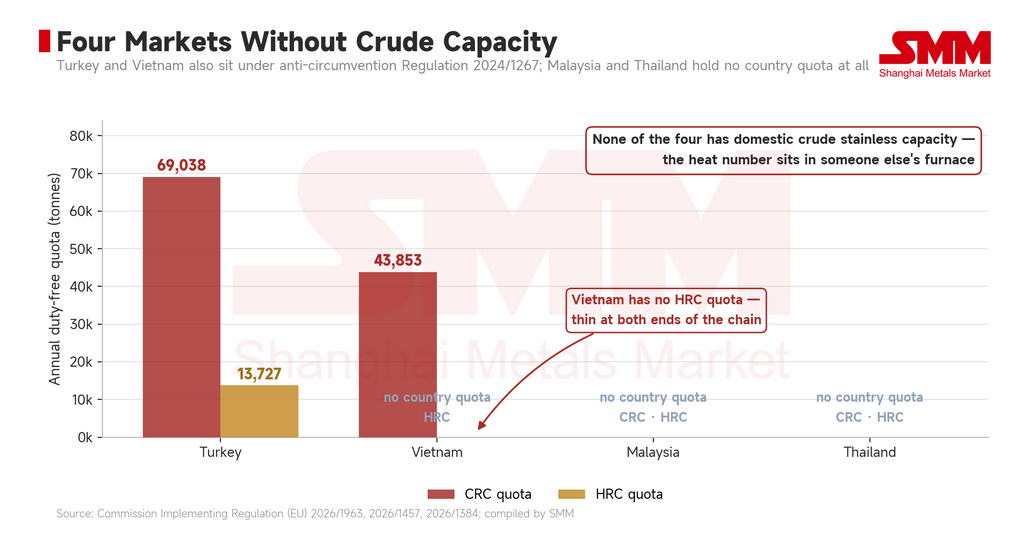
Group one: no domestic crude capacity — Turkey, Vietnam, Malaysia, Thailand
The heaviest evidence burden sits here.
Turkey holds 69,038 mt of CRC quota and Vietnam 43,853 mt — neither figure is small. Malaysia and Thailand hold no country-specific CRC allocation and draw on the residual pool.
What unites the four is the absence of domestic crude stainless melting capacity. The heat number is not in their hands; it is in a supplier's furnace.
The transition permits alternative documents, but those documents must still carry the heat number. If the upstream mill will not provide it, the alternatives cannot be produced either.
Vietnam warrants a separate note: it holds CRC quota but has no country-specific HRC allocation. Its route — importing Indonesian hot-rolled coil, cold-rolling it, exporting to the EU — has quota cover only at the finished end. Should melt origin become the basis for attribution, the quota foundation under that route is very thin.
Turkey and Vietnam carry one further layer. The EU's 19.3% anti-dumping and 20.5% countervailing duties on Indonesian stainless CRC were extended to Taiwan (Province of China), Turkey and Vietnam under anti-circumvention Regulation 2024/1267. All three already sit inside an anti-circumvention perimeter; melt-and-pour adds a documentation gate on top of duties already in force.
Malaysia is the clearest case. Local exports to Europe are pure cold-rolling; hot-rolled coil and slab are entirely bought in. Where the upstream furnace sits depends on whether the current purchase came from Indonesia, Taiwan (POC) or South Korea. Melt origin is not a fixed answer here — it is a variable to be re-established shipment by shipment.
Turkey is already responding. Nikel Paslanmaz announced investment exceeding $150 million this year in an integrated stainless long-product plant and a cold-rolling mill, commissioning staged across 2027 and 2028. Turkey imports roughly 700,000 mt of stainless annually; the strategic case for domestic integration tracks the melt-and-pour timetable closely.
Group two: crude capacity, but MFN track in both categories — China mainland and Taiwan (POC)
Taiwan (POC) holds 52,985 mt of CRC quota, third in the category; the China mainland holds 40,431 mt. Both have domestic crude stainless melting capability. MTCs are available and heat numbers sit in their own production records.
Their 1st October challenge is process redesign, not document procurement: building the ledger that maps heat numbers to export consignments. Substantial work, but the path is clear.
The binding constraint is quota structure — and it applies across both categories. Taiwan (POC) holds 52,985 mt CRC and 19,984 mt HRC; the China mainland holds 40,431 mt CRC and 9,515 mt HRC. All four allocations sit entirely on the MFN track with zero FTA component, and under Annex II Section 3 neither may draw on residual quota. Once the country-specific allocation is exhausted, exporters face the 50% duty with no cushion.
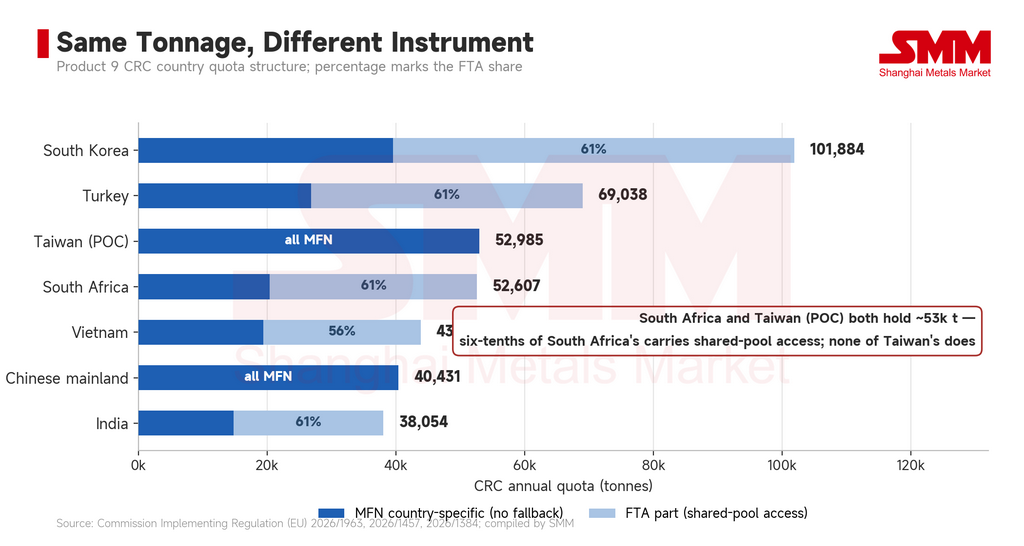
South Korea makes the contrast plain. Of its 101,884 mt CRC allocation, 39,565 mt is MFN and 62,319 mt is FTA — six-tenths of the volume carries shared-pool access, so exhausting the country quota does not end the route. Taiwan (POC)'s 52,985 mt is entirely MFN. Not one tonne of cushion.
The gap is not merely two-to-one on volume. Structurally these are two different instruments: one is a pass with a fallback, the other a one-way ticket.
Taiwan (POC) carries an additional circumstance. As a subject of the 2024 anti-circumvention proceedings, eight stainless producers secured exemptions but must continue demonstrating they have not materially increased purchases of Indonesian-sourced material. EUROFER subsequently challenged those exemption decisions in two cases (T-390/24, T-391/24), still pending. Melt-and-pour shifts the evidentiary granularity from annual compliance review to every single customs entry.
Group three: favourable on both variables — South Korea, India, South Africa
South Korea's 101,884 mt CRC allocation is the largest in the field, six-tenths of it on the FTA track. With domestic crude stainless capacity, melt-and-pour poses no new obstacle. Its 20,735 mt HRC allocation includes 12,166 mt of FTA component — again with a cushion.
India's strength is in stainless long products and tube: bars at 92,557 mt, wire rod at 18,772 mt, seamless pipe at 15,329 mt, all first by a wide margin. CRC at 38,054 mt is unremarkable, but 23,276 mt of it — over 60% — sits on the FTA track. HRC at 26,019 mt ranks second. MTCs and heat numbers are internal to its own system.
South Africa holds 52,607 mt of CRC quota, close to Taiwan (POC)'s figure — but 32,178 mt of it is FTA. Same headline number in the low 50,000s; six-tenths of South Africa's carries shared-pool access, and none of Taiwan (POC)'s does. The same figure, two entirely different positions.
What these three share: the rule tightens someone else's channel, and their relative share rises accordingly.
Group four: Indonesia — not the beneficiary, but where the risk converges
Start with a figure that invites misreading.
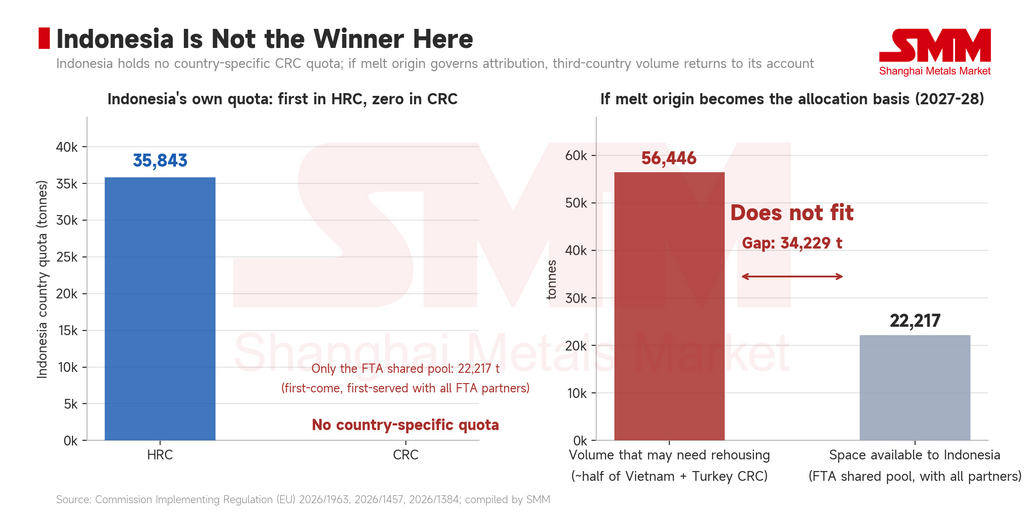
Indonesia holds the largest country allocation in hot-rolled stainless at 35,843 mt, ahead of India, South Korea and Taiwan (POC). On that number alone it looks like the winner on this list.
Open the cold-rolled category, and Indonesia holds no country-specific quota at all. The CRC country list runs South Korea 101,884 mt, Turkey 69,038 mt, Taiwan (POC) 52,985 mt, South Africa 52,607 mt, Vietnam 43,853 mt, China mainland 40,431 mt, India 38,054 mt. Indonesia is absent. It can access only the FTA shared pool — 22,217 mt, first-come first-served across all FTA partners — or the MFN residual pool.
At present this is not a problem, because melt-and-pour is only a declaration duty and quota attribution still follows customs origin. Indonesian melt rolled into cold-rolled coil in Vietnam draws on Vietnam's 43,853 mt, not on Indonesia's account.
The problem is the next step.
From 1st October 2027, melt-and-pour data feeds into country quota allocation. By 30th June 2028, the Commission must assess whether melt origin should become the basis for quota eligibility.
If that step completes, the books get restated: Indonesian-origin cold-rolled coil currently booked against Vietnam and Turkey returns to Indonesia's account. And Indonesia has no country-specific CRC quota to absorb it.
A rough calculation on current figures. Vietnam's 43,853 mt plus Turkey's 69,038 mt totals 112,891 mt, before adding Malaysian and Thai volumes drawn from the residual pool. Indonesian-sourced feedstock accounts for a meaningful share of both markets' European exports — take even half, and over 50,000 mt needs rehousing. Indonesia's FTA shared pool totals 22,217 mt, shared with every FTA partner.
It does not fit.
And what does not fit lands on Indonesian order books.
If Indonesian melt has insufficient quota cover in the EU, processors in Vietnam, Turkey and Malaysia will recalculate before buying Indonesian slab and hot-rolled coil: can this material still enter Europe once rolled? Whose quota does it draw on? What happens when that quota runs out?
When the answer is uncertain, the rational move is to switch feedstock. These processors are significant buyers of Indonesian stainless semi-finished product — and any Europe-bound share that shifts to Taiwanese (POC) or Korean material reduces Indonesian mill orders.
The transmission chain runs:
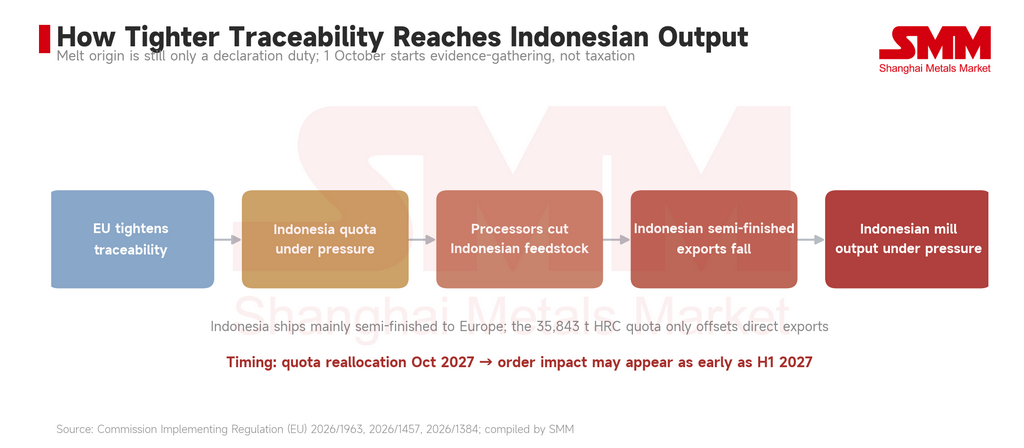
EU tightens traceability → Indonesian quota comes under pressure → third-country processors reduce Indonesian feedstock purchases → Indonesian semi-finished export demand falls → Indonesian production schedules come under pressure.
Indonesia has not gained a route here. It has been assigned the quota risk of the entire chain.
Can the 35,843 mt HRC allocation offset this?
Only partially. It offsets direct finished-product exports, while Indonesia's flow to Europe is predominantly semi-finished — slab and hot-rolled coil sold to third-country processors, with a low share of finished product exported directly. The HRC quota is ample, but activating that channel requires Indonesian mills to build direct European customer relationships, develop CBAM reporting capability, and resolve logistics and lead times. None of that is a one- or two-quarter fix.
In the near term the more likely position is: the direct channel underused, the indirect channel compressed.
Timing is the key variable
None of this materialises in October 2026. At this stage melt-and-pour is a transparency obligation, quota still follows customs origin, and existing trade routes continue to function.
But from 1st October, every consignment of Indonesian-origin steel entering the EU via a third country has its melt origin recorded. That dataset is precisely what the Commission will use when it adjusts quota allocation in October 2027 and assesses whether to switch the allocation basis in 2028.
1st October starts evidence-gathering, not taxation.
For Indonesian mills the date to track is October 2027. If that allocation round begins adjusting Vietnamese and Turkish volumes on melt-origin data, the market will react one to two quarters ahead. The order-book impact could surface in the first half of 2027.
V. The stainless quota calendar keeps moving
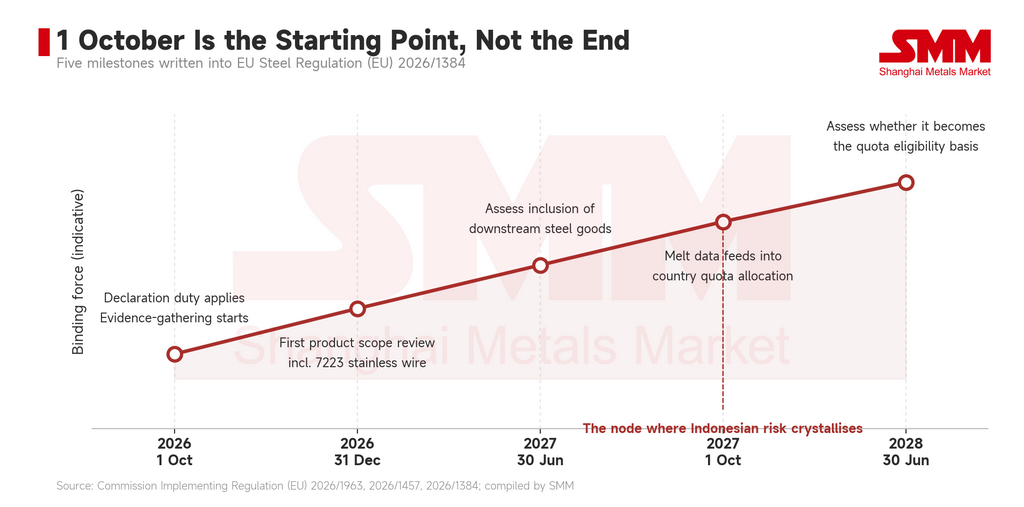
1st October is the starting point, not the end.
Under EU Steel Regulation (EU) 2026/1384: the first product scope review completes by 31st December 2026, with stainless wire under HS 7223 on the consultation list; by 30th June 2027 the Commission assesses whether to bring in downstream goods containing significant steel content; from 1st October 2027 melt-and-pour data feeds into country quota allocation; and by 30th June 2028 the Commission must assess whether melt origin becomes the basis for quota eligibility.
One further provision bears directly on quota. Carryover of unused quota is permitted in the first yearly period (1st July 2026 – 30th June 2027). After year one, the Commission decides by implementing act whether carryover continues, weighing import pressure, average quota utilisation — particularly where above 80% — and supply availability.
This one is worth watching for stainless. With CRC cut 53% and HRC cut 65%, utilisation will very likely run above the 80% threshold. Whether carryover survives year one will directly determine available headroom in the second half of 2027.
Outlook
The previous piece asked where the rules were. The answer: on the last possible day.
For stainless exporters the waiting is over and the preparation window is four weeks. The list is short, but every item starts now.
Confirm whether upstream suppliers will issue MTCs carrying both melt country and heat number. Where they will not, assemble the alternative document set. And begin building the heat-number-to-consignment ledger — because after October 2027, the MTC is no longer optional.
A one-year transition sounds generous. What it grants is time to fix documents, not time to fix process.
For a product with inherently high batch fragmentation, the process work starts now.
![[SMM Notícias Rápidas sobre Níquel] Atualização Diária — 2 de setembro de 2026](https://imgqn.smm.cn/usercenter/qLeLR20251217171733.jpg)