No primeiro trimestre de 2026, as remessas globais de sistemas de armazenamento de energia atingiram 100,0 GWh, um aumento de 96,5% em relação aos 50,9 GWh do mesmo período de 2025, elevando as remessas trimestrais a uma escala inteiramente nova. O panorama competitivo do setor passou por mudanças fundamentais. No 1T de 2026, as empresas chinesas enviaram 82,2 GWh globalmente, com sua participação global saltando de 62,7% no 1T de 2025 para 82,2%, um ganho de 19,5 pontos percentuais. Os integradores estrangeiros viram suas remessas cair de 19,0 GWh para 17,8 GWh, e sua participação encolheu de 37,3% para 17,8%. As empresas chinesas já não se limitam à fase de fornecimento de equipamentos; elas entraram amplamente no espaço de integração de sistemas na Europa, Ásia-Pacífico, Oriente Médio e África, competindo diretamente com integradores estrangeiros estabelecidos. A tendência clara é que a influência do setor está se concentrando nas mãos das empresas chinesas.
As remessas no mercado doméstico no 1T atingiram 37,4 GWh, representando 37,4% das remessas globais, apenas um leve aumento em relação aos 35,8% do 1T de 2025. A ausência de um salto expressivo na participação doméstica é atribuível principalmente a três razões. Primeiro, a carteira de pedidos entregue no 1T era dominada por projetos contratados em 2025 ou antes; um grande número de projetos já havia sido conectado à rede e entregue até o final do 4T de 2025, de modo que o 1T entrou em uma pausa sazonal, com clara defasagem sazonal. Segundo, no 1T, as fabricantes de células já enfrentavam a primeira rodada de alta nos preços das matérias-primas. Os preços spot do carbonato de lítio se recuperaram fortemente de seu piso no 4T de 2025, e os preços das células LFP 314Ah mainstream subiram de RMB 0,26-0,31/Wh no final de 2025 para RMB 0,35/Wh. Diante da forte alta das matérias-primas, os fabricantes domésticos de células aceleraram os esforços para estabelecer mecanismos de indexação de preços com integradores e proprietários de projetos a jusante, utilizando o preço do carbonato de lítio como referência para fórmulas de reajuste. No entanto, a transmissão de preços leva tempo, causando alguns atrasos nos cronogramas de entrega. Terceiro, os projetos no exterior oferecem margens mais altas; as taxas internas de retorno dos projetos no exterior são geralmente superiores às dos projetos domésticos. Dada a capacidade produtiva limitada, as empresas domésticas de células e integração têm uma clara preferência estratégica por priorizar entregas a clientes estrangeiros de maior margem. Enquanto isso, os proprietários de projetos domésticos tendem a aguardar janelas de preços mais favoráveis. Múltiplos fatores combinados fazem com que o pico da temporada de entregas de células e sistemas integrados no mercado doméstico esteja historicamente concentrado no segundo semestre do ano, deixando a participação doméstica no 1º trimestre relativamente baixa.
O mercado europeu registrou um crescimento explosivo no 1º trimestre, com os embarques regionais saltando de 4,3 GWh no 1º trimestre de 2025 para 22,4 GWh, um aumento de 421% em relação ao ano anterior, e sua participação global subindo de 8,4% para 22,4%, um ganho de 14,0 pontos percentuais. Os embarques europeus de armazenamento em escala de utilidade estão em transição de projetos predominantemente na escala de centenas de MWh para projetos na escala de GWh. O armazenamento co-localizado está sendo implantado mais rapidamente em mercados como Alemanha, Reino Unido e Bulgária. Entre os mercados europeus emergentes, os Países Baixos se destacam: a eliminação das políticas de compensação de energia está forçando os usuários existentes de energia fotovoltaica a adicionar armazenamento, e os preços negativos de eletricidade ultrapassaram 500 horas em 2025, melhorando significativamente a viabilidade econômica da implantação de armazenamento. A Bulgária, com fortes políticas de subsídios, um sólido pipeline de projetos e uma economia de projetos atrativa, agora está classificada ao lado da Alemanha e do Reino Unido como um dos mercados de investimento em co-localização mais atrativos; a capacidade fotovoltaica co-localizada no país já representa mais de 40% do total de instalações fotovoltaicas. O armazenamento residencial também contribuiu com volumes incrementais acima do esperado. As tensões geopolíticas contínuas continuam impulsionando uma forte demanda dos usuários finais por autonomia elétrica, e com os preços da eletricidade permanecendo elevados, a demanda de compra de armazenamento doméstico foi liberada de forma intensa. O mercado do Reino Unido registrou um benefício político concentrado no 1º trimestre: a partir de 2026, novas edificações deverão instalar sistemas fotovoltaicos, e o "Warm Homes Plan" disponibiliza 15 bilhões de libras para apoiar o desenvolvimento de energia fotovoltaica, armazenamento e bombas de calor. Na escala de utilidade, o impacto do ajuste na restituição do imposto de exportação é relativamente limitado – a taxa de restituição para exportações de armazenamento em escala de utilidade já era baixa, e a carga tributária incremental nos níveis de célula e sistema representa uma pequena parcela do custo total. Portanto, o ajuste na restituição não afetou materialmente a demanda europeia de armazenamento em escala de utilidade. O mais importante é que os retornos dos projetos na Europa ampliaram significativamente no 1º trimestre, impulsionados por duas dimensões principais: primeiro, os spreads de preço de energia intradiários se ampliaram ainda mais, com períodos de preços negativos mais frequentes criando maiores oportunidades de arbitragem para o armazenamento; a estrutura de receita do armazenamento europeu evoluiu de simples arbitragem para um modelo de "arbitragem + serviços ancilares + contrato de capacidade", alterando fundamentalmente a lógica de retorno do investimento. Em segundo lugar, as receitas de serviços auxiliares também aumentaram – em mercados maduros como o Reino Unido, serviços auxiliares negociáveis, como resposta em frequência e capacidade de reserva, tornaram-se mais sistemáticos. A melhoria substancial na viabilidade económica tornou-se o fator fundamental por trás da disposição dos desenvolvedores em realizar encomendas.
Os mercados emergentes, liderados pela Índia, mantiveram uma forte tendência de crescimento incremental no 1.º trimestre. Os envios na região Ásia-Pacífico aumentaram de 2,8 GWh no 1.º trimestre de 2025 para 6,2 GWh, um aumento de 121%; os envios na região do Médio Oriente e África subiram de 2,8 GWh para 11,9 GWh, um aumento de 325%. Juntas, estas duas regiões aumentaram a sua participação global de 11,0% para 18,1%. Projetos híbridos de grande escala de solar com armazenamento e projetos de modernização da rede de distribuição na Índia entraram na janela de aquisição de equipamentos, e as empresas chinesas – com a sua vantagem de custo em células e sistemas do lado CC – dominam esse mercado. No Médio Oriente, a Arábia Saudita lançou um projeto de sistema de armazenamento em baterias de 37 GWh, e os Emirados Árabes Unidos lançaram um projeto de 28 GWh; juntos, representam mais de 65 GWh de capacidade incremental a entrar na fase de execução. Em termos de ritmo real de envios no 1.º trimestre, as empresas chinesas já haviam concentrado um grande lote de envios de equipamentos em janeiro e fevereiro, sustentando efetivamente os números de envios do 1.º trimestre para a região do Médio Oriente e África. Após o final de fevereiro, com uma escalada acentuada das tensões geopolíticas no Médio Oriente, a navegação pelo Estreito de Ormuz foi interrompida. A maioria das linhas de transporte marítimo globais suspendeu rotas de alto risco ou redirecionou, elevando os custos logísticos em 30-50%. Alguns integradores líderes enfrentaram pedidos de empreiteiros gerais do Médio Oriente para reduzir encomendas ou atrasar entregas, aumentando o risco de prolongamento dos ciclos dos projetos. No entanto, os envios do 1.º trimestre já haviam sido expedidos antes dessas perturbações, pelo que o impacto a curto prazo ainda não estava totalmente refletido nos dados trimestrais.
O mercado australiano apresentou sinais incrementais claros impulsionados por políticas no 1.º trimestre. O governo australiano aumentou o orçamento do seu "Cheaper Home Battery Plan" de 2,3 mil milhões de dólares australianos para 7,2 mil milhões de dólares australianos e introduziu um esquema de subsídios escalonado por capacidade, com efeito a partir de 1 de maio de 2026: subsídio total para 0-14 kWh, subsídio de 60% para a faixa de 14-28 kWh e subsídio de 15% para a faixa de 28-50 kWh. Durante a transição política, os sistemas residenciais de armazenamento de grande capacidade (até 50 kWh) registaram uma corrida de instalações antes de 1 de maio, proporcionando um suporte claro para as expedições australianas no T1 e início do T2. Espera-se que as instalações residenciais de armazenamento na Austrália atinjam 8 GWh em 2026.
Olhando para o futuro, o ritmo das expedições globais de armazenamento de energia será moldado por múltiplas variáveis interativas. No mercado doméstico chinês, embora os preços das matérias-primas permaneçam elevados e voláteis, e as discussões de mercado sobre efeitos de retroalimentação negativa estejam a aumentar, a transmissão de preços das células para os integradores e destes para os proprietários de projetos envolve um desfasamento temporal significativo. Além disso, os fabricantes de células geralmente mantêm mais de um mês e meio de inventário de matérias-primas. Portanto, espera-se que as expedições domésticas de células e sistemas ainda acelerem no segundo semestre do ano, com o pico anual de expedições provavelmente a ocorrer no T3 e T4. No entanto, o efeito cumulativo da retroalimentação negativa merece atenção redobrada. Para a Europa, um pipeline sólido de projetos incrementais e retornos de projetos em contínua melhoria proporcionam uma base firme para as expedições. Espera-se que a procura no T2 permaneça forte. Os projetos europeus de armazenamento co-localizado entrarão numa fase de entrega mais intensiva, a procura incremental impulsionada por políticas em mercados emergentes como os Países Baixos será ainda mais desbloqueada, e espera-se que o mercado de armazenamento residencial regresse a um crescimento sustentado num contexto de preços elevados de eletricidade e estruturas de custos gradualmente estabilizadas. Na Austrália, após a alteração das regras de subsídio em 1 de maio, poderá haver um breve período de ajustamento, mas com forte apoio político, as instalações anuais manterão um crescimento elevado; ao mesmo tempo, os projetos de armazenamento em escala de utilidade entrarão numa fase de libertação concentrada. O mercado dos EUA, condicionado pelas taxas de juro e barreiras comerciais, registou uma desaceleração acentuada no crescimento, mas o T1 foi uma época tradicionalmente fraca, e espera-se que as expedições do T2 aumentem sequencialmente. No Médio Oriente, as expedições e entregas de projetos mantêm atualmente um ritmo normal; os equipamentos já expedidos completarão gradualmente o reconhecimento de instalação, e espera-se que os dados de expedição se concentrem no T2 e T3. O impulso geral nos mercados emergentes permanece amplo, com a procura rígida a continuar a ser libertada na Índia, Médio Oriente e África, e outras regiões. Com base na base do T1 de 100,0 GWh, e assumindo que não surgem variáveis extremas no mercado subsequente, as expedições globais de armazenamento de energia em 2026 deverão ultrapassar 440 GWh. À medida que o mercado se expande em escala, entrará também numa fase de concorrência multidimensional em termos de capacidade de entrega local, desempenho do sistema e retornos ao longo de todo o ciclo de vida.
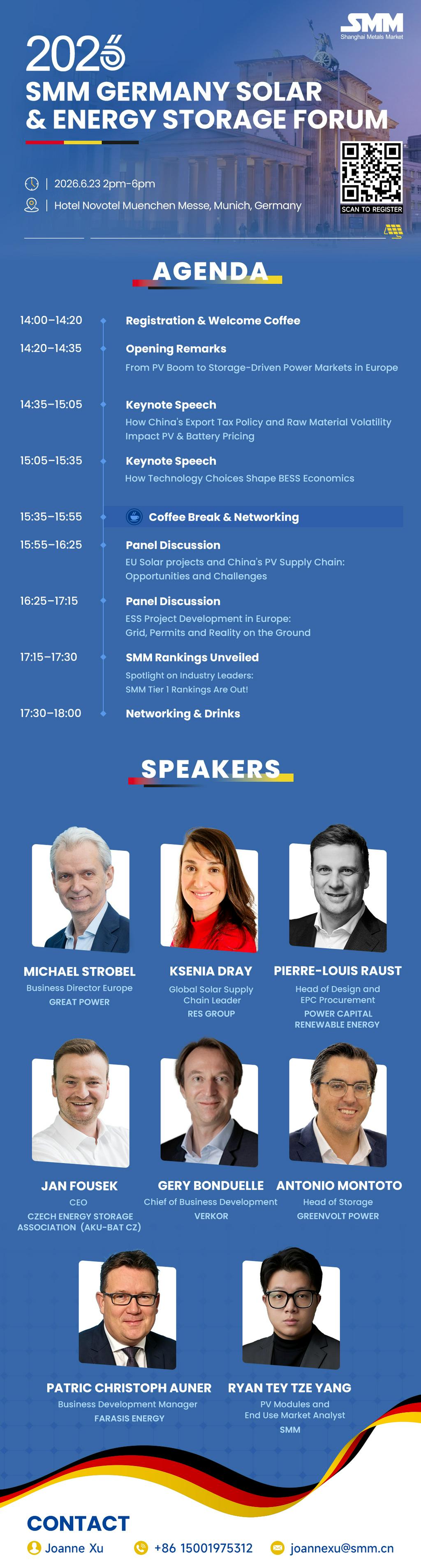
As mudanças estruturais no mercado europeu de armazenamento de energia estão a remodelar a lógica da cooperação na cadeia industrial China-Europa. Com foco em questões centrais como as realidades do desenvolvimento de projetos europeus, a transmissão de preços dos sistemas e a colaboração da cadeia de fornecimento chinesa, a SMM organizará o 2026 SMM Germany Solar & Energy Storage Forum na tarde de 23 de junho de 2026, em Munique, em paralelo com a Intersolar Europe & ESS Europe. O fórum reunirá desenvolvedores europeus e chineses de referência e instituições do setor, incluindo RES Group, Great Power, Verkor, Farasis, Greenvolt Power, AKU-BAT CZ, GCL e Gaojing, juntamente com representantes da cadeia industrial chinesa, para explorar caminhos práticos para a cooperação China-Europa no armazenamento de energia.
Agenda detalhada: 2026 SMM Germany Solar & Energy Storage Forum_Metals Market
Registe-se gratuitamente através do link e siga a SMM para mais relatórios e detalhes sobre o evento.
![[Bateria de Lítio: GEM Foca na Expansão do Mercado de Produtos de Alta Qualidade para o Negócio de Precursores Ternários]](https://imgqn.smm.cn/usercenter/ezoBg20251217171730.jpg)
![[Armazenamento de Energia: Três Projetos de Baterias de Armazenamento da CALB Aprovados]](https://imgqn.smm.cn/usercenter/AmiJU20251217171730.jpg)