SMM News, May 21:
Metals market:
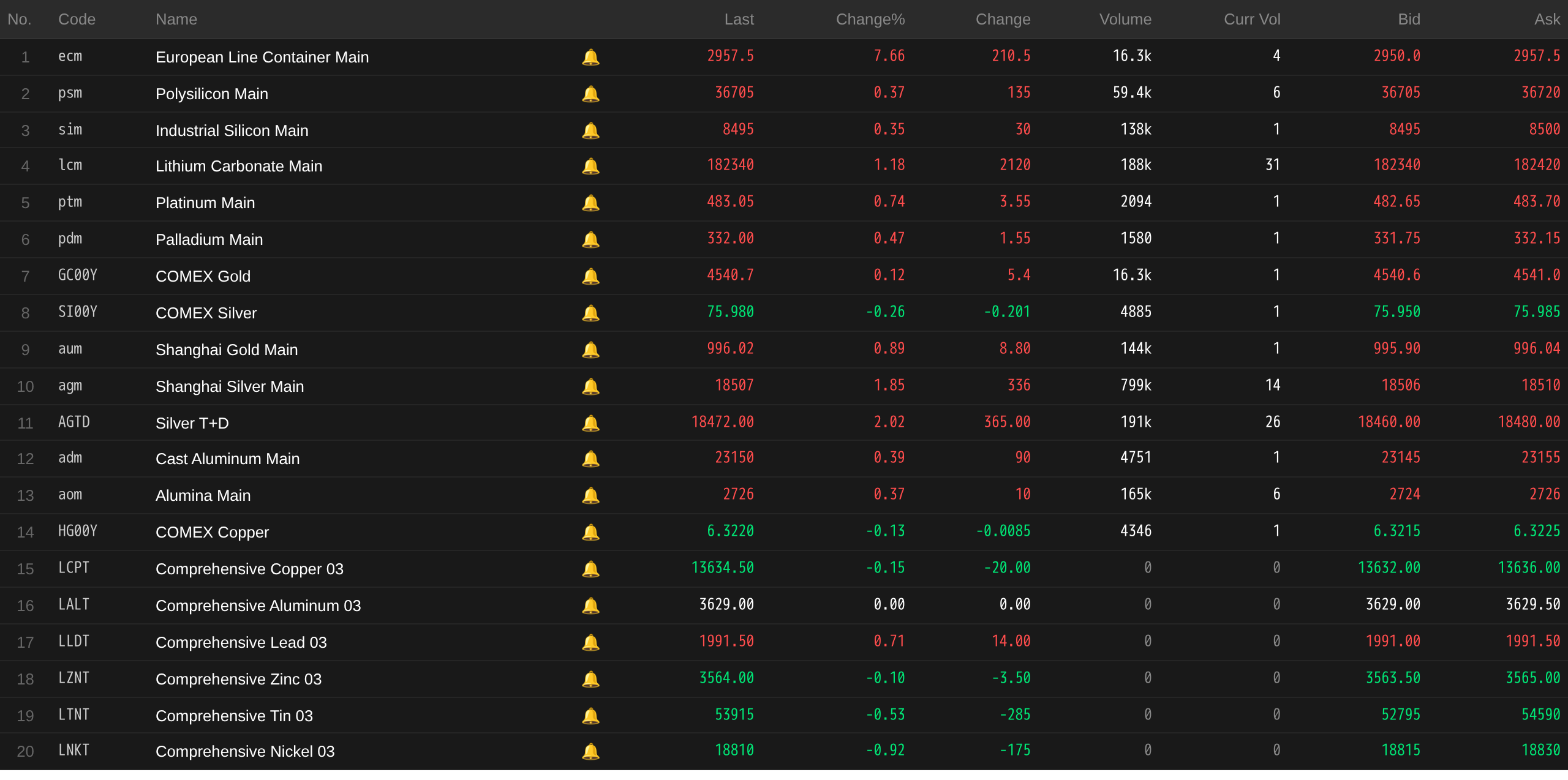
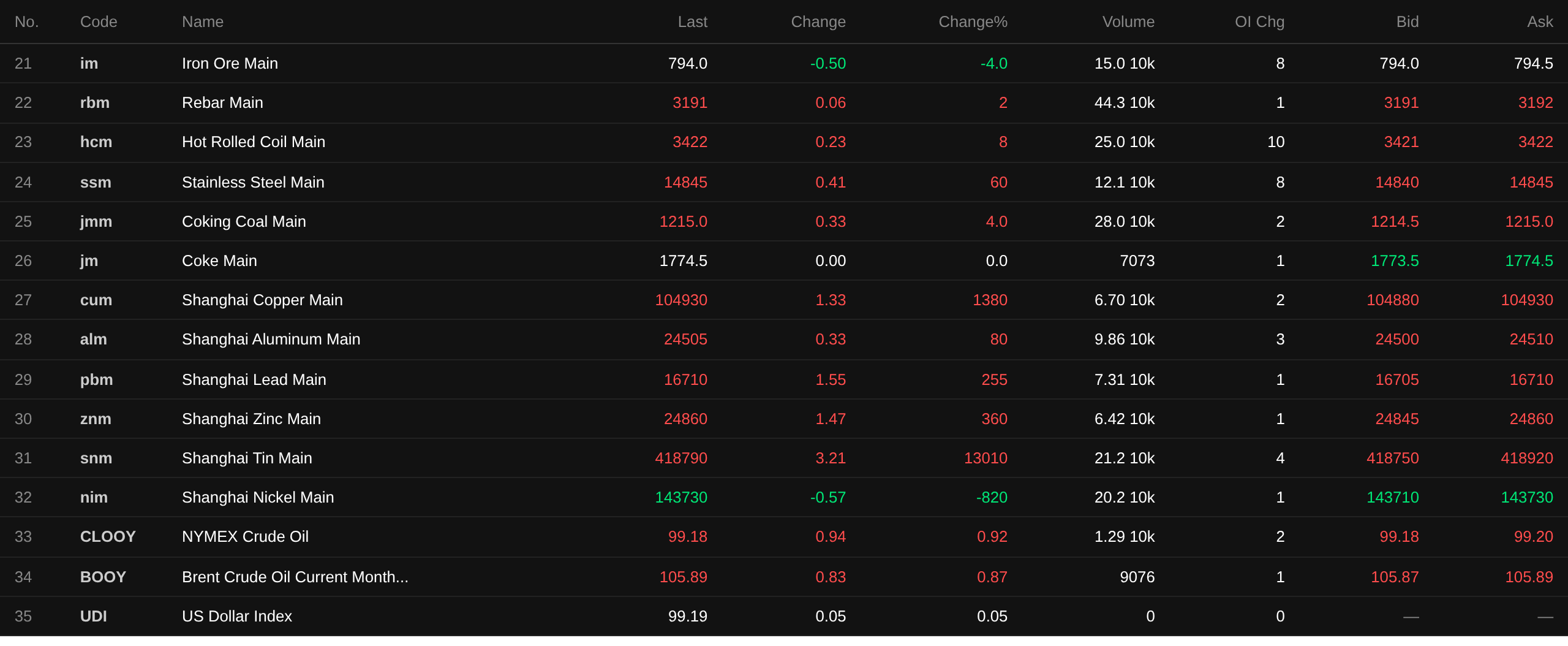
As of the midday close, most base metals in the domestic market rose. SHFE copper gained 1.33%. SHFE aluminum rose 0.33%. SHFE lead gained 1.55%, SHFE zinc rose 1.47%. SHFE tin gained 3.21%. SHFE nickel fell 0.57%.
In addition, the most-traded foundry aluminum futures rose 0.39%, the most-traded alumina contract gained 0.37%. The most-traded lithium carbonate contract rose 1.18%. The most-traded silicon metal contract gained 0.35%. The most-traded polysilicon futures rose 0.37%.
Ferrous metals mostly rose. Iron ore fell 0.5%, rebar edged up, hot-rolled coil gained 0.23%, and stainless steel rose 0.41%. Coking coal and coke: the most-traded coking coal contract gained 0.33%, and the most-traded coke contract was flat at 1,774.5 yuan/mt.
Overseas base metals: as of 11:32, LME metals generally fell. LME copper fell 0.15%. LME aluminum was flat at 3,629 yuan/mt, LME lead rose 0.71%. LME zinc fell 0.1%. LME tin fell 0.53%. LME nickel fell 0.92%.
Precious metals: as of 11:32, COMEX gold rose 0.12%, COMEX silver fell 0.26%. Domestic precious metals: the most-traded SHFE gold contract rose 0.89%, and the most-traded SHFE silver contract gained 1.85%.
In addition, as of the midday close, the most-traded platinum futures rose 0.74%, and the most-traded palladium futures gained 0.47%.
As of the midday close, the most-traded Europe containerized freight index contract rose 7.66%, closing at 2,957.5 points.
As of 11:32 on May 21, midday futures quotes for selected contracts:
Spot and fundamentals
Nickel:On May 21, SMM #1 refined nickel prices rose 1,550 yuan/mt from the previous trading day. Spot premiums: Jinchuan #1 refined nickel averaged 1,200 yuan/mt, down 250 yuan/mt from the previous trading day. Domestic mainstream brand electrodeposited nickel ranged from -600-500 yuan/mt.
Macro front
China:
[NDRC: To improve policy measures on fair competition, investment and financing, promotion of technological innovation, and business regulation]Li Hui, Director of the Private Economy Development Bureau of the National Development and Reform Commission (NDRC), stated at a press conference held by the State Council Information Office that the NDRC will better leverage its coordination function in promoting private economy development, organize and implement specific measures outlined in the rule-of-law action plan for safeguarding the private economy, and strengthen the implementation of the Private Economy Promotion Law. The NDRC will improve supporting systems, refine relevant policy measures on fair competition, investment and financing, promotion of technological innovation, and business regulation; continue to jointly release typical cases with relevant departments to demonstrate law interpretation through cases; implement policy effectiveness assessments, promote direct and swift delivery of enterprise-benefiting policies, and guide enterprises to enhance governance capabilities.
[China's Enterprise Credit Index stood at 162.41 in April this year, maintaining a positive trend] According to the State Administration for Market Regulation, China's Enterprise Credit Index stood at 162.41 in April this year, up 0.15 points from March, with enterprise credit levels maintaining a positive trend. In April, the top 5 industries by credit index ranking were finance, electricity/heat/gas and water production and supply, education, manufacturing, and water conservancy/environment and public facilities management. Compared with the previous month, information transmission/software and IT services, finance, and health and social work saw relatively notable index increases, achieving positive growth for three consecutive months, with credit development trends continuing to improve. (CCTV News)
[Qiushi commentary: How to deeply rectify "involution-style" competition in manufacturing]The article pointed out that to deeply rectify "involution-style" competition, institutional innovation must be used to drive competition quality upgrading. Only when government behavior is regulated and market mechanisms are streamlined can enterprises shift from low-price disorderly competition to value-based competition. A unified national market should be built to break down market segmentation, policies hindering fair competition should be firmly eliminated, outdated capacity should be phased out in an orderly manner in accordance with laws and regulations to prevent "bad money driving out good," and allow competitive enterprises to obtain resources matching their competitiveness. Performance assessment reform should correct government behavior, shifting assessment focus toward "quality" indicators such as development quality, technological innovation, and industrial coordination, aligning local government incentives with high-quality development, and curbing homogeneous investment attraction impulses at the source. Evaluation mechanism reform should rectify competitive behavior, reverse the "price-only" tendency, establish comprehensive evaluation mechanisms centered on technology, quality, and service, make quality-price alignment a market consensus, and guide resources toward enterprises with strong innovation capabilities and high product value-added.
The PBOC conducted 100 billion yuan of 7-day reverse repo operations in the open market at an interest rate of 1.40%, unchanged from the previous day. 500 million yuan of reverse repos matured today.
US dollar:
As of 11:32, the US dollar index rose 0.05% to 99.19. The US Fed meeting minutes showed that participants expected elevated energy prices would continue to exert upward pressure on headline inflation in the near term. Participants generally expected the impact of tariffs on core goods inflation to gradually diminish over the course of the year. However, some participants noted that tariff rates could rise further above current levels, leading to greater upward pressure on inflation. Some participants emphasized that after several consecutive years of inflation above 2%, elevated inflation could have a greater influence on wage and price-setting decisions. Nearly all participants noted that the Middle East conflict could persist for an extended period, or that even if the conflict ended, oil and other commodity prices could remain elevated longer than expected. In such a scenario, participants expected that supply chain disruptions, elevated energy prices, or pass-through of higher input costs to other prices would continue to push inflation higher. The vast majority of participants noted that the time required for inflation to return to the Committee's 2% target could be longer than they had previously expected, and that risks had increased.
The US Fed meeting minutes showed that regarding the monetary policy outlook, participants generally judged that persistently elevated inflation and uncertainty about the duration and economic impact of the Middle East conflict could necessitate maintaining the current policy stance for longer than expected. Some participants emphasized that it might be appropriate to lower the target range for the federal funds rate once clear signs emerged that the disinflationary trend had firmly resumed, or if the labour market showed signs of greater softening. However, most participants noted that if inflation remained persistently above 2%, some tightening measures might be needed. To address this scenario, many participants expressed a desire to remove language from the post-meeting statement that implied the Committee's future rate decisions might lean toward easing. Participants noted that monetary policy was not on a preset course and that future policy decisions would be determined on a meeting-by-meeting basis. According to CME "FedWatch": the probability of the US Fed holding rates unchanged through June was 97.3%, with a 2.7% probability of a cumulative 25 basis point cut. The probability of holding rates unchanged through July was 87.2%, with a 2.4% probability of a cumulative 25 basis point cut and a 10.4% probability of a cumulative 25 basis point hike. (Jin10 Data)
Data:
Data to be released today include US initial jobless claims for the week ending May 16, US April annualized housing starts, US April building permits, US May Philadelphia Fed Manufacturing Index, US May S&P Global Manufacturing PMI preliminary, US May S&P Global Services PMI preliminary, eurozone May Manufacturing PMI preliminary, eurozone March seasonally adjusted current account, eurozone May consumer confidence preliminary, France May Manufacturing PMI preliminary, Germany May Manufacturing PMI preliminary, UK May Manufacturing PMI preliminary, UK May Services PMI preliminary, UK May CBI industrial orders balance, and Australia April seasonally adjusted unemployment rate. In addition, attention should be paid to: Bank of England Governor Bailey's speech, and the opening of a new round of domestic refined oil price adjustment window.
Crude oil:
As of 11:32, both benchmarks rose. WTI gained 0.94% and Brent rose 0.83%. Supply concerns driven by market worries over the uncertain prospects of a US-Iran peace deal continued to support oil prices. In addition, a decline in US crude oil inventories also supported prices.
EIA report: commercial crude oil inventories excluding the Strategic Petroleum Reserve fell by 7.863 million barrels to 445 million barrels, a decline of 1.74%. The US EIA crude oil inventory draw for the week ending May 15 was the largest since the week of February 13, 2026.
CITIC Securities Research noted that global oil inventories were declining sharply, intensifying energy shortage risks. The US-Israel-Iran conflict disrupted passage through the Strait of Hormuz, causing global oil inventories to decline at a record pace and intensifying summer energy shortage risks. The market was temporarily buffered by prior surplus inventories, exemptions on Russian oil sanctions, and multiple countries releasing strategic petroleum reserves, while high oil prices also triggered a contraction in global oil demand. Currently, international oil prices were fluctuating at elevated levels, US refined product prices hit multi-year highs, oil products in multiple energy-importing regions in Asia were on the verge of shortage, dragging on regional economic growth. Oil prices may still have significant upside room, and accelerating the development of renewable energy has become a long-term measure for countries to guard against energy risks.
Sultan Al Jaber, CEO of Abu Dhabi National Oil Company (ADNOC) of the UAE, said on May 20 that the UAE was building an east-west oil pipeline bypassing the Strait of Hormuz. The project was nearly 50% complete and is expected to be completed and operational by 2027. According to the UAE's Gulf News, Al Jaber said during an online event hosted by the US think tank Atlantic Council that a large volume of global energy transportation still relied on a few key maritime chokepoints, and the UAE hoped to reduce dependence on the Strait of Hormuz through this project and enhance energy export security. (Xinhua)
Goldman Sachs stated that as the Middle East war continued and supply remained constrained, global crude oil and refined product inventories were being drawn down at a record pace this month. Goldman Sachs analysts noted in a report dated May 20 that since the beginning of May, visible inventories had been declining at a record pace of 8.7 million barrels per day, nearly double the average rate since the conflict began. They stated, "The physical market continues to tighten, with estimated oil exports through the Strait of Hormuz still at only 5% of normal levels." Goldman Sachs analysts said two-thirds of the May inventory decline was driven by a reduction in so-called "oil on water," with exports falling more than imports. Weak imports were "now spreading from Asia to Europe," they noted, with European jet fuel imports 60% below the 2025 average. (Jin10 Data)
Spot market overview:
►
►
►
Other metals spot midday reviews will be updated shortly, please refresh to check~
![[SMM Flash News] Indonesia Appoints Danantara to Form New BUMN Export Agency for Strategic Natural Resources](https://imgqn.smm.cn/usercenter/yhuhG20251217171735.jpg)
![Tight Supply Overlaid with Liquidity Tightening Expectations, SHFE Tin Contract Consolidates at Highs in Stagnant Trading [SMM Tin Midday Review]](https://imgqn.smm.cn/usercenter/fMkfI20251217171752.jpg)
![Slightly Widening Price Spread Between Futures Contracts Bolstered Efforts to Hold Prices Firm, Spot Copper Discounts on SHFE Copper Moved Sideways [SMM Shanghai Spot Copper]](https://imgqn.smm.cn/usercenter/JopQJ20251217171712.jpg)