Aluminum Plate/Sheet and Strip Exports Face Dual Pressure Despite 16.6% YoY Growth in Jan-Feb [SMM Analysis]

Published: Mar 22, 2026 16:18
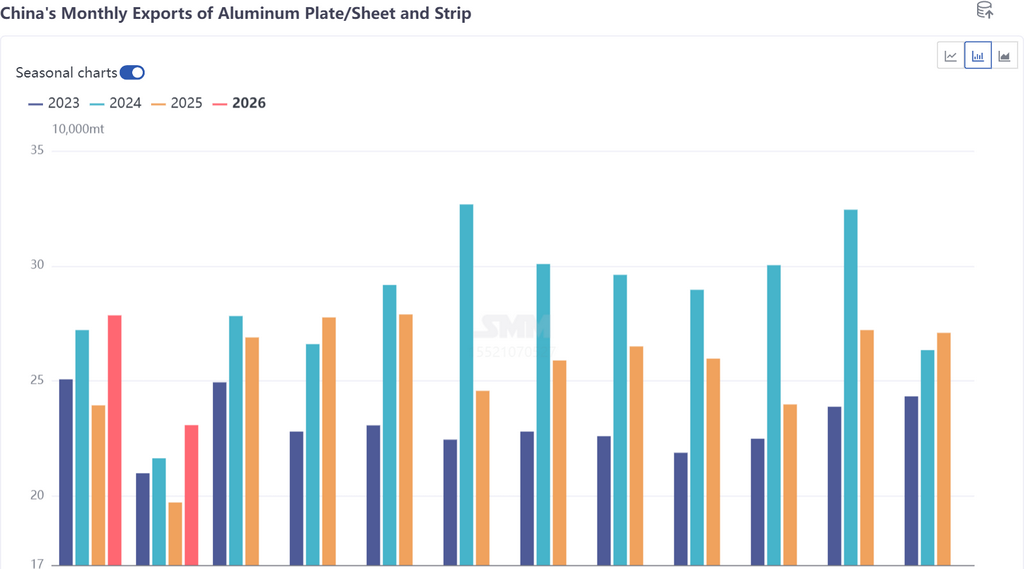
[SMM Analysis: Aluminum Plate/Sheet and Strip Exports up 16.6% YoY in January-February, to Face Dual Pressure] According to customs data, China’s total exports of aluminum plate/sheet and strip reached 509,300 mt in January-February 2026, up 16.65% YoY from 2025. Of this, exports were 278,500 mt in January, up 16% YoY, and 230,800 mt in February, up 17% YoY.

SMM, March 22, 2026:

According to customs data, China’s aluminum plate/sheet and strip (HS codes 76061121, 76061129, 76061191, 76061199, 76061220, 76061230, 76061251, 76061259, 76061290, 76069100, 76069200) exports totaled 509,300 mt in January-February 2026, up 16.65% YoY from 2025. Of this, January exports were 278,500 mt, up 16% YoY, and February exports were 230,800 mt, up 17% YoY.


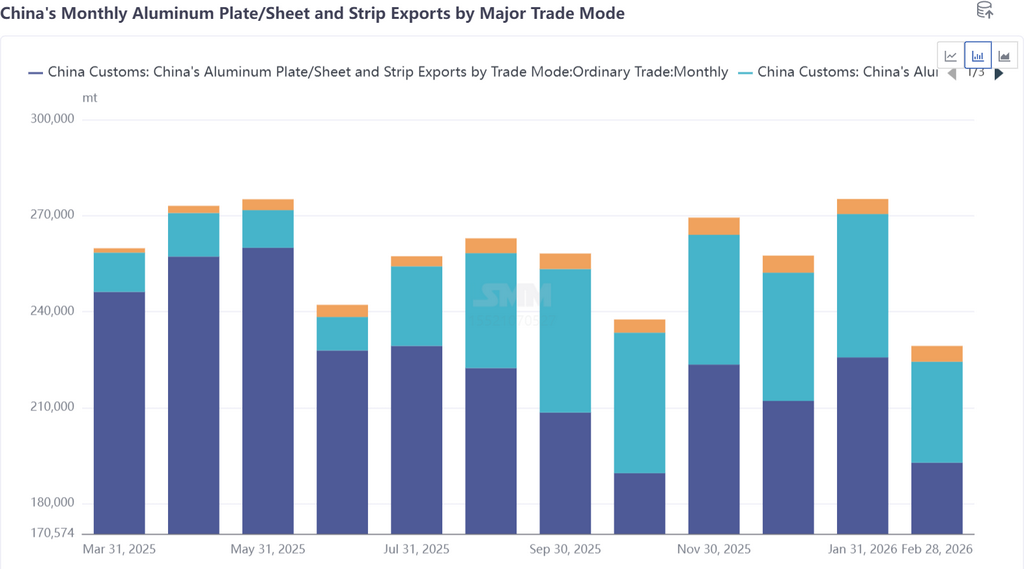
By trade mode, in January-February 2026, China’s aluminum plate/sheet and strip exports through processing trade with imported materials were about 76,000 mt, accounting for 14.9%; exports through processing trade with supplied materials were about 9,600 mt, accounting for 1.9%;


By country, the top five destinations for China’s aluminum plate/sheet and strip exports in January-February 2026 were Mexico (66,300 mt, 13.0%), the US (50,000 mt, 9.8%), Vietnam (34,000 mt, 6.7%), South Korea (31,000 mt, 6.1%), and Indonesia (2 mt, 4.0%), with all other countries accounting for about 60.4% in total.

In January-February 2025, directly affected by China’s cancellation of the aluminum semis export tax rebate policy, outside China clients front-loaded demand, while the market was also in a transition period of negotiating a new pricing system, resulting in relatively low exports in the same period last year. On the other hand, as the Iran-Israel conflict escalated and the security situation in the Strait of Hormuz deteriorated, trade flows in the region have now been effectively disrupted. According to the SMM survey, all orders involving the Middle East have now been fully suspended, and even some in-transit cargoes are facing returns or port detention because insurers have refused to cover war risks. The complete halt of these orders will directly and sharply hit exports in March and Q2, with an impact far exceeding seasonal fluctuations. Although industrialization in emerging markets such as Southeast Asia is still advancing, the incremental demand there will be unlikely to offset the loss of the Middle East market and the contraction in traditional markets in the short term. March aluminum plate/sheet and strip exports are expected to face downside risk and pull back under pressure, and the industry will enter a critical period of active destocking and market structure adjustment.

Data Source Statement: Except for publicly available information, all other data are processed by SMM based on publicly available information, market communication, and relying on SMM‘s internal database model. They are for reference only and do not constitute decision-making recommendations.

For any inquiries or to learn more information, please contact: lemonzhao@smm.cn
For more information on how to access our research reports, please contact:service.en@smm.cn
Related News
Middle East Trade Chain for Aluminum Foil Disrupted by Geopolitical Conflicts, Down 0.74% YoY in Jan-Feb [SMM Analysis]
4 hours ago
Middle East Trade Chain for Aluminum Foil Disrupted by Geopolitical Conflicts, Down 0.74% YoY in Jan-Feb [SMM Analysis]
Read More
Middle East Trade Chain for Aluminum Foil Disrupted by Geopolitical Conflicts, Down 0.74% YoY in Jan-Feb [SMM Analysis]
[SMM Analysis: China’s Aluminum Foil Exports Edged Down 0.74% YoY in January-February, Geopolitical Conflicts Disrupted the Middle East Trade Chain] According to customs data, China’s total aluminum foil exports in January-February 2026 (tariff codes 76071110, 76071120, 76071190, 76071900, 76072000) reached 214,800 mt, down 0.74% YoY from 2025, of which exports were 121,100 mt in January, up 2% YoY, and 93,700 mt in February, down 4% YoY.
4 hours ago
Middle East Conflict Boosts Oil Prices, Raises Concerns of Inflation and Potential Fed Rate Hikes
6 hours ago
Middle East Conflict Boosts Oil Prices, Raises Concerns of Inflation and Potential Fed Rate Hikes
Read More
Middle East Conflict Boosts Oil Prices, Raises Concerns of Inflation and Potential Fed Rate Hikes
The escalating conflict in the Middle East has driven international oil prices sharply higher, a trend that has deeply unsettled Wall Street. Wall Street is concerned that US inflation could reaccelerate as a result, forcing the US Fed to delay interest rate cuts and even shift its policy direction toward rate hikes. Bank of America revealed that "whether the Fed will raise interest rates this year" has become a key question its clients have frequently asked in recent days. BofA noted that although the possibility of a rate hike cannot be entirely ruled out, three conditions would need to be met for one to occur: the labour market remains stable, inflation worsens further, and Powell continues to serve as Fed Chairman.
6 hours ago
US Begins Preliminary Talks on Next Phase of Action, Possible Peace with Iran Amid Ongoing Conflict
6 hours ago
US Begins Preliminary Talks on Next Phase of Action, Possible Peace with Iran Amid Ongoing Conflict
Read More
US Begins Preliminary Talks on Next Phase of Action, Possible Peace with Iran Amid Ongoing Conflict
According to a US official and people familiar with the matter, after three weeks of fighting in Iran so far, the Trump administration has begun preliminary consultations on arrangements for the next phase of action and possible peace talks with Iran. However, US officials said the fighting is expected to continue for another two to three weeks. In addition, the official said that any ceasefire agreement must meet the following conditions: the reopening of the Strait of Hormuz, a resolution to the issue of Iran’s stockpile of highly enriched uranium, and the conclusion of a long-term agreement on Iran’s nuclear program, ballistic missiles, and its support for proxy armed groups in the region.
6 hours ago
Register to Continue Reading
Gain access to the latest insights in metals and new energy
Already have an account?sign in here