Recently, the General Administration of Customs released import and export data for January and February 2026. Customs data showed:
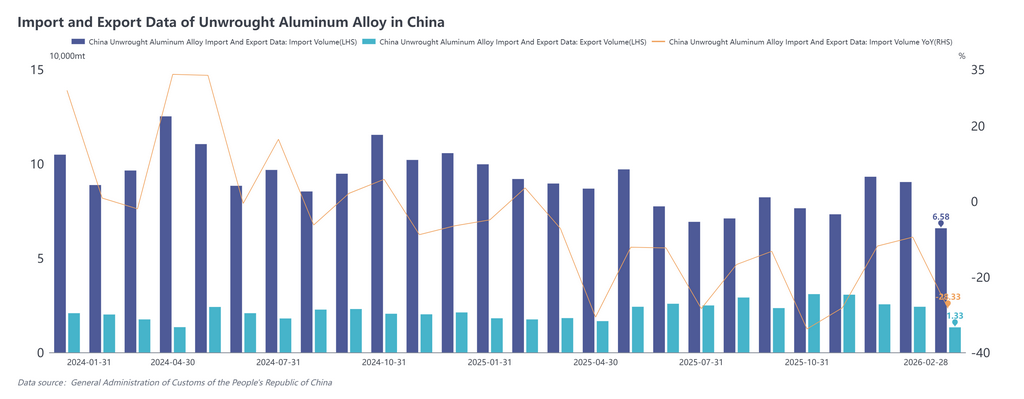
In January 2026, imports of unwrought aluminum alloy were 90,300 mt, down 9.4% YoY and down 3.1% MoM. In February 2026, imports of unwrought aluminum alloy were 65,800 mt, down 28.2% YoY and down 27.1% MoM. Cumulative imports in January-February 2026 were 156,100 mt, down 18.5% YoY.
In January 2026, exports of unwrought aluminum alloy were 24,200 mt, up 33.6% YoY and down 4.9% MoM. In February 2026, exports of unwrought aluminum alloy were 13,300 mt, down 24.0% YoY and down 45.1% MoM. Cumulative exports in January-February 2026 were 37,500 mt, up 5.3% YoY.
The chart below shows the monthly imports and exports of unwrought aluminum alloy from 2024 to 2026:
In January-February 2026, the top five sources of China’s unwrought aluminum alloy imports accounted for about 75% in total. Among them, Malaysia ranked first with 42,400 mt, accounting for 27%, followed by Russia (31,100 mt, 20%), Thailand (23,300 mt, 15%), Vietnam (12,300 mt, 8%), and South Korea (8,400 mt, 5%).
From January to February, the top three export markets for China’s unwrought aluminum alloy were Japan (21,200 mt), Mexico (4,300 mt), and India (2,200 mt), accounting for 57%, 11%, and 6%, respectively, while all other markets combined accounted for about 26%. In terms of trade mode, processing trade still dominated, accounting for more than 70%.
Overall, China's imports of unwrought aluminum alloy fell YoY in January and February 2026, while exports increased YoY. After the import window opened after December last year, imports stayed at around 90,000 mt in December and January, then pulled back in February due to the holiday and fewer working days. Entering March, the US and Israel launched joint military strikes on Iran, raising market concerns over the stability of aluminum supply. Hindered transportation, coupled with rising smelting costs, pushed LME aluminum prices sharply higher to a nearly four-year high. At the same time, countries including Japan and South Korea faced disruptions in procuring aluminum alloy ingots from the Middle East and turned to the Southeast Asian market for spot purchases, driving up Southeast Asia ADC12 prices from $2,950/mt at the start of the month to a peak of around $3,400/mt. By contrast, price gains in China were relatively limited, and the import window quickly turned into a loss. In the short term, China's imports of unwrought aluminum alloy are expected to continue shrinking, while exports are likely to increase, supported by high premiums outside China.