Key Copper Export Corridor in the DRC Disrupted; Rising Transport Costs May Affect Logistic Flows

Published: Mar 3, 2026 18:25
According to Bloomberg, flooding has caused the collapse of a key bridge located south of the Zambian border in the Democratic Republic of Congo (DRC), cutting off the main copper export route to the Kasumbalesa border post and disrupting outbound shipments from the world’s second-largest copper producer.

According to Bloomberg, flooding has caused the collapse of a key bridge located south of the Zambian border in the Democratic Republic of Congo (DRC), cutting off the main copper export route to the Kasumbalesa border post and disrupting outbound shipments from the world’s second-largest copper producer. In a statement released on Sunday, the Zambia Revenue Authority noted that traffic to and from the Kasumbalesa border crossing has been affected due to bridge damage and advised transporters to use alternative routes. According to SMM, this corridor accounts for roughly one-third of the DRC’s refined copper export shipments. At present, cargoes from the southern copper-cobalt belt are being rerouted via the Jiu–Sakania and Mokambo border crossings.

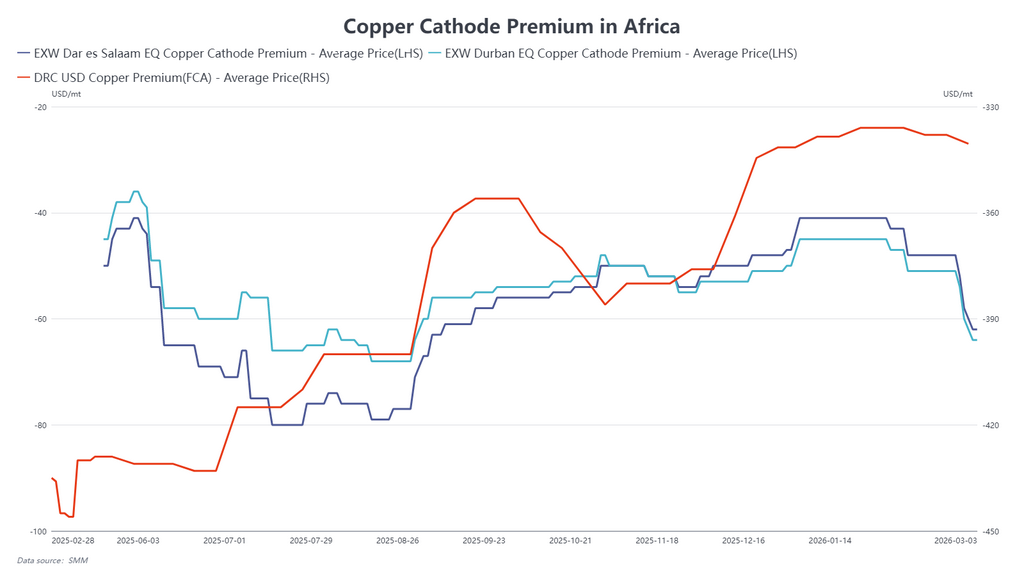
The disruption has had a direct impact on the regional logistics system. Approximately one-third of export volumes that previously transited through Kasumbalesa are now being diverted to the Jiu–Sakania and Mokambo routes. However, these alternative corridors have a daily vehicle capacity of around 1,000 trucks, making it difficult to fully absorb the additional traffic in the short term. Inland freight rates within the DRC are therefore expected to rise, leading to a temporary increase in transportation costs. At the same time, Africa’s smelting structure is predominantly hydrometallurgical and heavily reliant on sulfuric acid imports from Zambia. Any cross-border transport disruptions may further heighten operational risks for hydrometallurgical copper production, increasing localized supply uncertainty. Given that African refined copper premiums have been trending downward recently, this disruption may temporarily slow the pace of premium declines.
From an inventory perspective, reduced transport efficiency may cause refined copper to accumulate at mine sites, smelters, and ports, leading to a short-term buildup of regional “hidden” inventories. As these stocks are not reflected in LME or other visible inventory statistics, they may distort short-term market assessments of global inventory levels and influence expectations regarding the broader supply-demand balance.

For the Chinese market, if logistical bottlenecks persist beyond mid-April, arrivals in the second half of April may slow, potentially resulting in a modest decline in import volumes. However, alternative routes are already in operation, and further developments will depend on improvements in detour efficiency and customs clearance speed. Overall, the incident appears to represent a temporary logistical disruption, with its broader impact on the annual supply-demand structure still to be assessed.

Data Source Statement: Except for publicly available information, all other data are processed by SMM based on publicly available information, market communication, and relying on SMM‘s internal database model. They are for reference only and do not constitute decision-making recommendations.

For any inquiries or to learn more information, please contact: lemonzhao@smm.cn
For more information on how to access our research reports, please contact:service.en@smm.cn
Related News
Chile's Water Crisis Threatens Atacama's Copper and Lithium Mining Amid 14-Year Drought
Apr 3, 2026 19:10
Chile's Water Crisis Threatens Atacama's Copper and Lithium Mining Amid 14-Year Drought
Read More
Chile's Water Crisis Threatens Atacama's Copper and Lithium Mining Amid 14-Year Drought
Chile’s most pressing crisis at present is the issue of water resources. The Atacama Desert in Chile is one of the driest regions in the world and also the core area for copper and lithium ore extraction. The local area has experienced a drought for as long as 14 years, and reservoir storage has fallen to only about 30%. For miners, water resources are not a secondary issue, but an indispensable key production factor in such processes as ore processing, dust suppression, and equipment cooling. The decline in ore grade has further exacerbated the predicament
Apr 3, 2026 19:10
Trump Adjusts Metal Tariffs, Applies 50% Rate to Consumer Prices Under Section 232, Details Unclear
Apr 3, 2026 19:09
Trump Adjusts Metal Tariffs, Applies 50% Rate to Consumer Prices Under Section 232, Details Unclear
Read More
Trump Adjusts Metal Tariffs, Applies 50% Rate to Consumer Prices Under Section 232, Details Unclear
US President Trump adjusted the national security tariffs on imports of steel, aluminum, and copper, lowering the tariff rates on derivative products made from these metals, streamlining compliance procedures, and preventing the declared value of imports from being understated.A senior Trump administration official said that, under a proclamation signed by Trump, the US would continue to maintain a 50% import tariff on imports of metal commodities such as steel, aluminum, and copper pursuant to Section 232 of the Trade Act of 1974, but would apply this rate to the price paid by US consumers. It is currently unclear how the selling price—and the resulting tariffs—would be determined.
Apr 3, 2026 19:09
Barrick Confirms 2028 Production Target for Reko Diq Copper-Gold Project in Pakistan Despite Budget Concerns
Apr 3, 2026 19:08
Barrick Confirms 2028 Production Target for Reko Diq Copper-Gold Project in Pakistan Despite Budget Concerns
Read More
Barrick Confirms 2028 Production Target for Reko Diq Copper-Gold Project in Pakistan Despite Budget Concerns
Barrick Mining said that its Reko Diq copper-gold project in Pakistan still plans to achieve first production by the end of 2028.The project is a large-scale copper-gold project jointly developed by Barrick, the Pakistani government, and relevant joint venture partners, and is located in Balochistan, Pakistan. Although the company had previously warned that the capital budget previously disclosed for the project's two phases could face a significant increase, the 2028 production commencement target remained unchanged.
Apr 3, 2026 19:08