SMM April 22 News:
On April 21, 2025, at CATL's first Super Technology Day event, the highly anticipated sodium-ion battery was officially unveiled. The released sodium-ion batteries include two major product types: sodium-ion power batteries for new passenger vehicles and sodium-ion 24V start-stop integrated batteries for heavy-duty trucks. Their debut sparked strong reactions within the industry, becoming a focal point of attention.
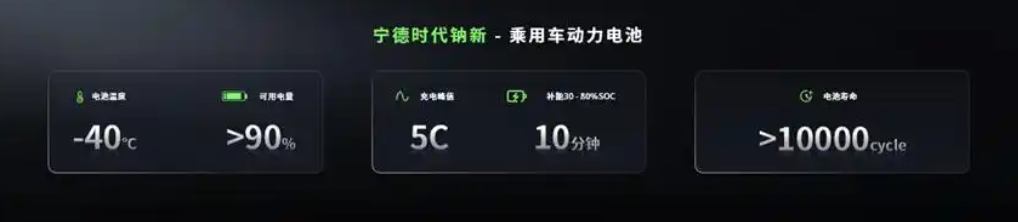
First, let's look at the sodium-ion power battery for new passenger vehicles. Its energy density reaches 175Wh/kg, a figure that leads the industry in mass-produced products, marking the first time sodium-ion battery performance has matched that of mainstream LFP batteries. In terms of driving range, it can basically meet the needs of daily commuting and medium-to-short-distance travel. Regarding charging speed, it supports a peak 5C charging rate, and even in extreme cold environments of -40℃, it takes only about 37 minutes to charge from 30% to 80%. In terms of cycle life, it can achieve over 10,000 cycles, significantly reducing the cost of battery replacement for users later on. Moreover, this battery can operate stably in a full temperature range from -40℃ to 70℃, maintaining 90% of its available capacity at -40℃. Even in extreme conditions with only 10% SOC remaining, the vehicle's power does not significantly degrade. It has also passed extreme tests such as nail penetration, electric drilling, and sawing without catching fire or exploding, demonstrating exceptional safety performance.
The sodium-ion 24V start-stop integrated battery for heavy-duty trucks is also full of highlights, with a service life of up to 8 years, truly achieving the same lifespan as the vehicle. Its full life cycle cost is 61% lower than traditional lead-acid batteries, greatly reducing battery cost expenditures during heavy-duty truck operations. It features full-capacity deep discharge, one-click start at -40℃, and the ability to start after being idle for a year. It is efficient, environmentally friendly, and economical, driving the commercial vehicle sector towards a lead-free battery era.
As a global leader in the battery industry, CATL's every move serves as a bellwether for the entire industry. The release of sodium-ion batteries reflects an important trend in the development of the global new energy battery sector. With the booming development of the global NEV industry and the rapid expansion of the ESS market, the demand for batteries has shown explosive growth. However, while lithium batteries are developing rapidly, they also face issues such as safety incidents, fires, and low efficiency in low temperatures. In this context, sodium-ion batteries, with their unique safety and low-temperature advantages, have ushered in unprecedented development opportunities.
From a resource perspective, sodium is extremely abundant on Earth, ranking as the 5th most abundant element in the Earth's crust, accounting for about 3% of the Earth's crust's mass. Its concentration in seawater is 60,000 times that of lithium. This means that compared to lithium resources, sodium resources are virtually inexhaustible, greatly reducing the risk of resource shortages. Additionally, sodium-ion batteries are cost-effective. Although the production and manufacturing costs of sodium-ion batteries are currently much higher than theoretical costs due to being in the early stages of commercialization, in the long run, with technological advancements and the promotion of large-scale production, there is significant room for cost reduction.
In terms of market applications, the primary application scenario for sodium-ion batteries is currently in ESS, mostly in demonstration projects. In the future, as their performance continues to improve and costs decrease, their application fields will further expand. In grid ESS, they play an important role in ensuring grid stability and peak shaving. In the field of communication base station backup power, sodium-ion batteries can become an ideal choice due to their excellent safety. In the low-speed EV sector, with their good low-temperature performance and relatively reasonable costs, they are expected to gradually replace lead-acid batteries.
However, for sodium-ion batteries to truly occupy an important position in the future battery market, they face a series of challenges. In terms of material costs, although sodium resources are abundant, the raw material costs for producing sodium-ion battery cathodes remain high, such as phosphorus and nickel resources, and the production technology for these materials has high barriers, requiring significant R&D investment. In terms of the industry chain, the sodium-ion battery industry chain is not yet mature, and some key links, such as the preparation of high-performance cathode and anode materials, have not fully achieved commercial large-scale production, which to some extent limits the capacity increase and cost reduction of sodium-ion batteries.
Overall, the future development prospects of sodium-ion batteries are bright but challenging, and it is still a window period for sodium-ion battery development. With the active promotion of industry giants like CATL and the efforts of more sodium-ion battery cathode and cell enterprises in technology R&D and industry chain layout, sodium-ion battery technology will become increasingly mature, and projects will gradually be promoted and implemented. SMM believes that sodium-ion batteries will play an increasingly important role in ESS, start-stop, and small power fields.

SMM New Energy Research Team
Cong Wang 021-51666838
Rui Ma 021-51595780
Disheng Feng 021-51666714
Yanlin Lyu 021-20707875
![[SMM Analysis] April Sodium-Ion Battery Market Review: Steady Momentum, Bottlenecks, and Opportunities Ahead](https://imgqn.smm.cn/usercenter/fblvS20251217171729.png)
![[SMM Analysis] Sodium-Ion Battery Cathode and Anode Supply-Demand Recovery and Capacity Expansion Accelerate](https://imgqn.smm.cn/usercenter/ZLcBf20251217171731.jpg)