[SMM Analysis] 0BB Technology and Cost of Encapsulation Film for Different Routes (Part 1)

Publicado: Jan 05, 2025 21:59 (GMT+8)
The welding method is the mainstream process for SMBB. Compared to traditional welding, 0BB welding with dispensing has advantages in terms of acceptance and equipment upgrades. The film-coating process is easy to penetrate the market and has achieved mass production. 0BB technology improves efficiency and, in the future, combined with copper interconnection and thin silicon wafer technology, will drive the development of heterojunction batteries.

Currently, the welding method is the mainstream process for SMBB, and in 0BB, the welding and dispensing process has a higher similarity to the mainstream SMBB process, allowing for upgrades and modifications of existing equipment with higher acceptance. Regarding new capacity, the film-coating process has a lower entry barrier, and Chint New Energy has already achieved mass production and product delivery using the film-coating process.

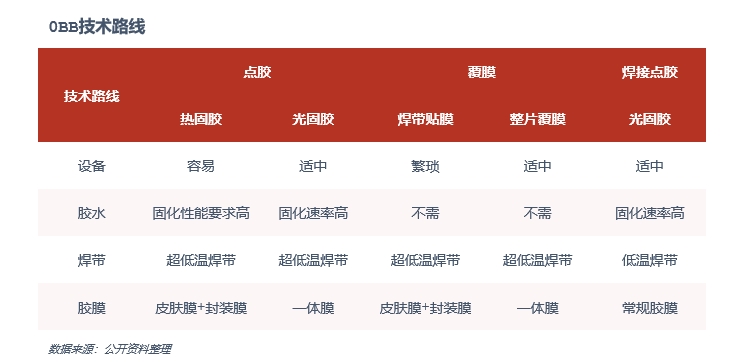
Welding and dispensing. This method involves welding the welding strip onto the solar cell and fixing it with glue or tape to prevent displacement. Its advantages include no need for special film encapsulation, strong bonding strength, excellent hot spot resistance, reworkability, and the ability to upgrade on existing equipment. However, it also has disadvantages, such as high requirements for the welding system, the need for high precision in dispensing, and slower speed.

Dispensing technology. First, an adhesive (such as UV glue or hot melt adhesive) is applied to the solar cell, then the welding strip is adhered to the solar cell and alloyed through lamination. This method eliminates traditional welding steps. Advantages: 1) Simplified process suitable for existing screen printing technology; 2) Expanded process window for series interconnection; 3) Simple equipment that can be easily upgraded on SMBB systems. Disadvantages: 1) Requires the use of additional protective film; 2) Cell abnormalities can only be detected after lamination. Some companies have optimized the process by designing hollows on the protective film to reduce interference between the adhesive and the welding strip while enhancing the bonding strength between the adhesive and the solar cell, thereby reducing risks in reliability testing.

Film-coating process. This method involves directly laminating the film, solar cell, and welding strip in one step to create a solar cell string. The specific process includes: solar cell loading and transmission (including the production and transmission of adhesive film and welding strip) → precise positioning of adhesive film, welding strip, and solar cell → solar cell film-coating → PL detection → transmission to the layout machine. This method eliminates the need to pre-combine the welding strip and adhesive film. Advantages: 1) High adhesion between the welding strip and the solar cell, reducing the risk of gridline detachment; 2) Simplified process without dispensing and welding steps; 3) No need for flux, reducing maintenance difficulty. Disadvantages: 1) Requires additional skin film or integrated film; 2) EL detection abnormalities can only be identified after lamination; 3) Higher application risks in the current market. Specialized rework equipment is required.
Declaração sobre a Fonte de Dados: Com exceção das informações publicamente disponíveis, todos os demais dados são processados pela SMM com base em informações publicamente disponíveis, comunicação de mercado e com base no modelo de base de dados interna da SMM. São apenas para referência e não constituem recomendações para a tomada de decisão.

Para quaisquer perguntas ou para obter mais informações, entre em contato: lemonzhao@smm.cn
Para mais informações sobre como aceder aos nossos relatórios de investigação, entre em contato:service.en@smm.cn
Notícias Relacionadas
[SMM PV Flash] Energiequelle vende unidade francesa e portfólio de 500 MW em renováveis para a H2air
25 Sep 2026 10:14 (GMT+8)
[SMM PV Flash] Energiequelle vende unidade francesa e portfólio de 500 MW em renováveis para a H2air
Leia mais
[SMM PV Flash] Energiequelle vende unidade francesa e portfólio de 500 MW em renováveis para a H2air
[SMM PV Flash] Energiequelle vende unidade francesa e portfólio de 500 MW em renováveis para a H2air
A Energiequelle concluiu a venda de sua subsidiária francesa, Energiequelle SAS, à desenvolvedora e operadora francesa H2air, por um valor não divulgado. A transação inclui a equipe local e um portfólio eólico e solar de aproximadamente 500 MW, composto por cerca de 60 MW em operação e projetos adicionais em estágios avançados de pré-construção. A Energiequelle descreveu a alienação como parte de um reposicionamento estratégico em mercados centrais, enquanto a H2air manterá os funcionários e continuará desenvolvendo os ativos.
25 Sep 2026 10:14 (GMT+8)
[SMM PV Flash] Play assina PPA eólico e solar de 15 anos com a Qair na Polônia
25 Sep 2026 10:14 (GMT+8)
[SMM PV Flash] Play assina PPA eólico e solar de 15 anos com a Qair na Polônia
Leia mais
[SMM PV Flash] Play assina PPA eólico e solar de 15 anos com a Qair na Polônia
[SMM PV Flash] Play assina PPA eólico e solar de 15 anos com a Qair na Polônia
A operadora de telecomunicações polaca Play assinou um PPA físico de 15 anos com a Qair Polska para cerca de 35 GWh de eletricidade eólica e solar por ano, ou aproximadamente 525 GWh ao longo do contrato. O fornecimento virá de centrais eólicas e fotovoltaicas operadas pela Qair na Polónia e incluirá garantias de origem com o rótulo EKOenergy. O acordo dá à Play visibilidade de fornecimento renovável a longo prazo, ao mesmo tempo que apoia o financiamento de nova capacidade renovável.
25 Sep 2026 10:14 (GMT+8)
[SMM PV Flash] Greenvolt Inicia Construção de BESS Polonês de 600 MW/2,4 GWh
25 Sep 2026 10:14 (GMT+8)
[SMM PV Flash] Greenvolt Inicia Construção de BESS Polonês de 600 MW/2,4 GWh
Leia mais
[SMM PV Flash] Greenvolt Inicia Construção de BESS Polonês de 600 MW/2,4 GWh
[SMM PV Flash] Greenvolt Inicia Construção de BESS Polonês de 600 MW/2,4 GWh
A Greenvolt iniciou a construção do projeto de armazenamento de energia em baterias Siedlce, de 600 MW/2,4 GWh, na Polônia, com operação comercial prevista para o final de 2027. O projeto inclui 210 contêineres de baterias e 105 contêineres de transformadores com sistemas de conversão de energia, com a BYD Energy Storage fornecendo a tecnologia de baterias e a P&Q e a ONDE apoiando a infraestrutura elétrica. Juntamente com o projeto Turośń Kościelna, em operação, e o projeto Ełk, previsto para entrar em operação no quarto trimestre, os três ativos totalizarão 1 GW/4 GWh.
25 Sep 2026 10:14 (GMT+8)
[SMM Analysis] 0BB Technology and Cost of Encapsulation Film for Different Routes (Part 1) - Shanghai Metals Market (SMM)