SMM, December 31: Tongwei Co., Ltd. recently announced that it held the 19th meeting of the 8th Supervisory Board. The Supervisory Board unanimously agreed that engaging in hedging activities would help the company fully utilize financial market tools to enhance its risk management capabilities, reduce the impact of commodity price, interest rate, and exchange rate fluctuations on its operations and performance, and ensure stable operations. All supervisors approved the company's plan to engage in hedging activities in 2025.
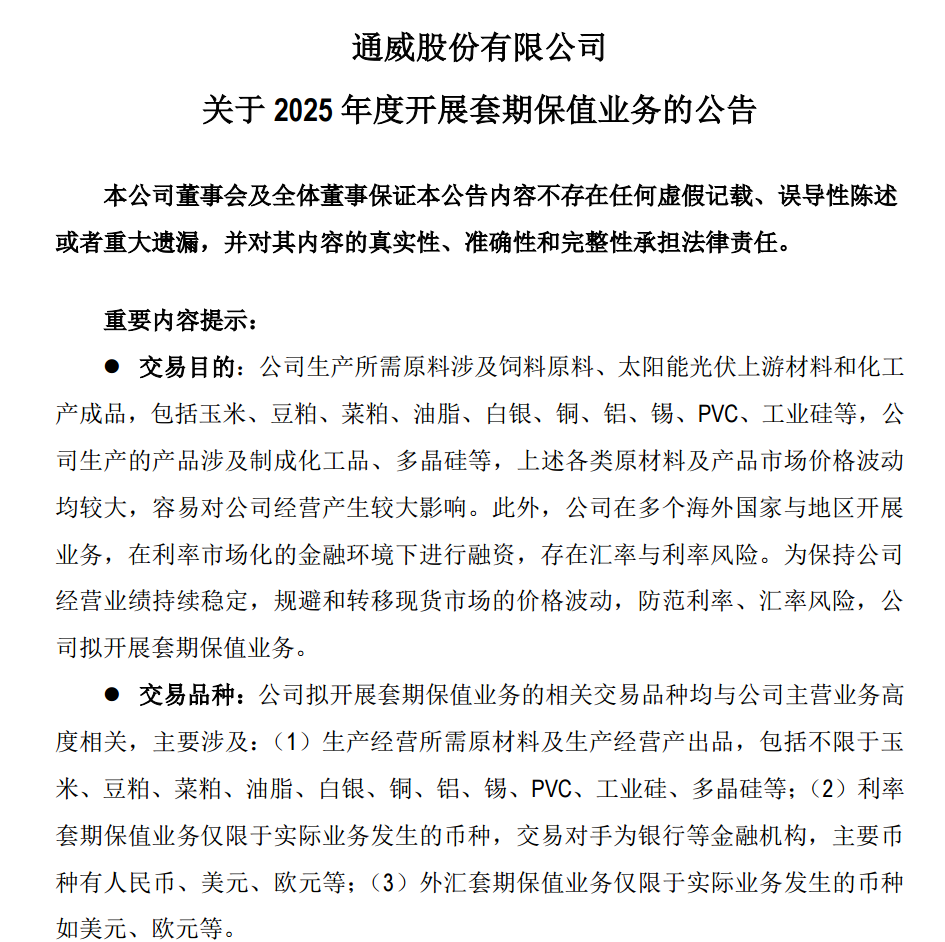
Tongwei stated that the hedging transactions it plans to undertake are closely related to its core business and mainly involve: (1) raw materials and production outputs required for operations, including but not limited to corn, soybean meal, rapeseed meal, oils, silver, copper, aluminum, tin, PVC, silicon metal, and polysilicon; (2) interest rate hedging limited to currencies involved in actual business transactions, with counterparties being banks and other financial institutions, primarily in yuan, US dollars, euros, etc.; (3) foreign exchange hedging limited to currencies involved in actual business transactions, such as US dollars and euros.
Regarding the purpose of these transactions, Tongwei explained that the raw materials required for its production include feedstock, upstream materials for solar PV, and chemical finished products, such as corn, soybean meal, rapeseed meal, oils, silver, copper, aluminum, tin, PVC, and silicon metal. The company's products include chemical finished goods and polysilicon. The market prices of these raw materials and products are highly volatile, which can significantly impact the company's operations.
Additionally, the company operates in multiple overseas countries and regions, where financing in a financial environment with market-driven interest rates exposes it to exchange rate and interest rate risks. To maintain stable operational performance and mitigate the price fluctuations in the spot market, as well as to manage interest rate and exchange rate risks, the company plans to engage in hedging activities. The hedging volumes for specific items will strictly adhere to the principle of not exceeding the scale of actual business transactions, fully utilizing financial market tools to enhance its risk management capabilities and ensure stable operations.
Regarding the impact of these transactions on the company, Tongwei stated that engaging in futures and derivatives hedging activities would help mitigate the impact of price fluctuations in raw materials, finished products, interest rates, and exchange rates on its operational performance, thereby reducing operational risks. However, it may also face certain risks. The company has established a comprehensive and effective internal control system and processes, with a systematic risk control framework for its operations. The potential investment losses from hedging activities are within the company's tolerable range, and the investment risks are controllable.
As a leading polysilicon enterprise in China, Tongwei's subsidiary Yongxiang Co., Ltd. has a high-purity polysilicon capacity exceeding 900,000 mt, with significant competitive advantages in scale, cost, technology, and market presence. It has maintained the highest global market share for consecutive years. Therefore, following the listing of polysilicon futures, the company announced its participation in polysilicon futures hedging to reduce operational risks, which is considered a "necessary step" to ensure stable operations.
Even before the listing of polysilicon futures, Jinko Solar had already expressed its intention to participate in polysilicon futures trading. On December 11, Jinko Solar announced that its engagement in commodity futures hedging aims to mitigate the impact of raw material price fluctuations on production costs, fully utilize the hedging functions of the futures market, effectively control market risks, and avoid speculative trading for profit. This approach enhances the company's overall risk management capabilities and financial stability. The trading items include raw materials related to the production operations of the company and its subsidiaries, such as copper, aluminum, silver, tin, and polysilicon.
Polysilicon Prices Experienced "Sharp Fluctuations," 2022-2024, Market Sentiment Recently Improved
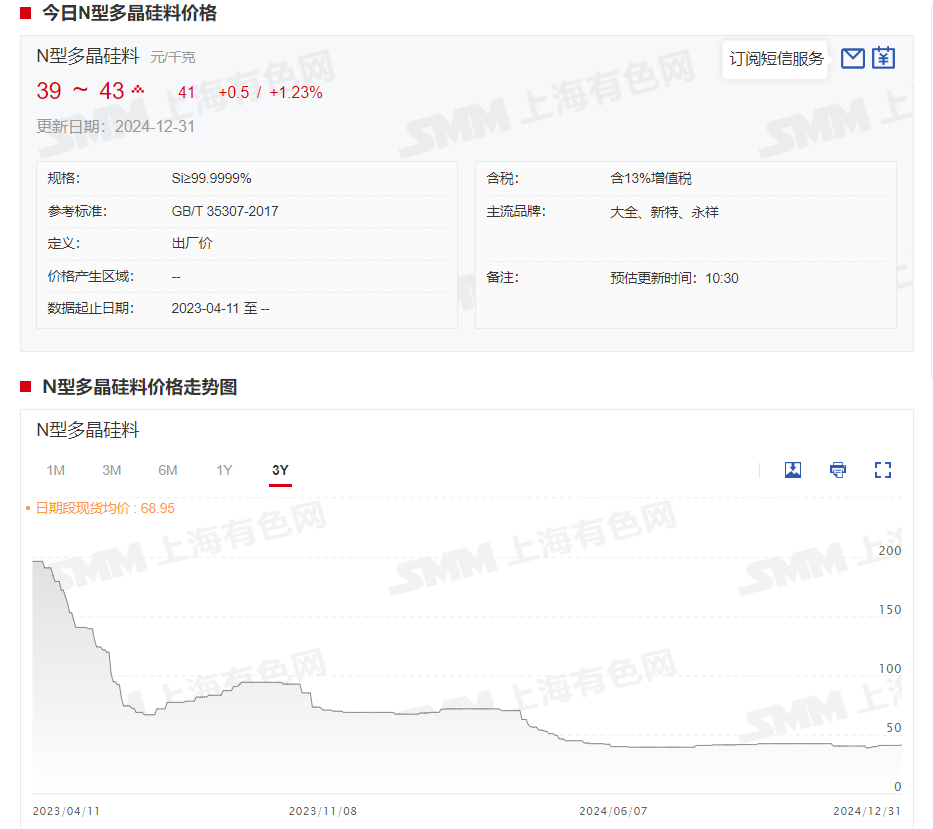
It is well known that since 2022, polysilicon prices have undergone literal "sharp fluctuations." In 2022, due to a supply-demand imbalance caused by mismatched polysilicon capacity, the average spot price of polysilicon once surged to a peak of 309 yuan/kg. However, by the end of 2022, with the concentrated release of new polysilicon capacity in China, the supply-demand relationship in the polysilicon market reversed, leading to a "collapse" in polysilicon prices. Although there were occasional price increases during this period, the oversupply situation persisted. By December 6, 2024, the average spot price of dense polysilicon had dropped to 33.5 yuan/kg, marking a three-year low and an 89.16% decline from its previous peak of 309 yuan/kg.
》Click to view SMM PV product spot prices
Recently, however, with an improvement in the overall supply-demand situation for polysilicon, market sentiment has started to recover. The price of N-type polysilicon has gradually rebounded, reaching 39-43 yuan/kg on the last trading day of 2024, with an average price of 41 yuan/kg, up 2.5 yuan/kg (6.49%) from the previous 38.5 yuan/kg.
According to the latest news on December 30, some market sources reported that certain top-tier polysilicon enterprises were selling polysilicon at 45 yuan/kg, either to crystal pulling facilities or traders. SMM confirmed that such orders do exist, with some companies quoting similar prices as early as the previous week. However, these cases are not representative, as the mainstream transaction prices remain at 40-41 yuan/kg. Currently, there is still some negotiation in the market regarding the latest transactions. Polysilicon enterprises are mostly quoting prices above 42 yuan/kg, while crystal pulling facilities are resistant to prices exceeding 42 yuan/kg, especially after recently completing large-scale stockpiling. The likelihood of representative large-scale transactions reappearing in the market is relatively low.
This pricing news further confirms the recent improvement in polysilicon prices. According to SMM's monitoring data, the overall supply-demand situation for polysilicon has indeed improved recently. On the supply side, polysilicon production has been continuously declining. In December, due to production halts at multiple bases during the dry season, domestic polysilicon production was approximately 93,000 mt, down 19.8% MoM from November. The continuous decline in production has alleviated supply pressure on polysilicon.
Inventory levels have also been decreasing. According to SMM statistics, the latest weekly polysilicon inventory was approximately 222,000 mt, down 23.44% from its peak. In mid-to-late December, several large orders were signed, with some companies destocking by around 20,000-30,000 mt. The destocking was driven not only by production cuts but also by stockpiling by downstream enterprises ahead of the Chinese New Year.
Additionally, rising downstream prices, the entry of some traders, and the listing of futures have all supported the recent improvement in polysilicon market sentiment. As a result, polysilicon spot prices have risen again under the influence of multiple favorable factors.
SMM expects polysilicon production to continue declining in January 2025, with an estimated decrease of around 2%. A production cut at a base in Inner Mongolia in January is expected to be the main factor affecting this change. 》Click to view details
Notably, on December 24, Tongwei announced that due to the dry season in south-west China during winter, electricity prices increased MoM. Considering that the overall PV industry remains in a bottom adjustment phase, its subsidiary Yongxiang Co., Ltd. has undertaken technological transformation and maintenance work as part of its overall production plan, implementing phased and orderly production cuts. Future production resumption plans will be coordinated based on changes in local electricity prices and market conditions. The company stated that these technological upgrades, maintenance, and production cuts would help reduce losses in its high-purity polysilicon business under the current market environment and are expected to positively impact its overall production and profitability.
It is worth mentioning that in response to investor inquiries on its interactive platform regarding polysilicon costs, Tongwei stated that leveraging its strong technological capabilities, the company has continuously advanced cost reduction efforts for high-purity polysilicon. By focusing on tackling key production challenges and implementing targeted solutions, it has encouraged innovation across the organization to achieve optimal costs. With a significant increase in the proportion of N-type products in its production, the company's unit comprehensive electricity consumption has dropped below 50 kWh, and silicon consumption has fallen to less than 1.04 kg/kg-Si. Cost metrics are generally categorized into cash cost, production cost, and full cost. From the perspective of the most recent complete fiscal year, the average production cost of the company's high-purity polysilicon products in 2023 had dropped to below 42,000 yuan/mt, maintaining a leading position in the industry.
![[Solar: Bangladesh introduz tarifa de US$ 0,086/kWh para energia solar em telhados com medição líquida e meta de 5 GW]](https://imgqn.smm.cn/usercenter/zvkUO20251217171743.jpg)
![[Solar: Frontier Energy da Austrália fecha contratos para o projeto híbrido solar-bateria Waroona na Austrália Ocidental]](https://imgqn.smm.cn/usercenter/JNxfy20251217171742.jpg)
![[Solar: Malásia lança programa solar nacional LSS6 com 2,5 GW de energia solar e 1,25 GW de armazenamento]](https://imgqn.smm.cn/usercenter/PkttC20251217171742.jpg)