2023 Motive Power Battery Overseas Market Share Battle: CATL in Pursuit, BYD Surges Ahead

Publicado: Feb 19, 2024 15:48
According to data from South Korean research firm SNE Research, the global (excluding China) sales of electric vehicle (EV) batteries totaled approximately 319.4 GWh in 2023, marking a 43.2% increase compared to the same period in 2022. Notably, in the global (excluding China) ranking of electric vehicle battery installations, LG Energy Solution (LGES) maintained its top position, experiencing a growth of 32.9% compared to the same period in 2022, with installations reaching 88.6 GWh and a market share of 27.8%.

Recently, data from South Korean research institution SNE Research revealed that in 2023, the global (excluding China) sales of electric vehicle batteries amounted to approximately 319.4 GWh, marking a 43.2% increase compared to the same period in 2022.
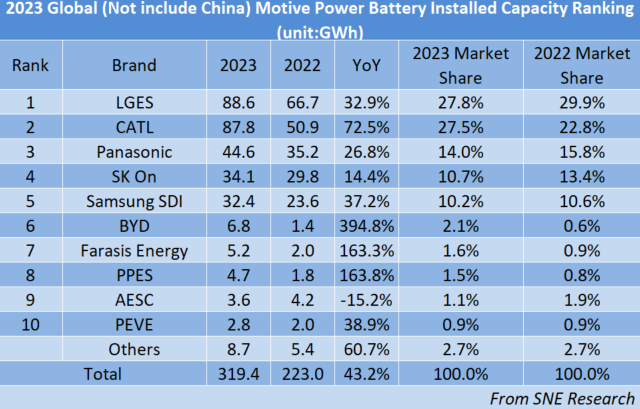
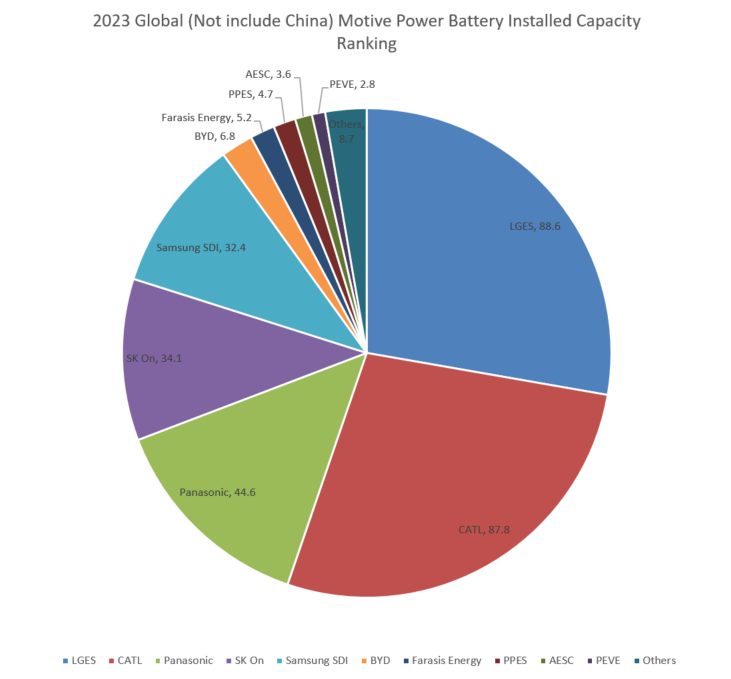
Worth noting is the ranking of electric vehicle battery installations globally (excluding China), with LG Energy Solution (LGES) maintaining the top spot. Compared to the same period in 2022, LGES experienced a growth of 32.9%, achieving an installation volume of 88.6 GWh and a market share of 27.8%.

In the global electric battery market outside of China, CATL follows closely behind LGES, securing the second position with a total installation volume of 87.8 GWh. CATL demonstrated continuous high growth of 72.5%, posing a significant threat to LGES's leading position with a market share of 27.5%.

SNE indicates that Chinese companies, including CATL, are experiencing higher growth rates in the global electric vehicle battery market than in the domestic market, rapidly expanding their global market share. CATL's batteries are installed in vehicles from major manufacturers such as BMW, MG, Mercedes-Benz, and Volvo, including Tesla Model 3/Y manufactured in China for export to Europe, North America, and Asia. Recently, CATL's batteries have been installed in Hyundai's new Kona and Kia Ray electric vehicles, further expanding the influence of Chinese companies in the domestic market.

Panasonic holds the third position in the rankings, with an installation volume of 44.6 GWh, showing a growth rate of 26.8% compared to the same period in 2022. In the global electric battery market (outside China) in 2023, Panasonic achieved a market share of 14%. As one of Tesla's main battery suppliers, Panasonic produces improved 2170 and 4680 batteries, aiming to increase its market share centered around Tesla in the future.

South Korean battery companies SK On and Samsung SDI rank fourth and fifth, with installation volumes of 34.1 GWh and 32.4 GWh, respectively. They experienced growth rates of 14.4% and 37.2% YoY, with market shares of 10.7% and 10.2%, respectively. SNE's analysis suggests that the growth of the three major South Korean battery companies is mainly attributed to strong sales of vehicles equipped with their respective batteries.

Chinese battery supplier BYD holds the sixth position, increasing its market share from 0.6% in 2022 to 2.1% in 2023, with overseas installation volume rising to 6.8 GWh, a remarkable 394.8% YoY increase. BYD is the company with the largest growth among the TOP 10 companies in the global new energy vehicle power battery market (excluding China).

Additionally, Chinese battery company EVE Energy rapidly increased its overseas battery market installations, achieving a growth rate of 163.3%. With an installation volume of 5.2 GWh, EVE Energy secured the seventh position with a market share of 1.6%.

Farasis Energy, with an installation volume of 3.6 GWh, also made it to the TOP 10 in the global market outside China in 2023, ranking ninth with a market share of 1.1%.

Toyota and Panasonic's joint ventures PPES and PEVE rank eighth and tenth, with installation volumes of 4.7 GWh and 2.8 GWh, respectively. Their market shares are 1.5% and 0.9%, with PPES experiencing a significant 163.8% YoY growth and PEVE growing by 38.9% in 2023 in the global electric battery market (outside China).
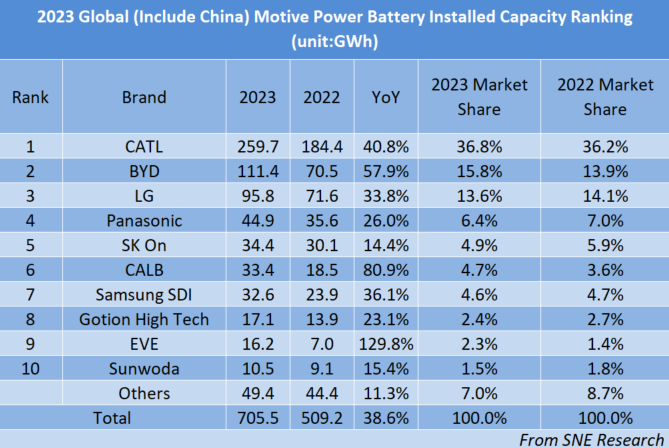
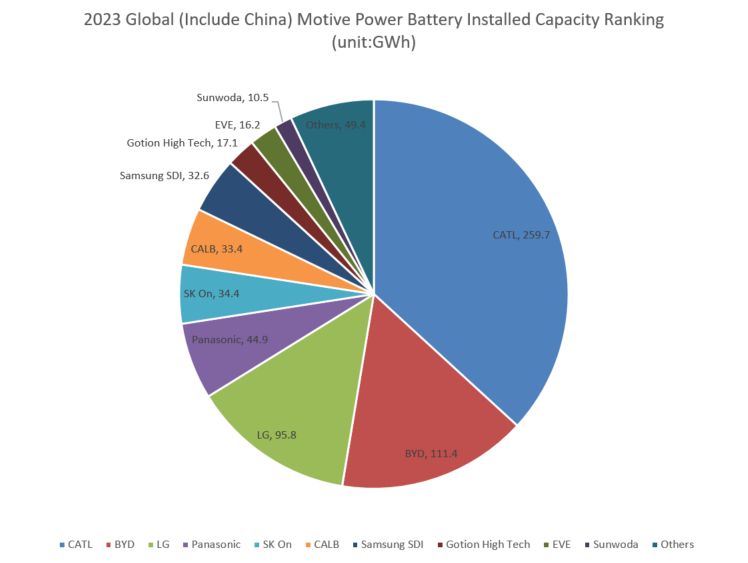
n addition to overseas electric vehicle (EV) battery installation data, SNE recently released the 2023 global (including the Chinese market) new energy vehicle power battery installation data. In 2023, the registered electric vehicle (EV, PHEV, HEV) battery installations worldwide reached approximately 705.5 GWh, a YoY increase of 38.6%. Examining the TOP 10 global power battery installers, Chinese companies secured 6 positions, with a market share of 63.5%, up from 59.6% in 2022. CATL and BYD combined still account for over half, reaching 52.6% market share.

SNE analysis indicates a significant slowdown in the growth rate of the global electric vehicle market in 2023, impacting the downstream secondary battery industry. Factors such as early adopters completing initial purchase demands, economic contraction due to high interest rates and prices, and a lack of charging infrastructure are identified as reasons slowing electric vehicle market demand growth. Although the slowdown in the electric vehicle market is expected to persist for some time, SNE anticipates that regulatory enforcement of IRA subsidies will strengthen from 2024, the number of models eligible for tax credits will decrease, and the maintenance of tax credits will depend on the results of the U.S. presidential election. Uncertainties have negatively impacted the demand for electric vehicles.

SNE believes that the electric vehicle market will shift towards a price-centric approach this year, intensifying competition among automakers to survive through price reductions. Attention is expected to be focused on battery technology development, competition, and strategies to stabilize the critical mineral supply chain.

If you have any questions regarding the industry data, or the news (e.g. how this can affect your business). Please feel free to reach out to me:

Robin He

SMM Li-ion Battery Materials Department

E: robinhe@smm.cn | T: +86-21-51595884

Declaração sobre a Fonte de Dados: Com exceção das informações publicamente disponíveis, todos os demais dados são processados pela SMM com base em informações publicamente disponíveis, comunicação de mercado e com base no modelo de base de dados interna da SMM. São apenas para referência e não constituem recomendações para a tomada de decisão.

Para quaisquer perguntas ou para obter mais informações, entre em contato: lemonzhao@smm.cn
Para mais informações sobre como aceder aos nossos relatórios de investigação, entre em contato:service.en@smm.cn
Notícias Relacionadas
[SMM Analysis] Zimbabwe's Rise Reshapes Lithium Market: Prices Near 15-Month Highs, Supply Focus Shifts to Africa
há 29 minutos
[SMM Analysis] Zimbabwe's Rise Reshapes Lithium Market: Prices Near 15-Month Highs, Supply Focus Shifts to Africa
Leia mais
[SMM Analysis] Zimbabwe's Rise Reshapes Lithium Market: Prices Near 15-Month Highs, Supply Focus Shifts to Africa
[SMM Analysis] Zimbabwe's Rise Reshapes Lithium Market: Prices Near 15-Month Highs, Supply Focus Shifts to Africa
Over the next decade (2026-2035), the combined market share of the three traditional major lithium producers Australia, China and Chile is expected to keep declining as emerging suppliers scale up, with Zimbabwe and Argentina identified as the key sources of new supply. Zimbabwe, in particular, is likely to lead a new round of African lithium expansion, according to a latest research report. Strong H1 momentum, supported by storage demand. China's battery-grade lithium carbonate spot price stood at around 153,950 yuan/mt (approx. USD 21,500/mt) on August 17, after a rally of more than 130% from the June 2025 low of 58,400 yuan/mt. The 2026 forecast for China lithium carbonate has been revised up to USD 20,100/t and lithium hydroxide monohydrate to USD 19,600/t, reflecting that H1 momentum. Prices are expected to ease in H2 as smelter maintenance ends and supply returns, but storage demand is limiting the downside market balances now point to month-on-month destocking through H2 2026, with some analysts projecting the year's price peak in late Q3/early Q4. From ore exporter to processor enforced by policy. Zimbabwe’s rise is no longer just a forecast. On February 25, 2026, Zimbabwe's mining ministry banned all exports of lithium raw ore and concentrates with immediate effect, forcing miners to build local processing capacity. Zimbabwe's output was expected to reach ~200,000 t LCE in 2026 (up over 15% year on year), equal to ~10% of global primary lithium supply and ~17% of global spodumene supply before the ban; the restriction is estimated to affect around 12,000 t LCE of monthly supply. Key projects include: 1) Huayou Cobalt's Arcadia ~70,000-80,000 t LCE of mine output expected in 2026, with its 50,000 t/yr lithium sulphate plant commissioned in Q1 2026 and now ramping up; 2) Sinomine's Bikita ~60,000-70,000 t LCE expected in 2026, with a 30,000 t/yr lithium sulphate plant slated for 2027; 3) Chengxin's Sabi Star (~35,000 t LCE) and Yahua's Kamativi (~50,000 t LCE) rounding out a Chinese-invested project portfolio totaling roughly 230,000 t LCE. 4) In 2025, Zimbabwe shipped over 1.2 million tonnes of spodumene to China about 15% of China's total imports making it a supply source Beijing's supply chain cannot easily replace. 2026 is the last investment peak of this cycle global lithium supply is projected to rise ~30% year on year to over 2.1 million t LCE in 2026, concentrated in China and Africa (Africa alone adding ~140,000 t to reach ~380,000 t LCE). Chinese output hit 970,000 t of lithium carbonate in 2025, with new additions this year from Qinghai/Tibet salt lakes, Sichuan spodumene and Jianxiawo's expected restart in H2. Australia shipped 158,000 t of spodumene to China in the week of August 10-16 alone. But few new projects are lined up beyond 2027 a key reason sentiment has flipped from glut to deficit: Morgan Stanley now forecasts an 80,000 t LCE global deficit for 2026, UBS sees a 22,000 t shortfall, versus a 61,000 t surplus in 2025. EVs slow, storage takes the wheel. Global lithium demand growth is expected to slow to 5.8% in 2026 (from 18.5% in 2025), with passenger EV sales growth falling to 3.9% (vs 22.8% in 2025 and 24% in 2024) as China's trade-in subsidies end and the US IRA rollback bites. Energy storage is now the core demand pillar: storage-sector lithium demand is forecast to jump ~55-74% in 2026, lifting its share of total lithium demand from 23% to ~31%. LFP batteries account for over 90% of battery storage applications and more than half of global EV battery installations; China's LFP cell makers reported hot August orders with output up ~5% month on month. China's NEV penetration hit 58.5% in June above 50% for the third straight month. Battery manufacturing investment in China grew 23% in January-July 2026. Risks. Lithium remains in a "tug-of-war" between supply-release concerns and storage-driven demand support, with risks skewed to the downside: a sustained price recovery could trigger rapid restarts (curtailed capacity covering 750,000+ t of concentrate sits near a ~USD 1,200/t restart cost line), sodium-ion substitution becomes economic if cell prices stay above ~0.4 yuan/Wh, and rising energy costs plus a potential sulfur shortage could squeeze miners' margins. Longer term, battery chemistry innovation and recycling could cut lithium intensity and expand secondary supply reshaping the opportunity window for emerging producers like Zimbabwe. SMM View: Zimbabwe's February export ban has turned the "move down the value chain" story from intention into policy reality Chinese invested projects at Arcadia and Bikita are now the country's only guaranteed export channels via lithium sulphate, and the roughly 12,000 t LCE/month of disrupted supply was a direct catalyst in this year's price rally above 150,000 yuan/mt. The report's core thesis a declining share for Australia, China and Chile, with Africa gaining is being validated in real time, Africa adds ~140,000 t LCE of supply in 2026, the largest increment after China. But Zimbabwe's ramp-up pace, its ability to keep sulphate exports flowing, and downstream pricing power remain the key variables determining whether it can fully deliver on its market-share ambitions
há 29 minutos
[SMM Flash] Previsões de preço do lítio para 2026 revisadas para cima; demanda de armazenamento apoia resiliência, crescimento da oferta limita potencial de alta
há 31 minutos
[SMM Flash] Previsões de preço do lítio para 2026 revisadas para cima; demanda de armazenamento apoia resiliência, crescimento da oferta limita potencial de alta
Leia mais
[SMM Flash] Previsões de preço do lítio para 2026 revisadas para cima; demanda de armazenamento apoia resiliência, crescimento da oferta limita potencial de alta
[SMM Flash] Previsões de preço do lítio para 2026 revisadas para cima; demanda de armazenamento apoia resiliência, crescimento da oferta limita potencial de alta
As previsões de preço médio do carbonato de lítio e hidróxido de lítio monoidratado da China continental para 2026 foram revisadas para cima, para US$ 20.100/t e US$ 19.600/t, respectivamente, refletindo a força dos preços no 1S. Espera-se que os preços amaciem no 2S, mas a demanda robusta por armazenamento de energia deve limitar a queda, com a incerteza sobre a reinicialização da mina Jianxiawo da CATL também contendo o sentimento baixista. Prevê-se que o crescimento da demanda global de lítio desacelere para 5,8% a/a em 2026, ante 18,5% em 2025, acompanhando a desaceleração do crescimento das vendas globais de veículos elétricos de passageiros (BEV+PHEV) para 3,9% a/a, ante 22,8% em 2025. A China continua sendo o principal motor da demanda: as vendas domésticas de VEN subiram 23,6% a/a, para 1,6 milhão de unidades em junho, com a penetração de VEN se mantendo em um recorde de 58,5% das vendas de veículos novos pelo terceiro mês consecutivo, à medida que a retirada de incentivos e as pressões estruturais levam o mercado a uma fase de crescimento mais madura. Os preços elevados dos combustíveis, ligados ao conflito no Oriente Médio, estão dando suporte adicional à demanda por trens de força eletrificados e híbridos. Do lado da oferta, a produção global de lítio deverá crescer 13,2% a/a em 2026, liderada pela Austrália e China, com a recuperação dos preços apoiando a retomada da capacidade australiana de custo mais elevado, apesar da pressão de custos com os preços de energia e uma potencial escassez de enxofre. A participação conjunta dos três maiores produtores – Austrália, China e Chile – deve diminuir até 2035, à medida que Argentina e Zimbábue aumentam a produção, com o Zimbábue sendo visto como um motor-chave do desenvolvimento de minas de lítio africanas nos próximos anos. Espera-se que o prêmio do carbonato sobre o hidróxido persista devido à adoção contínua da tecnologia LFP, que agora responde por mais da metade das instalações globais de baterias para veículos elétricos e mais de 90% da capacidade de armazenamento de energia em baterias. No longo prazo, as químicas de baterias sem lítio ou com baixo teor de lítio e os avanços na reciclagem de baterias representam riscos estruturais de queda para os preços. Visão SMM: A revisão confirma a resiliência dos preços no 1S, em vez de uma mudança nos fundamentos subjacentes – os preços atuais continuam sendo vistos como elevados em relação aos fundamentos, com o risco para o 2S inclinado para baixa. Quanto à oferta africana, o papel do Zimbábue no afastamento dos três principais produtores tradicionais na próxima década está alinhado com sua integração em andamento de sulfato/hidróxido; a continuidade da execução fortaleceria ainda mais a posição da África na estrutura global de oferta de lítio.
há 31 minutos
[SMM Flash] Nasarawa assina acordo suplementar de lítio de US$ 2 milhões com a Diamond New Energy
há 37 minutos
[SMM Flash] Nasarawa assina acordo suplementar de lítio de US$ 2 milhões com a Diamond New Energy
Leia mais
[SMM Flash] Nasarawa assina acordo suplementar de lítio de US$ 2 milhões com a Diamond New Energy
[SMM Flash] Nasarawa assina acordo suplementar de lítio de US$ 2 milhões com a Diamond New Energy
O acordo complementar de US$ 2 milhões do estado de Nasarawa com a Diamond New Energy garante o fornecimento contínuo de minério de lítio do bloco de mineração do estado para a refinaria de lítio Endo (aproximadamente 3 milhões de toneladas/ano, 6.000 t/d, a maior instalação de processamento de lítio da África Ocidental). Um documento simultâneo transferiu os direitos de mineração de 3,5 unidades cadastrais em Endo da Nasarawa Mining Company para a Ganfeng Lithium, dando à Ganfeng controle direto sobre o fornecimento upstream de espodumênio, reduzindo a dependência de minério de terceiros/artesanal e encurtando a cadeia logística mina-refinaria para sustentar volumes mais estáveis de produção de sal de lítio. Visão SMM: O verdadeiro significado do acordo é a segurança da matéria-prima para a capacidade de conversão de lítio, não o pagamento em si. A consolidação dos direitos de mineração de espodumênio sob o operador da refinaria reduz a volatilidade do fornecimento de minério e confere mais previsibilidade à produção de concentrado de lítio e sais downstream. Isso reflete a abordagem verticalmente integrada da Ganfeng em Goulamina, no Mali, incorporando ainda mais as cadeias de fornecimento de lítio controladas por empresas chinesas, da mina à refinaria, na África Ocidental, e somando aos crescentes volumes de lítio processado da região destinados ao mercado chinês.
há 37 minutos
2023 Motive Power Battery Overseas Market Share Battle: CATL in Pursuit, BYD Surges Ahead - Shanghai Metals Market (SMM)