Chinese Power Battery Enterprises Saw a Spike in Installed Capacity Compared to a Slowdown in its Japanese and South Korean Counterparts

Publicado: Jan 06, 2023 11:24 (GMT+8)
Fonte: SMM
Global power battery installed capacity reached 57.2 Gwh in November 2022, a year-on-year increase of 65.7% and a substantial increase of 19% month-on-month.

SHANGHAI, Jan 6 (SMM) - According to the data of SNE Research, the global power battery installed capacity finally recovered in November 2022 in the wake of the steep fall in October. It is shown that the global power battery installed capacity reached 57.2 Gwh in November, a year-on-year increase of 65.7% and a substantial increase of 19% month-on-month. The combined NEV power battery installed capacity worldwide in the first 11 months of 2022 totalled 446 Gwh, a year-on-year increase of 75% compared with the 255.3 Gwh in 2021.
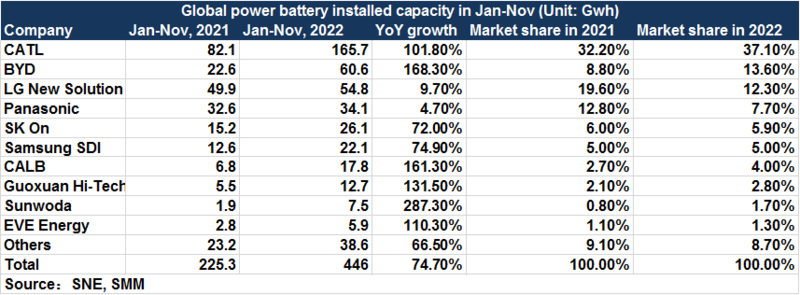
In terms of countries, the list of the top ten power battery companies in the world indicated that the growth rates of companies in China, Japan and South Korea were quite differentiated. Among them, the installed capacity of Chinese power battery companies more than doubled thanks to the rapid growth of its domestic new energy vehicle market demand. Six of the top ten companies are from China, accounting for 61% of the total global market share. The growth rate of Japanese and Korean battery cell companies, which once had a strong upward momentum in 2021, slowed down in 2022, and some of these companies' market share were swallowed by Chinese companies. Specifically, the market share of Korean companies slide by 7.4% to 23.1%, which was owed in good part to the slowdown in LG Energy Solution's growth. The market share of Panasonic also dropped from the previous 13% to about 8%. The reason behind the underperformance of Japanese and Korean enterprises was down to the poor demand in overseas market in 2022 under the influence of energy crisis, inflation, etc.

In terms of individual companyies, the two Chinese giants CATL and BYD achieved installed capacity of 165.7 Gwh and 60.6 Gwh respectively in the first 11 months of 2022, a year-on-year increase of 102% and 168%, respectively. They were the top companies in the world. It is worth noting that the growth rate of BYD's installed capacity reached 168% in 2022, second only to Sunwoda's, who enjoyed a year-on-year growth rate of 287%. Moreover, BYD's market share ranked second in the world, taking the long-held place of LG Energy Solution. BYD's sales of new energy vehicles skyrocketed in 2022. According to relevant data, BYD's total deliveries of new energy vehicles in 2022, with the popularity of its main models such as Qin Plus and Song Plus, stood at 1.86 million units, a year-on-year surge of 208%, ranking first in the world. Since BYD relied on its self-produced batteries for its new energy vehicles, the spike in its car sales naturally gave a boost to its power battery installed capacity. Fudi Battery started to supply batteries to companies other than BYD since March 2022, including Hongqi, Ford and Dongfeng. As such, its installed capacity was also boosted.

Compared with rapid growth of CATL and BYD, LG New Solution performed poorly in 2022. From January to November 2022, it will only achieved installed capacity of 54.8 Gwh, a slight year-on-year increase of 9.7%, which was far below the industry's average growth rate of 75%. The slowdown of LG New Solution's installed capacity in 2022 was mainly due to the internal failures of LG batteries that forced the company to recall its products multiple times. Besides, the growth rate of new energy vehicle sales in overseas markets gradually slowed down in 2022 due to the rising prices of lithium battery raw materials and inflation. The fact that the growth rate of demand for ternary batteries was slower than that for LFP batteries also weighed down the growth of LG New Solution's installed capacity. The performance of other two Korean power battery manufacturers, SK on and Samsung SDI, was slightly better, with each achieving installed capacity of 26 Gwh and 22.1 Gwh, an increase of 74% and 75% respectively. They took the 5th and 6th places among the top 10.

Panasonic, the only Japanese manufacturer on the top ten list, also performed weakly in 2022. Its installed capacity in the first 11 months of 2022 was only 34.1 Gwh, up slightly by 4.7% on the year, and its share dropped to 7.7% from the 12.8% in 2021.

CALB, the third largest power battery company in China, achieved 17.8 Gwh in its installed capacity in the first 11 months of 2022, a year-on-year surge of 161%. Its growth rate ranked third, second only to Sunwoda and BYD. At the same time, its market share in 2022 also rose rapidly from 2.7% in 2021 to 4%, closely following Panasonic, SK on and Samsung SDI.

Guoxuan Hi-Tech, Sunwoda and EVE Energy achieved installed capacity of 12.7 Gwh, 7.5 Gwh and 5.9 Gwh in the first 11 months of 2022, respectively, up 131%, 287% and 110% on a yearly basis.

Declaração sobre a Fonte de Dados: Com exceção das informações publicamente disponíveis, todos os demais dados são processados pela SMM com base em informações publicamente disponíveis, comunicação de mercado e com base no modelo de base de dados interna da SMM. São apenas para referência e não constituem recomendações para a tomada de decisão.

Para quaisquer perguntas ou para obter mais informações, entre em contato: lemonzhao@smm.cn
Para mais informações sobre como aceder aos nossos relatórios de investigação, entre em contato:service.en@smm.cn
Notícias Relacionadas
[SMM News] Solis inicia perfuração de lítio em Campo Grande
25 Sep 2026 15:16 (GMT+8)
[SMM News] Solis inicia perfuração de lítio em Campo Grande
Leia mais
[SMM News] Solis inicia perfuração de lítio em Campo Grande
[SMM News] Solis inicia perfuração de lítio em Campo Grande
Solis Minerals iniciou a perfuração diamantada em seu Projeto de Lítio Campo Grande, no Vale do Lítio Araçuaí-Salinas, no Brasil. A empresa planeja cinco furos totalizando cerca de 1.000 m, com profundidades planejadas de até 200 m, para testar pegmatitos de lítio ao longo de um corredor de 500 m. Os alvos baseiam-se em anomalias geoquímicas multielementares coincidentes na superfície e em resultados históricos de sondagem a trado. Trabalhos históricos da Rio Tinto e, posteriormente, mapeamento e trabalhos geoquímicos da Solis definiram os alvos. A Solis também mapeou um novo enxame de pegmatitos com três zonas de afloramento coerentes entre os furos planejados DHCG-001 e DHCG-004. O programa testará a continuidade, a geometria e o potencial de lítio dos pegmatitos abaixo da superfície, começando onde os pegmatitos mapeados coincidem com anomalias geoquímicas. A Solis afirma que a geologia e a geoquímica de Campo Grande são comparáveis às do Projeto de Lítio Colina, do Grupo PLS, cerca de 100 km a sudoeste. Separadamente, a Solis concluiu sete furos de sondagem em seu Projeto de Lítio Mandacaru, no Brasil, com resultados de análises pendentes.
25 Sep 2026 15:16 (GMT+8)
[SMM Notícias] Charger retoma perfuração no depósito de lítio Medcalf
25 Sep 2026 15:15 (GMT+8)
[SMM Notícias] Charger retoma perfuração no depósito de lítio Medcalf
Leia mais
[SMM Notícias] Charger retoma perfuração no depósito de lítio Medcalf
[SMM Notícias] Charger retoma perfuração no depósito de lítio Medcalf
A Charger Metals mobilizou uma segunda sonda de perfuração para seu Projeto de Lítio Lake Johnston, na Austrália Ocidental, como parte de um programa de 10.000 m voltado ao crescimento de recursos. Sondas diamantadas e de circulação reversa (RC) estão agora operando no depósito de lítio Medcalf, e a perfuração RC começou há pouco mais de uma semana. O programa dobrará os metros perfurados em Medcalf. A perfuração visa extensões e preenchimento na estimativa de recursos minerais inferidos de Medcalf, de 10,6 Mt com teor de 1% de Li₂O. A perfuração definiu ainda mais o Alvo de Exploração Medcalf West, de 3 a 5 Mt com 1 a 1,4% de Li₂O. O programa também visa fornecer testemunhos diamantados para testes metalúrgicos e geotécnicos. Após a recente atualização de recursos de Medcalf, que elevou o Li₂O contido em 34%, o conselho da Charger se comprometeu com um Estudo de Escopo do Projeto Lake Johnston. O recurso atual está em uma malha de perfuração predominantemente de 40 m x 80 m, incluindo 10.936 m de perfuração a um custo de US$ 32 por tonelada de Li₂O contido. O programa é totalmente financiado pela venda do Projeto de Lítio Bynoe pela Charger para a Core Lithium por US$ 3,75 milhões em dinheiro, recebidos em 17 de julho de 2026. Lake Johnston fica a 450 km a leste de Perth, na Província de Yilgarn, a cerca de 70 km do Projeto de Lítio Earl Grey, onde a Covalent Lithium iniciou mineração e comissionamento em março de 2024.
25 Sep 2026 15:15 (GMT+8)
[SMM News] Savannah levantou mais de 40 milhões de dólares para desenvolver o projeto de lítio português
25 Sep 2026 15:14 (GMT+8)
[SMM News] Savannah levantou mais de 40 milhões de dólares para desenvolver o projeto de lítio português
Leia mais
[SMM News] Savannah levantou mais de 40 milhões de dólares para desenvolver o projeto de lítio português
[SMM News] Savannah levantou mais de 40 milhões de dólares para desenvolver o projeto de lítio português
Em 23 de setembro, a Savannah Resources levantou US$ 30 milhões para o seu Projeto de Lítio Barroso em Portugal, através de 408 milhões de ações a £0,055/ação, incluindo US$ 11,2 milhões de acordos de subscrição com acionistas principais. Somados aos US$ 15,5 milhões em caixa, os fundos destinam-se à fabricação de itens de longo prazo, obras de estradas de acesso, contratação EPCM, engenharia de planta, licenciamento e direitos de uso da terra. O estudo de viabilidade definitivo da fase um do Barroso, de julho de 2026, delineou uma vida útil de mina de 14 anos com 183.000 t/ano de óxido de lítio, teor de 5,5%, com base no preço de US$ 1.788/t, gerando US$ 3,2 bilhões de EBITDA, US$ 1,9 bilhão de fluxo de caixa livre e US$ 913 milhões de VPL pós-impostos. O depósito contém 39 milhões de toneladas com 1,05% de Li2O, totalizando 411.900 toneladas contidas, o maior recurso de espodumênio de rocha dura da Europa. O financiamento impulsiona uma das poucas fontes de lítio de rocha dura em larga escala em desenvolvimento fora das cadeias de suprimentos ligadas à China, África e América do Sul, atendendo às metas de diversificação de matérias-primas críticas da UE.
25 Sep 2026 15:14 (GMT+8)