SHANGHAI, Sep 23 (SMM) - 2022 features high capacity utilisation rates among domestic aluminium smelters. Domestic aluminium smelters resumed work and production intensively in the first half of the year, and the total operating capacity has repeatedly hit historical highs. As a result, the domestic demand for overseas aluminium has declined significantly. Domestic aluminium semis production also achieved high growth under the stimulus of lucrative export profits and robust overseas demand. However, domestic and overseas aluminium supply is expected to encounter multiple disturbances, and the macroeconomy is also likely to remain volatile. How will the domestic export and import market of primary aluminium and aluminium semis respond to such situations?
Import and export of primary aluminium:
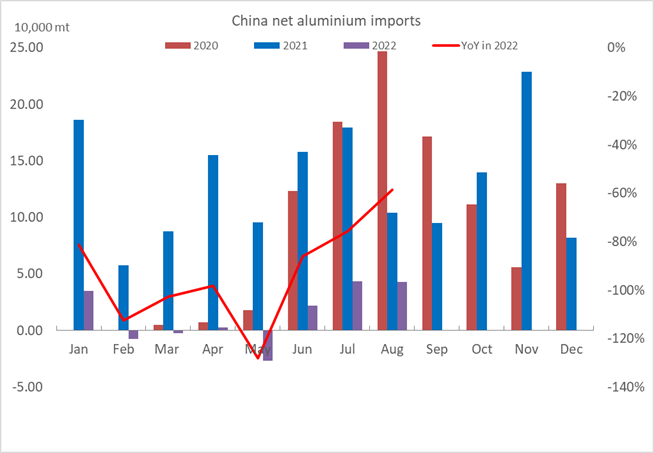
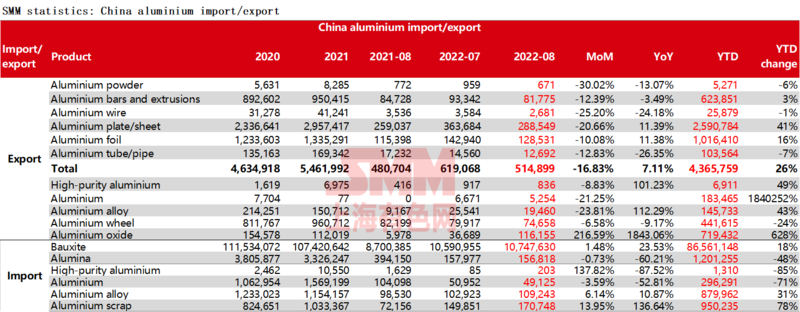
According to the General Administration of Customs, the import volume of primary aluminium in August stood at 49,300 mt, down 3.35% MoM and 53.3% YoY. The imports totalled 297,600 mt from January to August, a year-on-year drop of 71.1%. China's exports of primary aluminium in August were 6,100 mt, a decrease of 21% month-on-month, but an increase of 1,425% year-on-year. The net import volume in August recorded 43,200 mt, down 0.43% MoM and 58.9% YoY. The net imports were 107,200 mt from January to August, a year-on-year drop of 89.54%. (The above import and export data is based on HS code 76011090, 76011010) Based on the monthly net import data from January to August this year, it started to rally from June to August, with obvious momentum in the follow-up period.
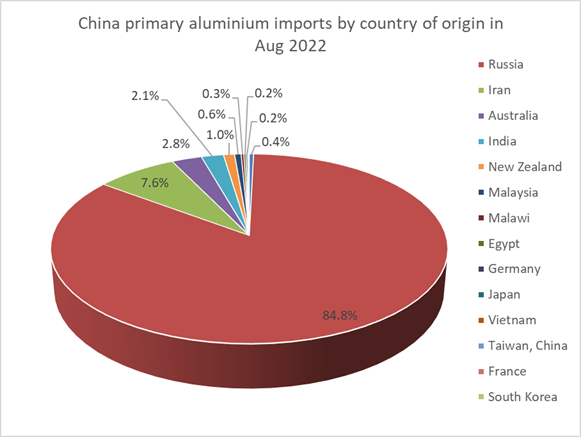
Judging from the country of origin in August, the imports still mainly came from the Russia with a volume of 42,000 mt, taking up 84.5% of China’s total imports. The imports from Russia stood at 231,000 mt for the first eight months in 2022, taking up 77.5% of the total, raking first among all the supplying countries to China. In addition, although the proportion of aluminium ingots imported from Iran and Malawi in July and August was small, there is a sign of further growth. According to market feedback, there are still some Iran aluminium ingots in transport, which are expected to arrive soon.
SMM attribute the inflow of Iran aluminium ingots to the following two reasons: ① Iran has expanded its aluminium capacity in 2022. According to the data of the Iranian Mining Development and Innovation Organization, the production of aluminium ingots in Iran totalled 538,600 mt throughout Iranian calendar year 1400, a year-on-year increase of 20%. Among the four major producers in Iran, Iran Aluminium Corporation ranks first, which produced 177,000 mt of aluminium ingots. Currently, Iran is the 18th largest aluminium producer in the world. Iran plans to reach the goal of producing 1.5 million mt of aluminium ingots annually by Iranian calendar year 1404 (March, 2025 - March, 2026). ② Overseas demand in Europe and other countries has deteriorated, and local companies have been seeking better sales channels.
Aluminium semis exports:
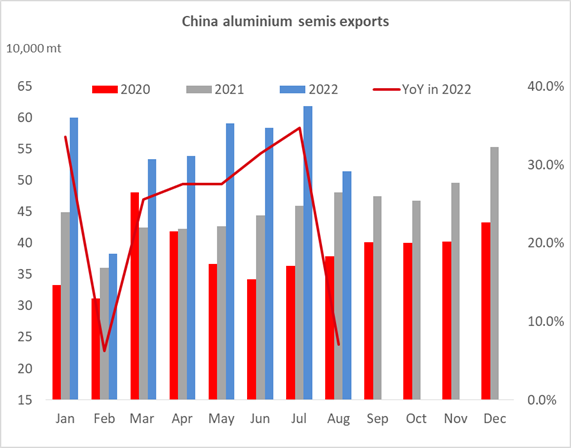
According to customs data, China's aluminium semis exports in August 2022 were 515,000 mt, an increase of 7.11% year-on-year and a drop of 16.83% month-on-month. In August, the export volume of domestic aluminium plate/sheet and foil as well as aluminium bars and other aluminium semis all declined to varying degrees on a MoM basis, especially aluminium plate/sheet and powder. The exports totalled 4.37 million mt from January to August, a year-on-year gain of 26%.
SMM believes that the MoM declines in the export volume are mainly due to the following causes:
① The high inflation in Europe and the United States continues to inhibit local demand, including aluminium semis and other products. For example, according to relevant news, cars in Europe and other regions are affected by the shortage of key components and chips, and the operating rates of the auto industry have declined. Some factories are reducing car production and waiting for the supply of chips.
② The export profits of aluminium semis fell, containing the export enthusiasm. In July and August, the domestic and overseas aluminium prices were fell as a whole. The domestic aluminium export profits fell compared with the first half of the year along with falling LME aluminium prices. In addition, geopolitical conflict has made enterprises worry about payment collection and other issues, and their willingness to export has also declined.
SMM Comments: In September-December, the domestic aluminium prices are likely to rise amid production cuts in Sichuan and Yunnan province. Meanwhile, overseas aluminium prices are constrained by macroeconomic recessions such as interest rate hikes in Europe and the United States. The SHFE/LME price ratio will rebound, paring the import loss of overseas aluminium ingots. Some low-priced Southeast Asia aluminium may flow into China. And according to foreign media, due to difficulties in finding buyers, Rusal is working on a plan to deliver aluminium directly to the LME warehouses in Asia. This may allude subsequent increase in the amount of Rusal aluminium ingot entering China. It is expected that in the future, domestic primary aluminium will maintain a positive value in net import volume with continuous growth. SMM estimates that the total net import of primary aluminium from September to December may reach 200,000 mt, and the net import volume throughout the entire year may stand at around 310,000 mt, a decrease of nearly 80% year-on-year.
In terms of aluminium semis, the export volume has increased significantly in 2022. But the export orders have been lacklustre amid poor overseas demand, according to the manufacturers. Nevertheless, the overseas aggressive interest rate hike is expected to come to a halt, and the total production reduction of European aluminium smelters has been too significant to be supplemented by primary aluminium from Russia and other sources. Therefore, overseas demand will need to be filled up with the exports of Chinese goods. However, compared with the first half of the year, the export profits of aluminium semis may continue to fall, which also suppresses the export volume. SMM predicts that domestic aluminium semis exports will maintain a year-on-year increase from September to December, but the growth may slow down.
![Preços do alumínio despencam novamente, mercado à vista excepcionalmente fraco [Análise diária do alumínio à vista no sul da China da SMM]](https://imgqn.smm.cn/usercenter/TFHUe20251217171651.jpg)
![Enfraquecimento do suporte de custos, aliado à realização insuficiente na alta temporada, pressionou o centro de preços do ADC12 para baixo [Revisão Semanal de Sucata de Alumínio e Alumínio Secundário]](https://imgqn.smm.cn/usercenter/XUnxM20251217171723.jpeg)