SMM Analysis of the Impact of Power Shortages in Yunnan on Chinese Aluminum Supply

Publicado: Sep 2, 2022 10:41
Fonte: SMM
SHANGHAI, Sep 2 (SMM) - Not long after the stringent power rationing policy in Sichuan, Yunnan, another aluminium production hub, has also suffered from hydropower shortages recently, triggering concerns over supply in the province.

SHANGHAI, Sep 2 (SMM) - Not long after the stringent power rationing policy in Sichuan, Yunnan, another aluminium production hub, has also suffered from hydropower shortages recently, triggering concerns over potential output reduction in the province. SMM’s latest survey showed that most of the aluminium smelters in Yunnan are currently in normal operations, but they have expressed concerns over the future power supply. Many aluminium smelters in Yunnan have recently undertaken orderly electricity consumption and practice of power load interruptions. As a major aluminium producing province that relies heavily on hydropower, the operations of aluminium smelters in Yunnan will have a significant impact on the entire aluminium industry.  

Aluminium capacity distribution in Yunnan 
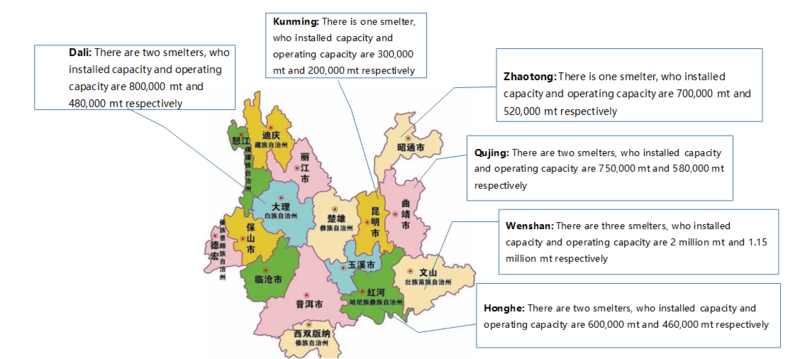
 

Driven by multiple favourable policies and low-carbon initiative, a tremendous amount of aluminium capacity has been relocated to Yunnan in recent years. In 2021, Yunnan cancelled the preferential power tariff policy to the aluminium industry that it had previously promised, under the requirement of the National Development and Reform Commission (NDRC) in its Notice on Tiered Power Tariffs in Aluminium Industry. Nevertheless, under the push to achieve carbon peak and carbon neutrality goals, Yunnan attracted smelters from other regions to transfer their aluminium capacity to the province by virtue of its abundance of cheaper green hydropower. 

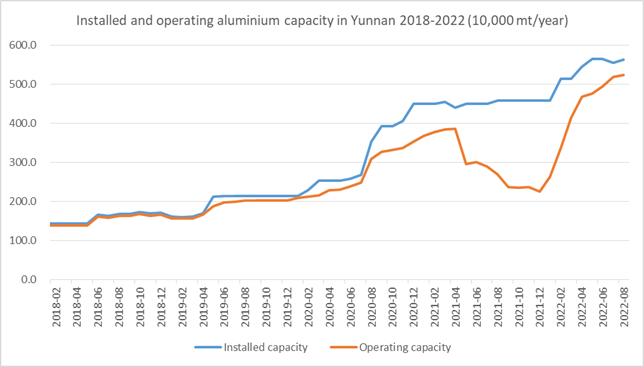
According to the latest statistics of SMM, the installed aluminium capacity in Yunnan currently stands at approximately 5.63 million mt, up 23% year on year and accounting for 12.7% of China's total installed aluminium capacity. As of the end of August, the operating aluminium capacity in Yunnan stood at 5.25 million mt, up 94.4% year on year. As more smelters, such as Weiqiao Group, will transfer their capacity to Yunnan, the installed aluminium capacity in the province looks set to exceed 9 million mt in the future, ranking first in the country. 

According to data from the Energy administration of Yunnan, with the 12 big hydropower stations, such as Wudongde, Baihetan, Xiluodu, Nuozhadu, Huangdeng, Guanyinyan and Ludila, being put into operation successively, Yunnan's installed hydropower capacity has surged from 34.99 million kW to 78.2 million kW, ranking second in China. 7 out of the top ten hydropower stations in China are located in Yunnan, which also has 3 power stations of 10 million kW and 14 power stations of 1 million kW. Yunnan's installed power capacity has jumped to 100 million kW, with green energy power generating capacity accounting for about 90%, 60 percentage points higher than the national average. From January to July, Yunnan's industrial power generation above designated size reached 213.11 billion KWH, up 16.1% year on year. Specifically, its hydropower generation stood at 171.03 billion KWH, up 26.8%, and thermal power generation at 25.47 billion KWH, down 17.1%. Clean electricity accounted for 88.1%, 4.2 percentage points higher than the same period last year. 

According to the feedback from aluminium smelters in Yunnan, the electricity supply in the province was normal from January to August, and hydropower was abundant in the first half of this year, encouraging local smelters to resume their production or put their new capacity into operation at a faster pace. The operating aluminium capacity in the province constantly refreshed new highs, intensifying the local supply pressure. 

Nevertheless, local hydropower companies said that nearly half of the main power stations reported insufficient water supply in August, and the water storage of main reservoirs decreased when compared with last year, which could threaten the power supply in Yunnan this winter and next spring. Based on the current water level and rainfalls, the market is increasingly concerned about the operations of aluminium smelters in Yunnan. Smelters may be subject to power rationing and production curtailment after the dry season arrives.

According to SMM's preliminary estimates, the domestic installed aluminium capacity totalled 44.47 million mt at the end of August, while the operating capacity decreased 800,000 mt from the end of July to 40.6 million mt. If 20-30% of aluminium capacity in Yunnan is reduced due to the power rationing, the domestic operating capacity may fall below 40 million mt, and domestic aluminium supply pressure will be significantly alleviated in 2022. The uncertainty over future power supply will have an impact on the transfer of aluminium capacity from other regions to Yunnan, and SMM will keep a close eye on the operations of local smelters.

Declaração sobre a Fonte de Dados: Com exceção das informações publicamente disponíveis, todos os demais dados são processados pela SMM com base em informações publicamente disponíveis, comunicação de mercado e com base no modelo de base de dados interna da SMM. São apenas para referência e não constituem recomendações para a tomada de decisão.

Para quaisquer perguntas ou para obter mais informações, entre em contato: lemonzhao@smm.cn
Para mais informações sobre como aceder aos nossos relatórios de investigação, entre em contato:service.en@smm.cn
Notícias Relacionadas
PMI Industrial dos EUA cai para 53,8 em julho, PMI de Serviços atinge máxima de oito meses
há 12 horas
PMI Industrial dos EUA cai para 53,8 em julho, PMI de Serviços atinge máxima de oito meses
Leia mais
PMI Industrial dos EUA cai para 53,8 em julho, PMI de Serviços atinge máxima de oito meses
O PMI preliminar da indústria de transformação dos EUA do S&P Global caiu inesperadamente para 53,8 em julho, o menor valor desde março, enquanto as expectativas do mercado apontavam para uma subida para 54,3. Em contraste, o PMI preliminar dos serviços ficou em 53,6, o maior nível em oito meses, elevando o PMI composto preliminar para 53,6, também o maior em oito meses, com ambas as leituras a excederem significativamente as expectativas do mercado.
há 12 horas
Trump Discute Estratégia de Saída da Guerra com o Irã: Escalada Militar ou Negociações em Meio a Diálogos Contínuos
há 12 horas
Trump Discute Estratégia de Saída da Guerra com o Irã: Escalada Militar ou Negociações em Meio a Diálogos Contínuos
Leia mais
Trump Discute Estratégia de Saída da Guerra com o Irã: Escalada Militar ou Negociações em Meio a Diálogos Contínuos
O presidente dos EUA, Trump, ao discutir a "estratégia de saída" da guerra com o Irã na Casa Branca, observou que os EUA enfrentam duas opções: primeiro, manter as operações militares atuais ou mesmo intensificar os ataques para desmantelar gradualmente as capacidades militares do Irã; segundo, chegar a um acordo por meio de negociações. Trump mencionou que, embora o Irã esteja interessado em um acordo, atualmente "ainda não está pronto". Ele afirmou que os EUA podem manter o ritmo atual das operações ou optar por intensificar os ataques mais rapidamente. Além disso, os EUA ainda estão negociando com o Irã.
há 12 horas
Midea Ar Condicionado troca a tradicional abertura do ano frio por uma estratégia focada no varejo em 2027
há 12 horas
Midea Ar Condicionado troca a tradicional abertura do ano frio por uma estratégia focada no varejo em 2027
Leia mais
Midea Ar Condicionado troca a tradicional abertura do ano frio por uma estratégia focada no varejo em 2027
De acordo com Yingketong, a Midea Air Conditioning anunciou oficialmente em julho de 2026 que não mais iniciará a tradicional Abertura do Ano Frio para o novo ano de refrigeração de 2027, comprometendo-se integralmente com uma nova estratégia de “lutar pelo varejo e competir pelos usuários finais”. Esta decisão marca uma pausa temporária no modelo de quase três décadas de “coletar pagamentos na baixa temporada e perseguir volume na alta temporada” na indústria de ar condicionado. A “Abertura do Ano Frio” é um ritmo de negócios único no setor de ar condicionado. Normalmente, a partir do segundo semestre (de julho/agosto a outubro/novembro), os fabricantes realizam aberturas em lotes, por meio de incentivos políticos, para atrair comerciantes do canal a efetuarem pagamentos antecipados e estocarem mercadorias. Em seguida, no primeiro semestre do ano seguinte, concentram os embarques por meio de várias promoções de vendas em grande escala, criando um ciclo de “empurrar o estoque na baixa temporada e perseguir o volume na alta temporada”. As medidas específicas da Midea Air Conditioning para o cancelamento da nova Abertura do Ano Frio incluem: não mais realizar reuniões de abertura que envolvam pagamentos centralizados do canal, vinculação a políticas e estocagem em larga escala; abolir a prática de “pagamentos antecipados obrigatórios para garantir políticas anuais”; e migrar para o reabastecimento no terminal com base na demanda real, com a implementação de políticas normalizadas em ciclo completo.
há 12 horas
SMM Analysis of the Impact of Power Shortages in Yunnan on Chinese Aluminum Supply - Shanghai Metals Market (SMM)