
Sales of NEVs Totalled at 896,000 Units Worldwide in June, and BYD Ranked First in the First Half

Publicado: Jul 29, 2022 11:24 (GMT+8)
Fonte: SMM
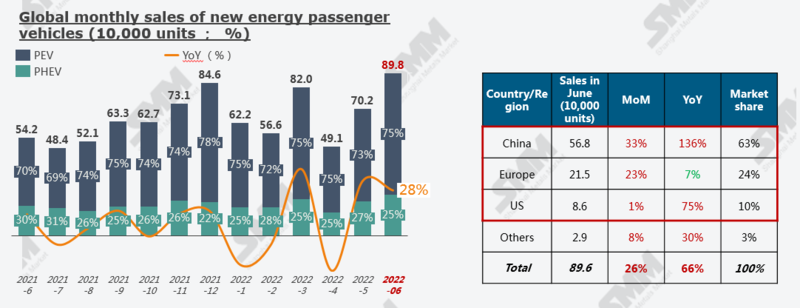
A total of 896,000 new energy vehicles were sold worldwide in June, up 26% MoM and 66% YoY. Among them, 672,000 pure electric cars were sold, an increase of 30% month-on-month, accounting for 75% of the total sales, while 225,000 plug-in hybrid electric cars (PHEVs) were sold, an increase of 15% month-on-month, accounting for 25%.

SHANGHAI, Jul 29 (SMM) – A total of 896,000 new energy vehicles were sold worldwide in June, up 26% MoM and 66% YoY. Among them, 672,000 pure electric cars were sold, an increase of 30% month-on-month, accounting for 75% of the total sales, while 225,000 plug-in hybrid electric cars (PHEVs) were sold, an increase of 15% month-on-month, accounting for 25%. As the biggest NEV market in the world, China sold 568,000 NEVs in June, an increase of 33% MoM and accounting for 63% of the global market. Europe sold 215,000 NEVs in June, an increase of 23% MoM. The top seven countries in Europe were Germany, France, Britain, Norway, Italy, Sweden and Belgium, which together accounted for over 80% the sales in Europe. The United States sold just 86,000 NEVs in June, up 1% MoM.
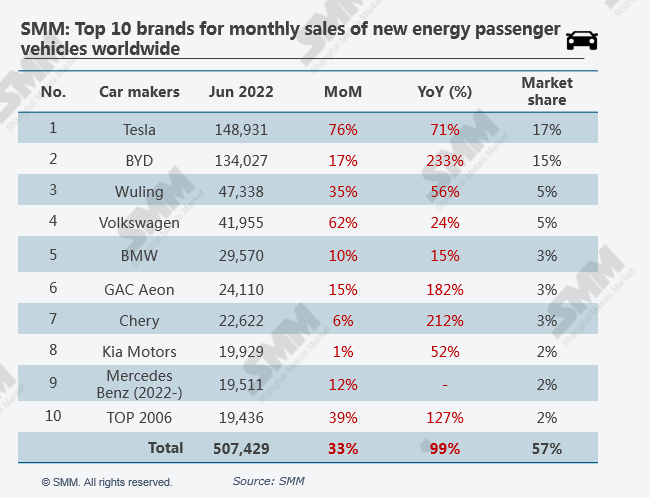
Tesla, the top car company in terms of sales, sold 148,931 unit in June, an increase of 76% month-on-month and 71% year-on-year. According to Tesla's Q2 financial report, its Shanghai and California factories both reached their highest monthly output in the second quarter. The California factory had an annual production capacity of over 650,000 units, and the Berlin Gigafactory had an annual production capacity of over 250,000 units. Tesla's four major factories all reported increasing production capacity. Elon Musk, Tesla's CEO, said that Tesla's car production might grow higher in the second half of this year. In June, BYD's global sales totalled 134,027 units, an increase of 17% month-on-month and a year-on-year increase of 233%, ranking second. BYD has sold more than 100,000 units for four consecutive months. Unlike Tesla that only sold electric vehicles suach as Model Y and Model 3, BYD's sales varied in terms of car models, and pure electric cars and plug-in hybrid electric cars were both included. In the new energy market, BYD's sales in the first half of 2022 exceeded 640,000 units, surpassing Tesla to rank first in the world. According to BYD's official estimates, BYD's total sales in 2022 will reach 1.5 million units, and are expected hit 2 million units if the supply chain is well established.
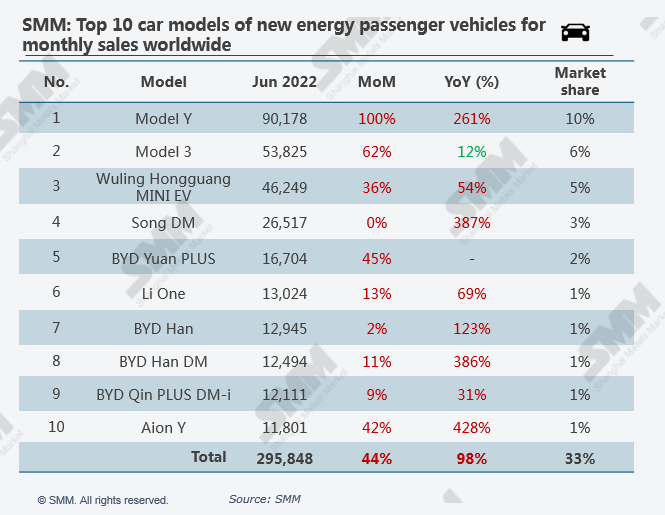
In terms of car models, Model Y, Model 3 and Wuling Hongguang MINI still remained the top three. The sales of Model Y were 90,000 units in June, an increase of 100% month-on-month and a year-on-year increase of 261%, while the sales of Model 3 in June were 54,000 units, up 63% on the month and down 12% on the year. The decline was attributed to the pandemic which led to suspended production at Tesla's Shanghai factory and reduced overseas exports. According to Der Spiegel, the German Ministry of Economic Affairs plans to end the subsidies for PHEV purchases earlier at the end of this year, and reduces the cash subsidies for purchasing electric vehicles by one-third from 2023. The Times also reported that the British government in June cancelled the policy of providing 1,500 pounds of subsidies for electric vehicles purchases. All these policies had affected the sales of electric vehicles. In June, five BYD models made it to the top ten list. Among them, Qin PLUS, whose sales had declined due to the rectification of production lines in its Changsha plant, sold 12,111 units after the rectification, an increase of 9% month-on-month and 31% year-on-year. 
At the same time, NEVs sales in Germany, Britain, France and Italy, who contributed most of the sales in Europe, fell by 10%, 1%, 9%, and 10% year-on-year respectively despite of increase on the month. This was mainly due to the impacts of Russian-Ukrainian war and subsiding subsidies. At present, the improved supply in the Chinese market and the rising oil prices have boosted the new energy market. The month-on-month increase in NEV sales in June was also significantly driven by favourable policies. In particular, some subsidies and new car consumption vouchers are effective only for first comers or may expire at the end of June, further boosting the sales of automobiles in June.

 

Declaração sobre a Fonte de Dados: Com exceção das informações publicamente disponíveis, todos os demais dados são processados pela SMM com base em informações publicamente disponíveis, comunicação de mercado e com base no modelo de base de dados interna da SMM. São apenas para referência e não constituem recomendações para a tomada de decisão.

Para quaisquer perguntas ou para obter mais informações, entre em contato: lemonzhao@smm.cn
Para mais informações sobre como aceder aos nossos relatórios de investigação, entre em contato:service.en@smm.cn
Notícias Relacionadas
Remessas de smartphones na China caem ano a ano no 3º trimestre; Huawei é a única grande marca a registrar crescimento de dois dígitos
há 18 horas
Remessas de smartphones na China caem ano a ano no 3º trimestre; Huawei é a única grande marca a registrar crescimento de dois dígitos
Leia mais
Remessas de smartphones na China caem ano a ano no 3º trimestre; Huawei é a única grande marca a registrar crescimento de dois dígitos
【Remessas de smartphones na China caem em termos anuais no 3º tri, Huawei é a única grande marca a registrar crescimento de dois dígitos】As remessas de smartphones na China no 3º trimestre de 2026 totalizaram aproximadamente 57,9 milhões de unidades, uma queda de 15,4% em relação ao ano anterior, em comparação com uma queda de cerca de 4% no primeiro semestre. Por fabricante, a Huawei deteve uma participação de 21,1%, um aumento de 17,3% em termos anuais, tornando-se a única grande fabricante a alcançar crescimento de dois dígitos; a Apple ficou com 17,8%, queda de 4,3%; OPPO 15,5%, queda de 17,6%; vivo 15,3%, queda de 24,9%; Xiaomi 13,8%, queda de 20,4%; e Honor 13,0%, queda de 24,2%. O trimestre foi caracterizado por queda nos volumes e aumento nos preços, já que o aumento dos custos elevou os preços médios de venda.
há 18 horas
A Guanghua Technology relata forte crescimento da receita nos três primeiros trimestres
há 18 horas
A Guanghua Technology relata forte crescimento da receita nos três primeiros trimestres
Leia mais
A Guanghua Technology relata forte crescimento da receita nos três primeiros trimestres
【Guanghua Technology registra forte crescimento de receita nos três primeiros trimestres de 2026】A Guanghua Technology divulgou seu relatório do terceiro trimestre de 2026, com receita nos três primeiros trimestres atingindo CNY 3,575 bilhões, um aumento de 74,89% em relação ao ano anterior, lucro líquido atribuível aos acionistas de CNY 129 milhões, um aumento de 42,29% em relação ao ano anterior, e lucro líquido não recorrente de CNY 124 milhões, um aumento de 40,44% em relação ao ano anterior. Somente no terceiro trimestre, a receita atingiu CNY 1,328 bilhão, um aumento de 74,15% em relação ao ano anterior, com lucro líquido atribuível aos acionistas de CNY 34,34 milhões, um aumento de 0,62% em relação ao ano anterior.
há 18 horas
Malásia divulga dados sobre volume de resíduos de baterias pela primeira vez, regime de reciclagem obrigatória ainda não implementado
há 18 horas
Malásia divulga dados sobre volume de resíduos de baterias pela primeira vez, regime de reciclagem obrigatória ainda não implementado
Leia mais
Malásia divulga dados sobre volume de resíduos de baterias pela primeira vez, regime de reciclagem obrigatória ainda não implementado
【Malásia divulga pela primeira vez dados sobre volume de resíduos de baterias em resposta parlamentar; regime de reciclagem obrigatória ainda não foi estabelecido】O Ministério dos Recursos Naturais e Sustentabilidade Ambiental da Malásia divulgou pela primeira vez, em resposta parlamentar escrita, que foram geradas 13.743,15 toneladas de resíduos de baterias da categoria SW103 em todo o país entre 2021 e 2025, com apenas sete instalações licenciadas de reciclagem fora do local em operação até março de 2026, localizadas em Kedah, Selangor, Johor, Perak, Negeri Sembilan e Penang. O ministério também confirmou que ainda não foi estabelecido um regime obrigatório de reciclagem de baterias (responsabilidade alargada do produtor) para fabricantes de veículos elétricos, estando a legislação ainda em estudo quanto à base jurídica, mecanismos de financiamento e coordenação interministerial. O Departamento do Ambiente está a elaborar as alterações da Fase 2 à Lei da Qualidade Ambiental de 1974, incorporando um mecanismo de lista negra dirigido a infratores reincidentes.
há 18 horas


