Since the beginning of this year, it is not uncommon for mortgage interest rates to fall, with popular cities such as Guangzhou, Nanjing, Hangzhou and Suzhou bearing the brunt. Individual cities have even appeared the state of "flying close to the ground".
A credit officer at a large state-owned bank in Suzhou said bluntly that it had now fallen to the "bottom line" and "can't be any lower," China News Service reported. Real estate agents in Suzhou have confirmed that recently, many banks in Suzhou have reduced the interest rate on their first home loans to 4.6%, which is the same as that of LPR. In recent years, Suzhou mortgage interest rates peaked around the beginning of 2020, at 6.12%.
"this has led to the recent popularity of the second-hand housing market in Suzhou, with nearly 10,000 second-hand houses on the platform in one month." The intermediary said that Suzhou mortgage interest rates hit bottom across the board, followed by a rebound may rise, many people are interested in this short window.
Data from the Shell Research Institute show that since March, the mainstream mortgage interest rates in 82 of the 103 cities have been reduced, with the average first home loan interest rate of 5.34% and the second home loan interest rate of 5.60%, down 13 and 15 basis points respectively from the previous month, the biggest monthly decline since 2019, and mortgage rates close to the level of the third quarter of 2020.
With the reduction of mortgage interest rates, the speed of lending has become more and more obvious. Since early March, loans can be approved in one or two days after the fastest face-to-face visa in Beijing, and loans can be made in three days after the transfer of ownership. An intermediary said that he basically handled the loan in more than a week, the slowest no more than half a month. Lending in the second half of last year will have to wait at least six months.
According to other media reports, the approval cycle of real estate loan issuance in Shanghai has also been further accelerated to 2 weeks from more than 4 months at the end of 2021 to 3 weeks. And when visiting the intermediary and some real estate salespeople, we learned that at present, some banks in Shanghai have not emphasized the flow of banks.
Property buyers in second-tier cities in the northeast said that the mortgage interest rates a month ago were as high as 5.7% for the first suite and 5.9% for the second suite. But now, the newly adjusted interest rates of many banks have touched 5.0% for the first suite and 5.2% for the second suite.
The buyer calculated an account: "with a house of 2 million yuan, the down payment is 500000 yuan and the loan is 1.5 million yuan for 30 years." The interest rate of 5.0% is more than 8000 yuan per month, and the interest rate of 5.7% is more than 8700 yuan per month. Over the past 30 years, we can pay back more than 200,000 yuan less, and a car has come out. "
Real estate policy continues to relax, and the impact of the epidemic can not be ignored.
Data from the Shell Research Institute show that since March, the mainstream mortgage interest rates in 82 of the 103 cities have been reduced, with the average first home loan interest rate of 5.34% and the second home loan interest rate of 5.60%, down 13 and 15 basis points respectively from the previous month, the biggest monthly decline since 2019, and mortgage rates close to the level of the third quarter of 2020.
Data compiled by the Donghai Futures Research Institute show that the sales area and sales of commercial housing in the month from January to February rose 6% and 1.6% respectively compared with December last year, while real estate sales are still weak. In terms of funding sources for real estate development, the growth rate from January to February was-17.7% compared with the same period last year, slightly narrowing 1.6% from the previous month, and the overall level was at a low level. New real estate construction increased by-12.2% year-on-year, down 19% from the previous month; real estate construction increased by 1.8% year-on-year, up 37.2% from the previous month; and completion increased by-9.8%, down 11.7% from last month.
The steel industry PMI released by the China things Union Steel Logistics Professional Committee yesterday showed that it was 44.3% in March 2022, down 3.0% from the previous month, and the growth rate of the steel industry slowed down. From the sub-index changes, in March, the domestic epidemic multi-point spread on the iron and steel industry is more obvious, steel production has declined, the overall market demand has tightened, raw materials and finished products logistics and transport pressure increased, market prices increased. However, the iron and steel industry has a stable recovery foundation in the future. It is expected that in April, the release of market demand will accelerate and steel production tends to pick up, but the cost pressure may continue, leading to a slight rise in steel prices.
Referring to the PMI of the steel industry in March, Zhu Shaonan, an analyst at Soochow Futures, believes that both supply and demand in the steel industry declined significantly in March, mainly due to the impact of the epidemic. The epidemic has led to the limitation of iron and steel raw materials, especially in large steel-producing cities like Tangshan, there are more blast furnaces overhauled and repaired. At the same time, the impact on demand is also very obvious, steel downstream enterprises affected by the epidemic limited start-up, steel demand is weak. At present, the impact of the epidemic is continuing, but it is expected to be well controlled in April, and the steel PMI data will pick up to a certain extent next month.
Qiu Yihong, an analyst at Haitong Futures, believes that steel PMI data and manufacturing PMI data both point to the impact of the epidemic on supply and demand and the manufacturing industry. On the one hand, it confirms the current situation of weak supply and demand in the steel market in March, on the other hand, it also implies that the market may have higher requirements for stable growth and related measures in the later stage. During the two sessions this year, "enhancing the core competitiveness of the manufacturing industry" was included in the government work report for the first time, and the direction is clearer than the positioning of "keeping the proportion of the manufacturing industry basically stable" last year. Especially in the context of rising inflation risks overseas, volatile situation, downward pressure on the domestic economy, and repeated epidemics, the strength of stable growth of follow-up policies actually needs to be guaranteed.
With the relief of the epidemic and the recovery of the real estate market, the related varieties are expected to climb?
Some market participants believe that in the future, with the relaxation of real estate policy and the cooperation of central bank interest rate cut and reserve reduction policy, the real estate market may continue to pick up. Specific to commodities, after April, with the advent of the domestic peak season and the epidemic may be gradually alleviated, steel is likely to rise in stages in the medium to long term.
As far as rebar is concerned, rebar is up more than 20% from its October low.
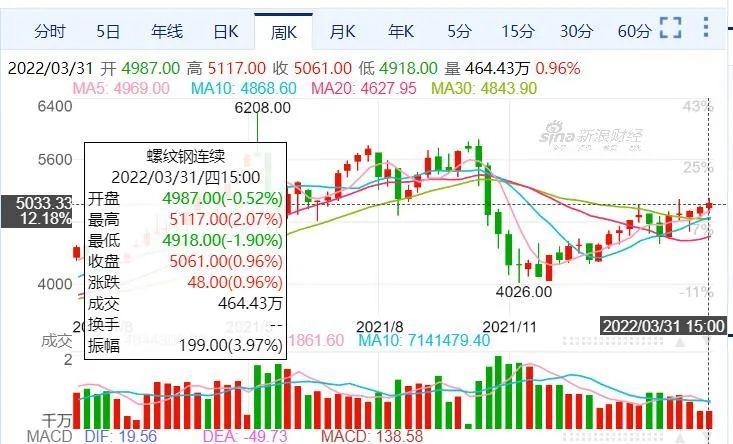
Qiu Yihong said that the rising market of steel is on the one hand because the trend of iron ore and double coke is stronger than that of finished products, so although the current demand for steel is relatively poor, prices are also rising due to rising costs. On the other hand, based on the optimistic expectation of demand after the relief of the epidemic, if the epidemic can see an obvious inflection point before mid-April, with downstream replenishment and work rush, demand will break out to a certain extent, and steel prices will continue to rise. However, the first quarter real estate start data is still relatively poor, steel demand is also difficult to have very optimistic expectations, and the current steel prices are already at a historically high level, for the future tend to oscillate too high, but should not look too high, at the same time need to pay attention to the duration of the epidemic and the landing of various policies.
In terms of fundamentals, Zhu Shaonan said that the current iron and steel market is in a pattern of weak supply and demand, the supply side is affected by the epidemic, raw materials are scarce, and steel mills are overhauled more. At the same time, due to the shortage of scrap resources and high prices, the operating rate of electric furnaces is even lower. On the demand side, it is also relatively weak. generally, the demand in March gradually rebounded from the previous month, and it was basically flat every week in March this year. At the end of March last year, the demand for steel products of the five major varieties reached 12.14 million tons, and this year it was only 9.93 million tons, a decrease of 2.21 million tons compared with the same period last year. Relatively speaking, the impact of demand is greater, resulting in a very slow decline in steel inventory.
The recovery of the housing market will further drive steel prices to rise to a high point?
Qiu Yihong partly agrees with this: first of all, a very important part of the real estate market is the credit situation. 1.19 trillion yuan of new social finance was added in February, which decreased significantly and was significantly lower than the market expectations. Residents' medium-and long-term loans even dropped from the second highest value in the same period to the lowest in the same period, with a negative value for the first time in history, indicating that the financial pressure of enterprises is still obvious, and the stimulating effect of residents' consumption is not significant. The transaction of commercial housing in the corresponding high-quality data is still relatively low. The current housing speculation will not change, the real estate market will not be flooded, and the cumulative growth rate of real estate investment will still be in the downward channel.
Secondly, there are indeed two obvious problems in the current real estate market: first, there is no improvement in the land market, which leads to a short-term improvement in the performance of the whole front end of real estate; second, sales are still in the doldrums. the credit problem of real estate enterprises superimposed the expectation of rising housing prices has hit the mentality of the market to buy up but not buy down, which makes a series of policies to promote consumption not fully transmitted to the actual demand. At present, we can not confirm the end of the weak cycle of the real estate downturn. Therefore, for the real estate industry, the policy risks are indeed cleared in an orderly manner, but the real estate enterprises are still facing greater pressure, and the impact on steel demand may not be as sufficient as the policy on the development of the industry. medium-and long-term steel demand is still uncertain.
Finally, the iron and steel market is under the intertwined background of weak reality and strong expectations. The main logic of the short-term steel market is still based on the relaxation of traffic control after the epidemic is stable and the expectation of resuming work and production. The peak demand season is delayed by the impact of the epidemic. However, from the accumulated experience of anti-epidemic in China, the time for the stability and even improvement of the epidemic situation is gradually approaching, and the demand compensation after the epidemic is worth looking forward to. The obstacles of logistics and transportation will also be gradually reduced, and the cost support force brought by the replenishment of raw materials is also on the strong side. Therefore, short-term demand replenishment and raw material replenishment logic will have the upper hand, steel raw materials and finished materials prices support is strong, but it is expected to be difficult to achieve medium-and long-term market.