SMM February 21: in the online live conference hosted by SMM on February 17, Liu Xiaoyi, senior analyst of SMM new energy industry, analyzed and prospected the supply and demand pattern of China's lithium market in the first quarter of 2022. She believes that from 2021 to 2022, driven by the slow putting into production of lithium mines and the high growth rate of demand in the new energy market, the prices of lithium carbonate and lithium hydroxide will rise all the way; followed by the successive commissioning of overseas mines, downstream demand will be met, and the price of lithium salt will be slightly adjusted.
I. Analysis on the Development of New Energy vehicles and Lithium Industry in the World and China
Global sales of new energy vehicles totaled about 6.79 million in 2021, up 114 per cent from a year earlier, compared with 3.54 million in China, with a penetration rate of 13.4 per cent, according to SMM. Driven by national policy support, the layout and investment of battery and car companies, and increased consumer acceptance of new energy vehicles, it is estimated that by 2025, the total global sales of new energy vehicles will be 18.35 million, and the penetration rate of domestic new energy vehicles will rise to 30%.
With the advantages of obvious cost and safety performance, the market share of iron-lithium battery will increase gradually in 21-23 years, and the ternary iron-lithium battery will occupy different market segments according to its technical characteristics in 24-25 years.
Compared with ternary battery, lithium iron phosphate battery has greater cost advantage and better safety performance, and its market share is expected to increase gradually from 2021 to 2023. The ternary battery mainly has the characteristics of high energy density, high energy density and good performance at low temperature. it is expected that ternary battery and lithium iron phosphate battery will occupy different market segments according to their different technical characteristics from 2024 to 2025.
According to previous statistics from SMM, China's lithium-ion battery production is expected to grow by 38 per cent from 2018 to 2021 and may remain at around 34 per cent from 2021 to 2025.
The advantages of safety and high performance-to-price ratio have led to the obvious outbreak of lithium iron phosphate market, and the future energy storage market will support a substantial increase in demand for lithium iron phosphate. China's lithium iron phosphate market will expand significantly from 2022.
Development trend of lithium iron phosphate: from the perspective of power field, due to the advantages of safety and cost performance, coupled with the improvement of low-temperature performance and energy density, its share in the power market (especially passenger cars and overseas) will continue to increase; from the field of energy storage, due to the advantages of cycle performance and the improvement of low-temperature performance, it is expected that the demand for lithium iron phosphate on the domestic power generation side and Electroweb side, as well as overseas household energy storage will be greatly increased in the future.
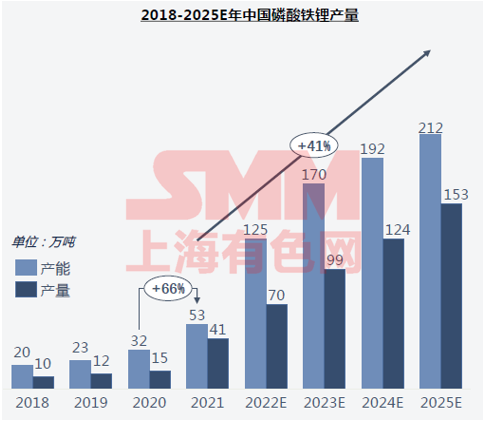
According to the forecast chart of China's lithium iron phosphate production from 2018 to 2025E compiled by SMM, China's lithium iron phosphate market will expand significantly from 2022. From 2021 to 2025, China's production of lithium iron phosphate is expected to grow by about 41%.
The general trend of high energy density, with solid-state batteries in the future, the improvement of safety and energy density will further consolidate the trend of high nickelization.
From the current domestic mainstream battery technology development route, high energy density battery has been the trend of the times. In the future, with the combination of high nickel ternary battery and solid state battery, the improvement of safety and energy density will further consolidate the trend of high nickel.
The increase of lithium demand mainly comes from electric vehicles and energy storage industry, and the demand of traditional industry is stable for a long time. The general trend of lithium iron phosphate in the past five years will increase the proportion of lithium demand.
According to the proportion of lithium demand of various industries in the world from 2018 to 2025 compiled by SMM, the increase in lithium demand in recent years mainly comes from electric vehicles and energy storage industry, and the demand for lithium in traditional industries has been stable for a long time.
In 2021, ternary materials accounted for 59% of lithium demand, and lithium iron phosphate accounted for 21%. Taking into account the rapid increase in the proportion of lithium iron phosphate in power batteries in recent years, it is estimated that by 2025, the proportion of lithium iron phosphate demand for lithium will increase to 30%, and the proportion of lithium demand for ternary materials will be reduced to about 56%.
II. Analysis and Prospect of supply and demand pattern of Lithium Salt Market in China in the near Future
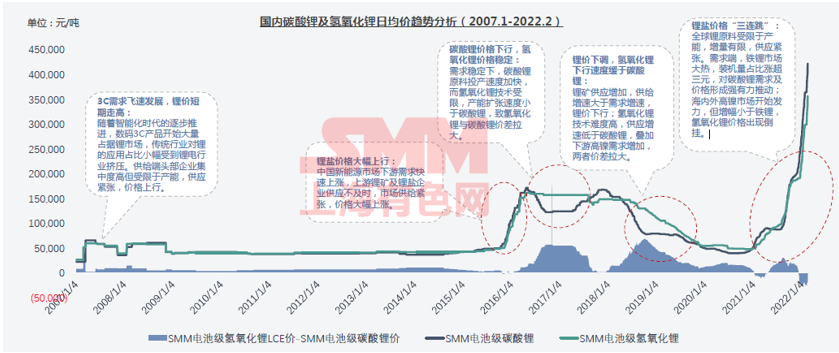
Historical price trend of lithium salt: the growth rate of lithium supply in 2015 was not as fast as that of demand, and lithium prices rose sharply; after three years of decline since 2017, lithium prices broke through an all-time high from 2021 to 2022
SMM compiled a chart of lithium prices from 2007 to 2022. As can be seen from the chart below, lithium prices fell for as long as three years from 2017 to the end of 2019, with the biggest drop in 2019, mainly due to the increase in the supply of lithium mines and the decline in lithium prices due to the growth rate of supply faster than the growth rate of demand. Lithium prices have risen rapidly since the second half of 2020, and lithium prices have experienced three consecutive jumps in 2021: global lithium raw materials are limited by production capacity, limited increments and tight supply. On the demand side, the iron lithium market is very hot, and the installed capacity accounts for more than three yuan, which strongly promotes the demand and price of lithium carbonate; the high nickel market at home and abroad begins to develop, but the growth rate is less than that of iron lithium, and the price of lithium hydroxide is upside down.
"Click to order to view the spot historical price of SMM new energy products.
Global Distribution of Lithium Resources: China's resources are more diversified than those of overseas countries
At present, there are mainly three types of lithium resources in the world: spodumene, salt lake and lithium mica, while China has these three types of lithium resources, which are more diversified compared with overseas countries.
In 2022, the global lithium supply is expected to increase by 26%, and lithium extraction from spodumene and salt lakes will be carried out at the same time, but the mainstream production capacity has been strongly bound and it is difficult to find in the spot market.
In 2022, the global supply of lithium resources is expected to be about 740000 tons of lithium carbonate equivalent, an increase of 26% over the same period last year. The output of spodumene concentrate was about 3.25 million tons, an increase of 36 percent over the same period last year, and the output of lithium extraction from salt lakes was about 288,000 tons, an increase of 34 percent over the same period last year.
Raw material end: the spodumene concentrate in China was obviously removed to the reservoir in 2021, and continued in 2022, and the price increased gradually.
According to SMM statistics, spodumene concentrate in China will obviously go to the warehouse in 2021, and the situation will continue in 2022, and the price of spodumene concentrate will continue to rise.
Distribution of Lithium smelting Enterprises and Raw material usage in China
China's lithium smelting enterprises are mainly distributed in Shandong, Jiangxi, Qinghai and Sichuan, in which Jiangxi mainly extract lithium from lithium mica, Qinghai and Tibet mainly extract lithium from salt lakes, and Tibet, Shandong, Jiangxi and Jiangsu mainly extract lithium from spodumene.
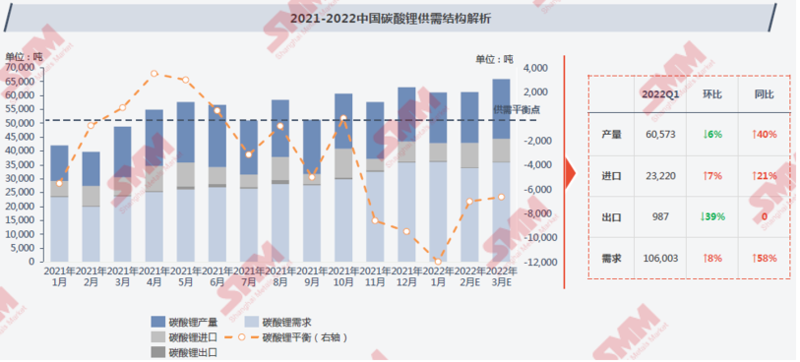
Since July last year, the monthly balance of lithium carbonate has continued to go to the warehouse, and the gap in the Q1 market in 2022 has been enlarged under the influence of the overhaul of lithium salt enterprises around the Spring Festival.
From the analytical table of supply and demand structure of lithium carbonate in China from 2021 to 2022, we can see that the monthly balance of lithium carbonate has been removed continuously since July 2021. Until the first quarter of 2022, under the influence of the overhaul of lithium salt enterprises around the Spring Festival, the gap between supply and demand of lithium carbonate enlarged.
Lithium iron phosphate was driven by the power market and the demand was strong in the second half of Q1 from 2021 to 2022. The operating rate of lithium manganate market decreased significantly due to the influence of cost.
From 2021 to 2022, Q1 lithium iron phosphate is driven by the power market, and the demand is strong. While the lithium manganate market is affected by the cost, the operating rate has decreased significantly, and the demand for lithium carbonate has dropped. The demand for lithium carbonate in the ternary material market is relatively stable.
Short-term and long-term forecasts: high demand growth in 2021-22, insufficient supply of raw materials and rising prices; new overseas mines and salt lakes were put into production in 2023-24, with a slight correction in supply, demand and prices; lithium carbonate may still be in shortage under the outbreak of the energy storage market in 2025.
In terms of lithium carbonate, in the short term, SMM predicts that the shortage of raw materials, driven by the high demand growth rate of lithium carbonate from 2021 to 2022, may lead to a sustained rise in the price of lithium carbonate. From 2023 to 2024, with the commissioning of new overseas mines and the improvement of salt lake mica technology to meet the downstream demand, the price of lithium carbonate will be adjusted slightly. By 2025, lithium carbonate may still be in short supply under the explosion of the energy storage market.
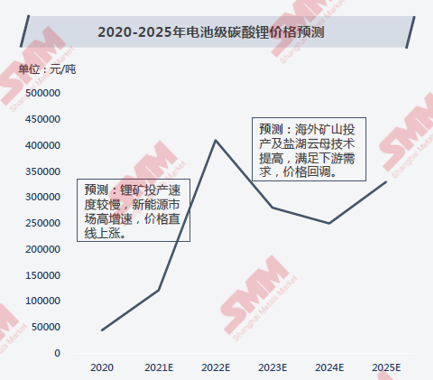
In terms of lithium hydroxide, the domestic demand has greatly increased, maintaining a tight balance in the third quarter of 2021 and mainly removing the warehouse in the fourth quarter; after the 2022 festival, Q1 mainstream enterprises have annual maintenance, and the market has been stripped of the warehouse obviously.
Since the third quarter of 2021, the domestic demand for lithium hydroxide has increased greatly, the lithium hydroxide market has maintained a tight balance in the third quarter, and mainly in the fourth quarter. Entering the first quarter of 2022, the annual maintenance of mainstream enterprises after the festival, the lithium hydroxide market goes to the warehouse obviously.
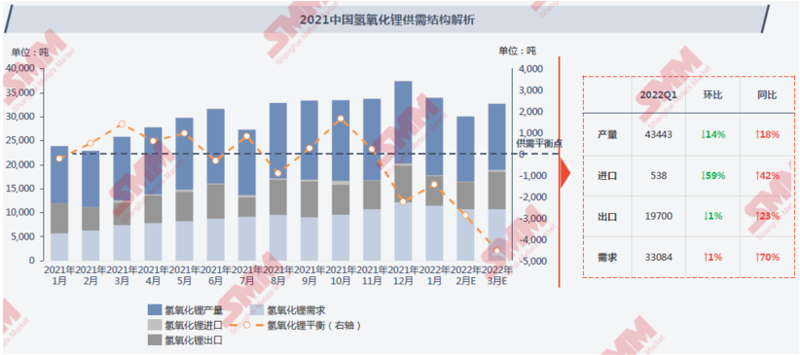
Short-term and long-term forecasts: demand for high growth in the second half of 2021-22, shortage of raw materials and rising prices; new overseas mines were put into production in 2023-24, supply and demand and prices were slightly adjusted; 25 years of overseas high nickel demand broke out, lithium hydroxide may still be in gap.
In the short term, from 2021 to the second half of 2022, it is expected that with the rapid growth of demand for lithium hydroxide in the new energy market, lithium ore will be put into production slowly, and the shortage of raw materials may cause lithium hydroxide prices to continue to rise; from 2023 to 2024, as overseas spodumene concentrate mines are put into production to meet downstream demand, lithium hydroxide prices will stabilize; by 2025, when overseas high nickel demand breaks out, lithium hydroxide may continue to have a supply gap.
April 20-22 (the Seventh China International Conference on New Energy) 2022
New ecology of sustainable and high development
As the global carbon emission requirements become more stringent year by year and superimposed multinational subsidy policies and other incentives, the European market electrification route is clear. Including the Netherlands, Norway, the United Kingdom, Sweden and other European countries have formulated a ban on the sale of fuel vehicles, starting from 2025 to stop the sale of fuel vehicles. Driven by this, the global output of new energy vehicles is expected to exceed 18 million in 2025.
At present, under the promotion of the "double carbon" strategy, the automobile industry is also accelerating the development of low carbon, and the development of new energy vehicles is ushering in new opportunities. Driven by policy and global electric trend, the whole industry chain from mine to vehicle has entered the Pentium era. The ensuing contradictions also gradually appear, the mismatch between supply and demand between the industrial chain, resulting in significant fluctuations in the price of battery materials and raw materials in various links, "short board" highlights whether it will affect the coordinated development of the industrial chain? At this time of both opportunities and challenges, SMM sincerely invites you to attend the "2022 (Seventh) China International New Energy Conference". Jointly explore the development and changes of new energy sources for lithium electricity.
April 20-22 invites you to gather in Chengdu!

![[Resumo da Reunião Matinal de Cobalto-Lítio da SMM] Produtos Químicos de Lítio se Consolidam e Divergem, Intensifica-se o Cabo de Guerra entre Oferta e Demanda na Cadeia Industrial](https://imgqn.smm.cn/usercenter/tKgKv20251217171725.png)
![[SMM Resumo da Reunião Matinal sobre Cobalto] Demanda da alta temporada fica aquém das expectativas, competição na cadeia industrial continua a se intensificar](https://imgqn.smm.cn/usercenter/eGQFu20251217171723.jpeg)