First, the industry chain tracks the latest feedback
Short-term price & annual price.
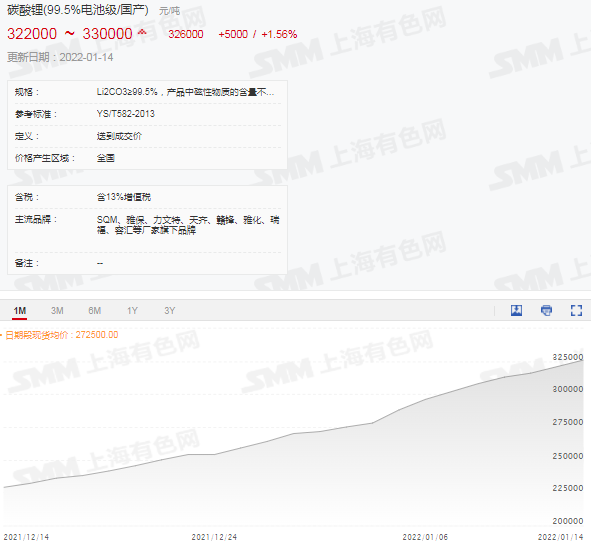
This week (January 10-January 14) SMM quoted, the price of battery-grade lithium carbonate is 320-330,000 yuan / ton, industrial-grade lithium carbonate price is 300,000-310,000 yuan / ton, part of the competitive price is 355-365,000 yuan / ton; the price of lithium hydroxide is about 270,000-300,000 yuan / ton. Since the end of the fourth quarter of last year, this round of increase has reached 150000 / ton, mainly due to the reduction in supply after the superposition of downstream reserve demand after the fourth quarter.
"Click to view the spot price of SMM metal
In terms of price rhythm, determined by supply and demand, the trend is expected to be similar to that of 21 years. After the Spring Festival, the price increase has weakened, prices have stabilized, and a new round of rise has begun at the end of the second quarter and the third quarter after the horizontal market. In terms of variety, lithium carbonate rises first, and the increase in lithium hydroxide is expected to catch up by the middle of the year.
Year-round price, the industrial chain is relatively optimistic about this year's price judgment, shouting out a relatively high price. At the same time, we are relatively optimistic about this year and next year. There is a strong certainty that supply falls short of demand in 22 years; many expansion projects in 23 years are planned to be put into production in the second half of the year or the end of the year, considering capacity climbing, which means that the increment of supply in 23 years is limited, and demand is still in short supply in 23 years. The degree of shortage in 24-25 years may ease, but there is a good chance that the trend of supply falling short of demand will not be reversed.
Downstream acceptance. The conclusion is that both domestic and overseas customers, the lower reaches of the current price is fully accepted, the spot is currently in a difficult state. Generally feedback, battery and car companies are more concerned about the market share, and are more worried about the lack of resources to guarantee supply and accept the reality of shortage of resources.
II. Several issues of concern to the market
Is lithium a 21-year-old photovoltaic silicon material? Can you wait until the lithium price falls to the inflection point? We believe that lithium is a resource product and silicon is an industrial product, which cannot be completely equated. The raw materials of silicon are not scarce, so you can invest if you have funds, and it will take about a year to expand production. The production expansion cycle of lithium ore ranges from 2 years to 3-5 years; it takes 6 months for downstream lithium batteries and 1 year for cathode materials, that is, the imbalance between supply and demand is at least 2-3 years.
What is the price affordability of several lower reaches? The four major downstream of lithium: power battery, consumer battery, energy storage, traditional industry. Price affordability is in the following order: power-consumption-traditional industry-energy storage.
How many cars can 21 years of lithium meet? According to the forecast of Guojin New Energy vehicle team, 10 million trams were sold worldwide in 22 years. According to the lithium demand of each vehicle corresponding to 50kg, the power link corresponds to the demand of 500000 tons. We estimate that the lithium supply in 22 years will be 682000 tons, that is, the remaining 180000 tons of lithium supply in the three major downstream areas of consumption, energy storage and traditional distribution, corresponding to 60-80,000 tons, 30,000-40,000 tons and 80,000 tons of demand in the three areas respectively, which is the same as the same period last year or slightly lower than the same period last year. It means that by slightly reducing the demand in the other three major areas, 22 years of lithium can meet the demand for 10 million new energy vehicles. If demand in the other three major areas is to grow year-on-year, 22-year lithium can also meet the demand for 9 million new energy vehicles.
Fourth, investment advice & the choice of the target.
From a fundamental point of view, the shortage of lithium resources in 22 and 23 years is difficult to be greatly alleviated in 24 and 25 years, and lithium has the attribute of periodic growth. At present, the market still treats lithium as a cyclical price increase in stock prices. The market needs to accept the high prices and high profits of the lithium sector for at least the next two years, especially for companies with resources.
The next good layout time point judgment of the plate is before the first quarterly report, the fundamental data strengthening verification + the highly elastic performance catalysis of the first quarterly report. On the target, we focus on the performance thinking in the past 22 years, dividing the plate, focusing on the companies with resources, processing capacity and future growth, leading Tianqi lithium industry, Ganfeng lithium industry, flexible Yongxing materials, Shengxin lithium energy, Koda manufacturing and so on.
Fifth, risk hint
Lithium mine new production capacity, resumption of production capacity put into production faster than expected, and so on.
![[Boato sobre bateria de estado sólido refutado: Wang Fang, do CATARC, afirma que nenhuma determinação de conformidade foi feita para empresas de baterias de estado sólido]](https://imgqn.smm.cn/usercenter/JSjkr20251217171728.jpg)
![[Bateria de lítio: Foshan Plastics planeja mais de RMB 7 bilhões para capacidade de separadores de alta qualidade]](https://imgqn.smm.cn/usercenter/aXRJI20251217171728.jpg)
![[Estado sólido: ProLogium inicia produção em massa de células totalmente em estado sólido de 3,5ª geração com 381 Wh/kg]](https://imgqn.smm.cn/usercenter/mpqgn20251217171727.jpg)