SMM: as we all know, there are two major salt lake bases in China, one is Qinghai Salt Lake with early start and strong concentration, and the other is Tibet Salt Lake with good resource endowment and great potential. Among them, Qinghai Salt Lake, as Xi Jinping once visited on the spot and emphasized the existence of speeding up the construction of a world-class salt lake industrial base, is favored by people in the industry. At present, the lithium extraction industry from salt lakes in Qinghai has begun to take shape, and its development speed is obviously faster than that in Tibet.
As the largest and most abundant soluble potassium and magnesium salt deposit in China, Qinghai Chaerhan Salt Lake has the largest lithium chloride reserves of 12.04 million tons, ranking first in the country. Even the former "loss king", * ST Salt Lake, which accounts for about 3700 square kilometers of the salt lake's resources, has been driven by the recent lithium extraction of the salt lake and is preparing to re-list on August 10th.
It is worth mentioning that * ST Salt Lake holds a total of 51.42% of Lanke Lithium, while another 48.58% is owned by Koda through its wholly-owned subsidiary Qinghai Koda Lithium Co., Ltd., and the holding subsidiary Qinghai Weili New Energy Materials Co., Ltd. As early as the end of 2020, in order to support the expansion of Lanke Lithium Industry's annual production capacity of 20, 000 tons of battery-grade lithium carbonate, * ST Salt Lake and Koda Manufacturing added up to 620 million yuan.
Now, after nearly four years of efforts, Lanke Lithium's battery-grade lithium carbonate project is in the climbing stage. With the arrival of summer, the company's lithium carbonate production has entered a high-yield period, and the daily lithium carbonate production has increased to 100 tons. What is even more admirable is that Lanke Lithium Industry's new annual production capacity of 20,000 tons of battery-grade lithium carbonate is being integrated with the company's existing 10,000 tons of lithium carbonate workshop by using some of the devices in the expansion project. Therefore, in the current peak season of lithium carbonate, according to the production capacity of 100 tons per day, the company has basically reached a comprehensive production capacity of 30,000 tons per year.
* ST Salt Lake said that the new expansion project of Lanke Lithium is expected to reach full production around October, when the company will have an actual annual production capacity of more than 30, 000 tons of lithium carbonate.
In addition to ST Salt Lake, which is famous for its recent listing announcements, there are Minmetals Salt Lake, Zangge Holdings and CITIC Guoan in Qinghai, which are also continuing to expand their production capacity to lithium salt.
According to the data, Minmetals Salt Lake is responsible for the Yiliping lithium mine in Qinghai, with lithium reserves of about 1.8 million tons (equivalent to 1.6 million tons of lithium carbonate). Now, the company has built a lithium carbonate production line with an annual capacity of 10, 000 tons. As for Zangge Holdings, its daily production of lithium carbonate is about 30 tons, and the company plans to sell 10, 000 tons of lithium carbonate in 2021.
Citic Guoan has a production capacity of 10,000 tons / year of lithium carbonate in Xitai Jinel Salt Lake, with a planned capacity of 20,000 tons / year. In addition, Qinghai Hengxin Lithium Industry, which has an annual production capacity of 20,000 tons of lithium carbonate, and Qinghai CITIC Guoan Lithium Industry (Xitaijinell Salt Lake) and Qinghai Xinghua (Dachaidan Salt Lake), which have an annual production capacity of more than 5000 tons of battery-grade lithium carbonate, The production capacity of lithium carbonate produced by Qinghai Salt Lake has basically reached 100000 tons per year.
At the domestic expert review meeting of the Plan and Action Plan for Building a World-class Salt Lake Industrial Base held on May 20, the review meeting made it clear that it is necessary to appropriately expand the development scale of lithium resources. we will strive to increase the annual output of lithium products in Qinghai to 150000 tons by 2025, to 180000 tons by 2030, and to 200000 tons by 2035, so as to build a world-class industrial base.
It should be noted that at present, China is still facing a shortage of lithium ore, and most of the spodumene concentrate needs to be imported. Recently, due to the historical high price of spodumene concentrate auctioned by Australia's main lithium mine Pilbara, which led to the rise in spodumene concentrate prices abroad, salt lakes, which can use local materials in China and have lower costs, have naturally been widely concerned by the industry again. Therefore, it is imperative to speed up the development of salt lake industry.
At the moment when the prices of raw materials are rising one after another, Qinghai Salt Lake enterprises have long been targeted by the major battery manufacturers downstream. Time New Energy, the subsidiary of Ningde Times with the largest production capacity of lithium iron phosphate, currently achieves the annual production capacity of 12GWh's lithium iron phosphate power battery and energy storage energy.
In order to win the mining rights of Dachidan Salt Lake owned by Dahua Chemical and further grasp the upstream lithium resources, Yiwei LiNeng announced that it planned to pay 110 million for a 5 per cent stake in Dahua Chemical.
Some institutions predict that the global supply of lithium carbonate is expected to reach 1.08 million tons in 2025, and there is a large gap. According to SMM's recent research, with the results of overseas pilbara lithium ore bidding, raw material shortage superimposed by rising mineral prices strengthens the willingness of smelters to quote prices, and the seller's market is obvious. From the perspective of supply and demand, overseas imports decreased, some manufacturers stopped production and maintenance led to a reduction in supply, demand terminal iron lithium plant gradually put into production, small power demand increased slightly, the domestic lithium carbonate market showed a tight balance, the material factory was weak and the transaction price was forced to rise. "View details
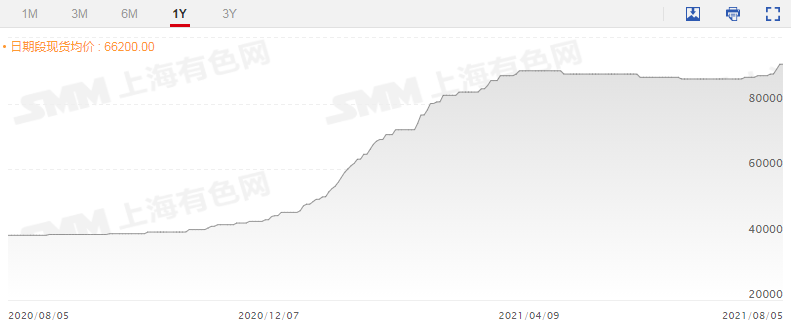
The spot quotation of SMM shows that as of Aug. 5, the average price of battery-grade lithium carbonate in China was 92000 yuan / ton, up 78.6% for the year.
"Click to view the spot market of SMM metal.
![[Análise SMM] Divulgados os dados comerciais de materiais para baterias de setembro: as importações de carbonato de lítio continuaram a subir em termos anuais. E os outros segmentos?](https://imgqn.smm.cn/usercenter/BmqWy20251217171726.jpg)
![Os preços dos produtos de cobalto permanecem sob pressão, com algumas empresas do mercado de sais de cobalto entrando em prejuízo. Quando os preços deixarão de cair? [Observação Semanal]](https://imgqn.smm.cn/usercenter/AmiJU20251217171730.jpg)