EU publishes 2020 edition list of key mineral resources

Publicado: Sep 18, 2020 16:03 (GMT+8)

SMM News: the European Union released the latest revised list of key mineral resources on September 3, 2020. a total of 30 minerals of great economic and strategic value to the European Union have been included in the EU 2020 critical resources list),.

The EU has routinely updated its list of key mineral resources every three years since it first published its list in 2008; the most recent update was in 2017. Compared with 2017, helium is deleted and lithium, strontium, titanium and bauxite are added to the list.

The list of key mineral resources in EU version 2020 is as follows:

Strontium, titanium, bauxite, lithium, antimony, light rare earth elements, phosphorus, barite, gallium, magnesium, scandium, beryllium, germanium, natural graphite, silicon-containing metal minerals (Silicon metal), bismuth, hafnium, natural rubber, tantalum, stone friends, niobium, tungsten, cobalt, heavy rare earth elements, platinum group metals, vanadium, coking coal, indium, phosphate rock, fluorite.

The only thing removed from the original list this time is helium; however, in view of the high concentration of helium supply, the EU will continue to pay attention to the dynamics of global helium resources and industry.

Although some of the existing minerals will be removed and new ones will be added in each update, the overall trend is that the number of key mineral resources in the list is increasing: 14 in 2011, 20 in 2014, 27 in 2017 and 30 this time. It shows that the EU is more and more dependent on key mineral resources and is more and more anxious about ensuring the safe supply of resources.

The 2020 version of the list focuses on externally dependent minerals, such as 98 per cent of rare earths from China, 98 per cent of borates from Turkey, 93 per cent of magnesium from China, 80 per cent of niobium from Brazil and 71 per cent of platinum group metals from South Africa. More than 60% of the world's cobalt comes from the Democratic Republic of the Congo, while more than 80% of the world's cobalt is processed in China before it becomes a battery-usable chemical.

The list also includes minerals with rapidly growing demand in the future. For example, lithium, as a necessary raw material for emerging high-tech industries and a conventional material for people's life, is known as the "energy metal of the 21st century" and is on the list for the first time this year. The EU predicts that EU lithium demand will increase 18-fold by 2030 and 60-fold by 2050. Over the same period, EU demand for cobalt will increase 5-fold and 15-fold, while demand for graphite will increase 4-fold and 14-fold, respectively.

The key mineral resources on the list are mainly rare metals such as rare earths (including light and heavy rare earths), niobium, tantalum, beryllium, hafnium, lithium and strontium, and rare elements such as indium, gallium and germanium, as well as coking coal, graphite, natural rubber and bauxite.

According to the announcement, these minerals have both significant economic value and supply risks, which have a significant impact on the industrial layout and investment of the European Union.

At the same time, the EU will also take necessary measures to expand its supplier network and reduce its dependence on a single country, with a focus on reducing its dependence on China. The main measures are:

(1) to form key mineral resources alliances, including industry members, investors, European Investment Banks, EU countries, and other countries that can help ensure the supply of key mineral resources in the European Union, in order to take joint action, increase the resilience of the European Union in the key mineral resources industry chain;

(II) to establish an international strategic partnership to strengthen mining cooperation with relevant countries in Canada and Africa from 2021 to promote the sustainable development of the local mining industry and ensure the supply of key mineral resources to the European Union;

(3) strengthen the mining, processing and smelting of mineral resources in the EU to reduce the degree of external dependence;

(4) strengthen the recovery and utilization of resources, especially the recovery and utilization of rare earth elements, the current recovery utilization rate is less than 1%.

Notice of meeting

Sponsored by SMM, Dongguan Magnetic Materials Industry Association, Ganzhou rare Earth Industry Association jointly sponsored the 2020 China rare Earth permanent Magnet Industry Market Application Development Forum will be held in Ganzhou, Jiangxi Province on October 15-16, when industry experts, business leaders, industry elites, investment circles and other people will gather together to explore the development trend of the rare earth industry and explore potential business opportunities in the industry. SMM sincerely invites you to join us for innovation and resplendence!

"Click to learn more and sign up online
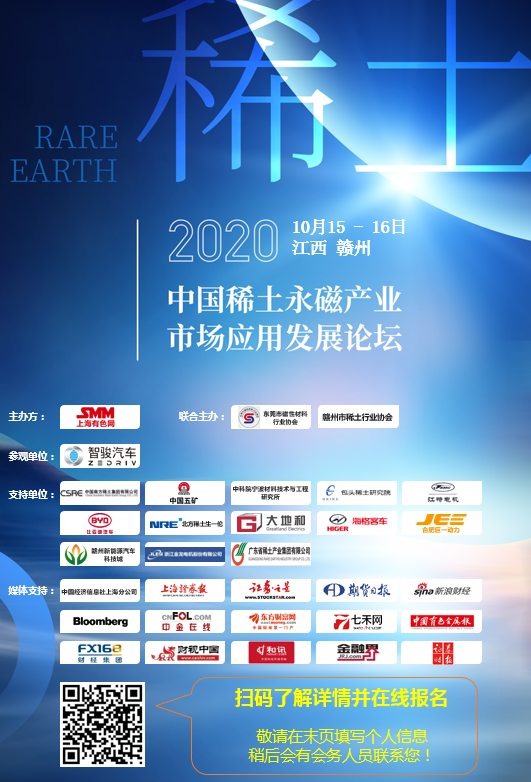
Please fill in your personal information on the last page and the meeting staff will contact you later!
Scan the QR code and apply to join the SMM rare earth industry exchange group
Declaração sobre a Fonte de Dados: Com exceção das informações publicamente disponíveis, todos os demais dados são processados pela SMM com base em informações publicamente disponíveis, comunicação de mercado e com base no modelo de base de dados interna da SMM. São apenas para referência e não constituem recomendações para a tomada de decisão.

Para quaisquer perguntas ou para obter mais informações, entre em contato: lemonzhao@smm.cn
Para mais informações sobre como aceder aos nossos relatórios de investigação, entre em contato:service.en@smm.cn
Notícias Relacionadas
Aterian reporta maiores vendas de minério 3T em Ruanda; margens de negociação permanecem estimativas
há 22 minutos
Aterian reporta maiores vendas de minério 3T em Ruanda; margens de negociação permanecem estimativas
Leia mais
Aterian reporta maiores vendas de minério 3T em Ruanda; margens de negociação permanecem estimativas
[SMM Flash de Tântalo] Os resultados intercalares da Aterian, divulgados a 30 de setembro, mostram £1,341 milhões de receitas de vendas de tântalo e outros minérios nos seis meses até 30 de junho de 2026, acima dos £20.000 do ano anterior. O lucro bruto foi de £522.000, enquanto o grupo registou um prejuízo antes de impostos de £568.000. O seu negócio de comércio no Ruanda mobilizou cerca de 2,18 milhões de dólares em capital de giro através de compras em joint venture. A administração avaliou as vendas potenciais dessas compras em 2,78 milhões de dólares, mas advertiu que a avaliação nocional não constitui receita reconhecida adicional. O lucro bruto de trading implícito de 602.000 dólares é também uma estimativa da administração, dependente de vendas concluídas, ensaios, preços realizados, custos e da alocação de lucros da joint venture. A Aterian afirmou que as inspeções de rastreabilidade limitaram os fornecedores e os volumes. Detinha £131.000 em caixa a 30 de junho; a sua expectativa de expansão dos volumes de trading a partir do quarto trimestre continua dependente da execução e do financiamento.
há 22 minutos
Os pontos de amostragem da Tusker no Malawi apontam para a dominância da ilmenita
há 25 minutos
Os pontos de amostragem da Tusker no Malawi apontam para a dominância da ilmenita
Leia mais
Os pontos de amostragem da Tusker no Malawi apontam para a dominância da ilmenita
[SMM Titânio Flash] A Tusker Minerals informou em 30 de setembro que a amostragem de acompanhamento em seu projeto Mzimba, no norte do Malawi, alterou sua interpretação geológica. O titânio magnético excedeu o equivalente de rutilo calculado em 112 das 149 amostras regionais de solo, apontando para um sistema dominado por ilmenita com rutilo localizado. Trinta e três amostras de canal de poço raso não mostraram rutilo de alto teor persistindo em profundidade. A Tusker afirmou que os resultados não sustentam um programa imediato de perfuração focado em rutilo nas anomalias da Fase 1. O resultado enfraquece o caso específico de exploração de rutilo premium sugerido por amostras selecionadas anteriormente. Ele não estabelece um recurso mineral nem demonstra que a ilmenita poderia ser extraída de forma lucrativa. A Tusker reavaliará seu modelo geológico antes de decidir sobre trabalhos adicionais em Mzimba; seu foco de capital e técnico de curto prazo permanece em Camarões. A mistura mineral e a continuidade do teor ainda precisam ser estabelecidas antes que o potencial de matéria-prima do projeto possa ser avaliado.
há 25 minutos
【Flash | PhotonLink da Coherent prepara o terreno para uma expansão comercial do fosfeto de índio (InP)】
há 2 horas
【Flash | PhotonLink da Coherent prepara o terreno para uma expansão comercial do fosfeto de índio (InP)】
Leia mais
【Flash | PhotonLink da Coherent prepara o terreno para uma expansão comercial do fosfeto de índio (InP)】
A Coherent lançou o PhotonLink, uma plataforma de óptica integrada para infraestrutura de IA que incorpora lasers de fosfeto de índio (InP), fotônica de silício, detectores e módulos ópticos. A empresa divulgou mais de 10 engajamentos de CPO, mais de 10 engajamentos de NPO e mais de cinco projetos de conectividade chip a chip, com clientes-âncora e acordos de longo prazo garantidos tanto para CPO quanto para NPO. A receita deve começar a crescer no quarto trimestre de 2026. A Coherent já enviou mais de 300 milhões de lasers de InP e está expandindo sua capacidade de fabricação de InP de 6 polegadas para suportar o aumento da demanda. O pipeline de clientes fornece um sinal de demanda comercial mais claro para dispositivos de InP e materiais a montante, embora a capacidade adicional e o consumo de índio não tenham sido divulgados.
há 2 horas
EU publishes 2020 edition list of key mineral resources - Shanghai Metals Market (SMM)