SMM: under the dual influence of the Xinguan pneumonia epidemic and the downturn in the auto market, auto parts companies seem to be having a hard time this year, with news of layoffs, wage cuts or factory closures. But even so, in order to cope with market changes, improve their own strength and other considerations, the pace of investment of some auto parts companies has not slowed down. According to statistics, in the first half of 2020, at least 19 auto parts companies have built new production or R & D bases in China. So, what are the details of these new projects? What kind of information and wind direction does it reveal?

The Chinese market is sticky, and foreign-funded parts and components enterprises continue to invest in China.
The "cut-off" crisis faced by the global automobile industry during the epidemic has led to an uproar that "manufacturing is coming back to its home country" and that "many countries will gradually withdraw their supply chains from China". In fact, Japan has previously been exposed to encourage Japanese companies to move back, although there is no explicit mention of moving out of China, but it is closely related to the Chinese supply chain.
However, in reality, the epidemic is only a temporary unexpected shock and cannot wear away the stickiness of China's auto market, which is both a supplier and a major market for the global manufacturing industry. the upcoming dividend from this market is still attractive enough. In recent years, foreign parts companies have been increasing the layout of production capacity in China. Many companies not only regard China as a manufacturing center based in Asia and even the whole world, but also begin to set up R & D and testing centers in China. Judging from the information from the carding of Gesco, even after the epidemic, the enthusiasm of foreign parts companies to invest in China remains unabated.
In June this year, Continental Group started construction of its new electronic air suspension plant in Changshu, which is expected to be put into operation in the second quarter of 2021. The move by Continental Group is obviously out of its emphasis on the Chinese market. Continental Group pointed out that China is an important growth engine for the dynamic control system business unit in the next few years, and the establishment of a new factory for electronic air suspension system will help it to better respond to market demand and speed up the development of this business unit in China.
Not only that, Weili Technology, a powertrain company of Continental Group, also announced in April this year that it would establish a new R & D center in Tianjin, which is expected to be completed in 2021. It is reported that this will become the research and development base of hybrid power and electrified powertrain technology. Cao Yanfei, head of the Asia-Pacific region of Weili's new energy technology division, said the Tianjin new R & D center will help the company build closer ties with local customers in China, the world's largest auto market.
The pace of Japanese Depco's layout in China has also not stopped. In June, it was revealed that Nippon Electric will build a new research and development base for electric vehicle drive motors in China, which will be put into operation in 2021. The new R & D base is expected to employ 1000 people, about 400 of whom will be responsible for the development of electric car motors. Depco also plans to increase the number of employees at two other existing factories in China, increasing the number of engineers specializing in electric vehicles from the current 100 to 650 within a few years. Shigenobu Nagamori, chairman and chief executive of Depco, is understood to have been a staunch advocate of cross-border expansion, arguing that there should be more globalisation and bringing the supply chain back home would only increase risk.
Foggia also still sees the Chinese auto market as a key strategic market. In May this year, Foggia announced the establishment of the Chongqing R & D headquarters of Foguela Automotive Electronics. It is reported that the Chongqing regional R & D headquarters is the first independent corporate R & D headquarters laid out by Foggia in China, with a total investment of 450 million yuan, and will undertake the research and development of on-board electronic products for Foggia's entire car customers. covers in-car entertainment systems, display screens, immersive audio and advanced driving assistance systems and other technical areas, and provide after-sales and technical consulting services. Tang Defu, president of Foggia China, made it clear in a recent interview with Gus that Foggia will continue to invest in the Chinese market in the future.
In addition to the above, in order to strengthen their competitiveness in the Chinese market, a number of foreign parts companies, such as Cruise, Estead, Invida, and so on, also carried out R & D or production in China in the first half of 2020.
The parts and components enterprises of autonomous car enterprises are coming fiercely, and there are many new investment and construction actions.
In recent years, the overall performance of the automobile market has declined, and it has become more and more difficult for car companies to make profits, which makes some car companies gradually realize that it is difficult to have more room for development if they continue to maintain the "closed" management of their parts business. As a result, some car companies began to plan to push the parts companies behind them to the front of the stage, becoming the company's new profit growth.
Such as the Great Wall. In 2018, Great Wall's parts business operated independently, and four companies were established: Honeycomb, Noble, Mande Electronics and Seiko. It is reported that after the independent operation of the spare parts business, its products will not only supply Great Wall Motor, but also participate in the market competition to provide spare parts products for more auto brands.
Another example is BYD. In March this year, BYD announced that in order to further speed up the foreign cooperation of new energy core components, the company officially established five Fudi companies: Fudi Battery Co., Ltd., Fudi Vision Co., Ltd., Fudi Technology Co., Ltd., Fudi Power Co., Ltd. And Fudi Mould Co., Ltd. It is reported that the Fudi company established by BYD will operate independently, be responsible for its own profits and losses, and have a high degree of independence and autonomy in operation.
According to Gaishi Automobile observation, these "new" independent parts enterprises with the background of whole vehicle enterprises are aggressive, and they have acted frequently since their establishment, even though the pressure of independent parts enterprises is generally high in the first half of 2020, there are still a lot of new construction projects, especially beehives.
In June this year, as the high-end parts industry base project of Great Wall Automobile in Yongchuan, the Honeycomb Yi Chuang 9AT automatic transmission production base project officially started, and is scheduled to be completed and put into production by the end of December 2021. It is reported that the Yongchuan production base of 9AT automatic transmission is the only production base of the project laid out by Great Wall Automobile in the southwest, with a total investment of 1.5 billion yuan. It will build a nine-speed automatic transmission production project, including assembly plant, hydraulic control, shell processing, shaft tooth processing, and research center, with an estimated output value of 1.4 billion yuan. After reaching production, it is expected to achieve annual tax revenue of 450 million yuan.
At the same time as the production base, there is also the honeycomb easy-to-create automobile engine production base project. With a total investment of 774 million yuan, the project will mainly build 10 production lines and production auxiliary facilities, which are expected to be fully completed and put into production in October 2021. After completion, it will have the ability to independently process and assemble engine parts, and can achieve an annual output of 180000 Taiwan gasoline and diesel engines.
Moreover, Honeycomb Transmission, the transmission system plate of Honeycomb easy Chuang, also announced in June that its intelligent production plant in Yangzhong, Jiangsu Province, is about to be put into production. The first phase of the plant has the production capacity of 250000 transmissions and 100000 new energy transmissions, mainly responsible for the production and assembly of components such as 9-speed wet double clutch transmission (9DCT) and its hybrid technology (9HDCT), hybrid special transmission (DHT) and so on.
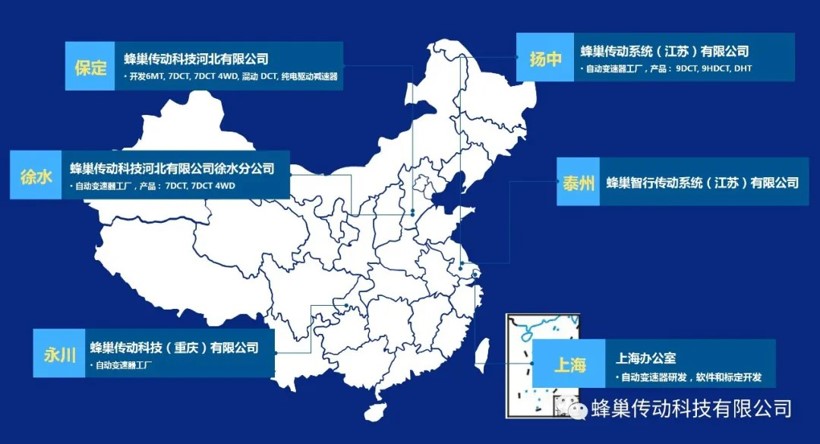
Honeycomb drive R & D and production layout; picture source: honeycomb transmission
In addition to the easy creation of Honeycomb, Noble Motors and Freddy batteries also announced new construction projects in the first half of this year. In May this year, Noble signed an investment cooperation agreement with the people's Government of Shenbei New area of Shenyang City, and the two sides reached an agreement on the investment, development and construction project of Noble Automobile Shenbei New area. This means that Noble Automobile Northeast Regional headquarters Base has officially settled in Shenbei New area, and the strategic layout has been expanded and upgraded again. In March this year, the Fudi battery plant in Chongqing was officially put into production, and the public production capacity will be increased to 10GWh. It is reported that Chongqing Fudi Lithium Battery Co., Ltd. plans to produce power battery 20Gwh with full annual production capacity.
The direction of investment is relatively concentrated, and new energy vehicles and other emerging areas are focused on.
In this year's environment, reducing costs and reducing expenditure has become a must in the operation of auto parts enterprises, but at the same time of "saving money", enterprises still have to spend the money they should spend, especially in the layout of emerging trends.
In the statistics of the new construction projects of parts and components enterprises in China, Geshi found that the new construction projects of these enterprises focused on new energy vehicles, intelligent network connection and other emerging areas, especially in the field of new energy vehicles. In addition to the Japanese electric production, Weili technology, honeycomb easy to create, Fudi battery mentioned above, the investment of SK innovation, Xin Wanda, Weibaster, Nathan, Kirishi, Weichai and other spare parts enterprises are also focused on the field of new energy vehicles, covering the production or R & D layout of batteries, motors and other sub-areas.
Among them, SK Innovation's second Chinese plant in Yancheng will be completed by the end of this year with a capacity of 20 GWh. The company is also considering investing in Chinese battery maker Huizhou Yiwei Lithium Energy Co., Ltd., turning the company into a joint venture to gain a further 8.5 GWh capacity.
Xinwanda announced in March that it would jointly fund the new Zhejiang Xinwangda New Energy Technology Co., Ltd. (hereinafter referred to as "Zhejiang Xinwangda New Energy") with the people's Government of Lanxi City, Zhejiang Province. It is understood that Zhejiang Xinwangda New Energy will set up a production base of lithium-ion battery project in Lanxi City, mainly engaged in lithium-ion battery research and development, production, testing, sales, operation and other business activities and as the main body of capital operation. The total investment of the project is 5.2 billion yuan. After reaching production, it can form a capacity of 800000 lithium-ion batteries per day.
Weibaster Jiaxing new factory and new energy power battery system research and development center was officially inaugurated in January. It is said that with the completion of the Jiaxing plant, Weibast will further promote the dual strategy of "strengthening and participating": on the one hand, it will strengthen the core business of car skylights; on the other hand, it will open up new areas of battery business in the Chinese market. provide electric vehicle solutions for this market.
There is also no shortage of new projects in the field of intelligent networking. In January this year, Fretek Intelligent Systems Co., Ltd. announced the formal operation of its Wuzhen factory. It is reported that the Wuzhen factory mainly produces advanced car parts used in ADAS and autopilot systems, including radar sensors, camera sensors, domain controllers and so on. Wuzhen factory, with a total construction area of 3000 square meters, has a fully automatic radar assembly and testing production line with independent intellectual property rights. In the second half of 2020, the factory also plans to build a national leading fully automated flexible assembly line to produce the second generation of forward-looking cameras and central domain controllers independently developed by Fretek.
In addition, for water-based coatings and other emerging areas, parts companies also have new actions, such as Estelle. As the automotive and paint industry continues to upgrade to sustainable products, China's water-based paint market will also continue to grow. In April this year, Estelle paint system laid the foundation for the expansion project of its Shanghai Jiading Water-based Coatings Plant, which is expected to be completed and opened in early 2021. Ester said the expanded waterborne paint plant will enable the company to better meet the growing demand for sustainable waterborne coatings from automotive and industrial coatings customers in eastern and southern China.
Click to register: "2020 (Fifth) China International Nickel, Cobalt and Lithium Summit Forum"

Scan the code to sign up for the Ni-Co-Li Summit or apply to join the SMM industry exchange group: