Flat steel production to grow in January, while long steel output to fall

Publicado: Jan 09, 2020 15:01 (GMT+8)
Chinese steelmakers plan to produce 9.71 million mt of hot-rolled coils and plates in January, up 5.32% from December

SHANGHAI, Jan 9 (SMM) – Chinese steelmakers are sharply stepping up production of flat products but trimming that of long products this month, as flat steel enjoys wider profit margins.

The latest SMM survey showed that Chinese steelmakers plan to produce 9.71 million mt of hot-rolled coils and plates in January, up 5.32% from the realised output in December. January’s flat steel output increase is larger than that in December, pointing to mounting supply pressure. About 427,000 mt would be exported, up 5.4% from a month earlier, and volumes slated to enter domestic markets are likely to increase 5.3% to 9.28 million mt.

Planned production of long steel, including rebar and wire rods, however, will shrink 2.1% from December to 10.69 million mt, according to the SMM survey. Output for domestic sales is planned at 10.42 million mt this month, down 1.98% on the month, with scheduled exports also lower by 6.8% to 275,000 mt.

Chart: Flat steel-long steel production difference (Source: SMM)
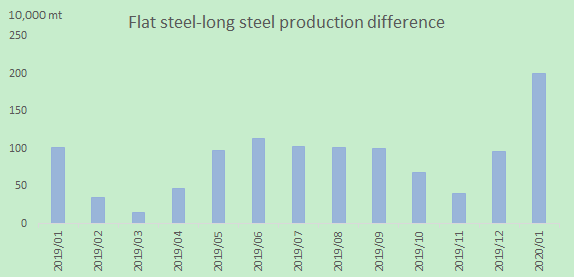
Rebar was more profitable than hot-rolled coil for much of the past year. The rebar-HRC profit spread peaked in late November as prices of construction steel jumped on certain product supply shortages, which prompted some mills to cut production of flat products and shift to long products.

Strong supply, coupled with seasonally weakening demand, later led to a pullback in prices of long steel however. Prices of long steel have been on the decline since late December, while those of flat steel have been firm, supported by supply shortfalls. This drove HRC profits to exceed those on rebar, and encouraged steelmakers to recover flat steel production.

Chart: Flat steel-long steel profit spreads (Source: SMM)
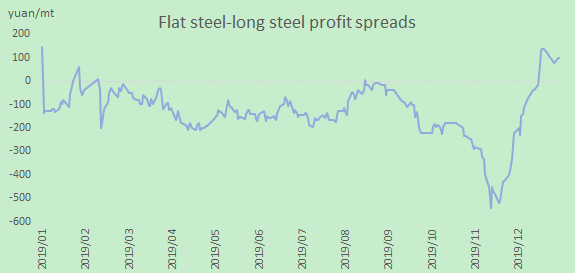
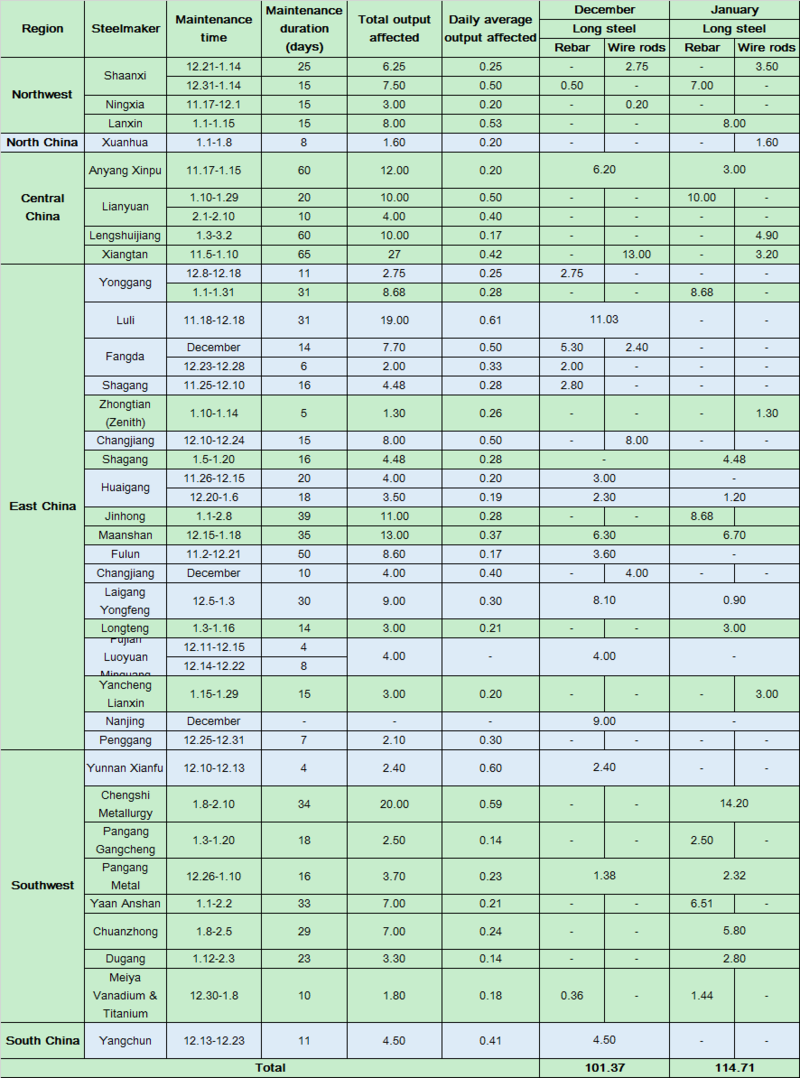
On the back of the divergence in profits between flat and long products, more long steel producers chose to conduct maintenance this month, while there is barely any maintenance scheduled at flat steel producers. Driven by enticing profits and healthy orders, flat steel mills will operate at full capacity this month and some even plan to put additional blast furnaces into operation to help ramp up production.

With end-user demand grinding to a halt ahead of the Chinese New Year holiday which falls in late January this year, spot prices of flat steel are set to weaken amid high supply. Prices of long steel, meanwhile, are expected to hover in a tight range on weakness in both demand and supply.

Chart: Maintenance at flat steel mills or facility shutdown (10,000 mt)
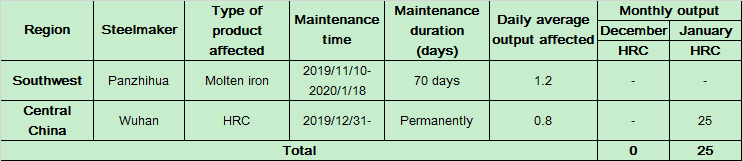
Chart: Maintenance at long steel mills (10,000 mt)
Declaração sobre a Fonte de Dados: Com exceção das informações publicamente disponíveis, todos os demais dados são processados pela SMM com base em informações publicamente disponíveis, comunicação de mercado e com base no modelo de base de dados interna da SMM. São apenas para referência e não constituem recomendações para a tomada de decisão.

Para quaisquer perguntas ou para obter mais informações, entre em contato: lemonzhao@smm.cn
Para mais informações sobre como aceder aos nossos relatórios de investigação, entre em contato:service.en@smm.cn
Notícias Relacionadas
Subsidiária da Western Mining recebe licença de 17 anos para mina polimetálica em Qinghai
há 2 horas
Subsidiária da Western Mining recebe licença de 17 anos para mina polimetálica em Qinghai
Leia mais
Subsidiária da Western Mining recebe licença de 17 anos para mina polimetálica em Qinghai
Em 22 de setembro, a Western Mining anunciou que sua subsidiária integral, Qinghai Ganxin Mining Development Co., Ltd. (“Ganxin Mining”), obteve recentemente uma Licença de Mineração emitida pelo Departamento de Recursos Naturais da Província de Qinghai. A mina, denominada Mina Polimetálica de Ferro de Geermu Tuwenchahan da Qinghai Ganxin Mining Development Co., Ltd., abrange ferro, cobre, ouro, molibdênio, zinco, chumbo e prata como substâncias minerais permitidas. A licença de mineração é válida de 3 de agosto de 2026 a 30 de agosto de 2043.
há 2 horas
Projeto de US$ 7,4 bilhões da Korea Zinc nos EUA passa por avaliação ambiental e terá operações experimentais em 2029
21 Sep 2026 17:02 (GMT+8)
Projeto de US$ 7,4 bilhões da Korea Zinc nos EUA passa por avaliação ambiental e terá operações experimentais em 2029
Leia mais
Projeto de US$ 7,4 bilhões da Korea Zinc nos EUA passa por avaliação ambiental e terá operações experimentais em 2029
Em 21 de setembro, a Korea Zinc anunciou que seu projeto de manufatura nos EUA, no valor de US$ 7,4 bilhões, havia passado na avaliação de impacto ambiental. A instalação está programada para iniciar operações de teste em 2029 e produção comercial no ano seguinte, produzindo 11 minerais críticos, 12 metais não ferrosos e ácido sulfúrico de grau semicondutor. Em abril, a Korea Zinc informou que havia concluído a aquisição de uma fundição local de zinco e outras empresas relacionadas. A empresa planeja implementar o projeto expandindo e modernizando as instalações existentes.
21 Sep 2026 17:02 (GMT+8)
Australia Reviews Anti-Dumping Duties on Galvanized Steel from India, Malaysia, Vietnam Amid Zinc Concerns
11 Sep 2026 18:30 (GMT+8)
Australia Reviews Anti-Dumping Duties on Galvanized Steel from India, Malaysia, Vietnam Amid Zinc Concerns
Leia mais
Australia Reviews Anti-Dumping Duties on Galvanized Steel from India, Malaysia, Vietnam Amid Zinc Concerns
On September 9, 2026, Australia initiated its second sunset review of anti-dumping measures on galvanized steel sheet from India, Malaysia and Vietnam, and separately launched a sunset review of countervailing measures on imports from India. The review covers July 2025-June 2026, with the final report expected by February 11, 2027. As galvanized steel is the largest end-use sector for zinc, the measures directly affect export costs and competitiveness, potentially impacting Australia’s domestic zinc demand and supply chain. Maintaining the duties would provide some protection for domestic steel and coating capacity, while termination could increase low-priced imports and affect regional zinc consumption. The final outcome remains subject to the authorities’ determination.
11 Sep 2026 18:30 (GMT+8)