CEO: economic slowdown in mining enterprises is still optimistic about copper demand, declining taste in mines and promoting technological innovation.

Publicado: Oct 30, 2019 17:46

SMM10, March 30 -: According to Deep-South Resources CEO Pierre Leveille talked about his views on the future trend of the copper market in a recent interview. He believes that despite the economic slowdown, copper use will rise as transport is electrified.

Decline of mine taste promotes technical innovation

At present, the average grade of copper ore in the world has a downward trend. For example, the taste of copper produced 100 years ago was 8 per cent. According to a mining intelligence survey conducted in 2017, the global taste in copper mines is only 0.53 per cent. In the past 100 years, there has been a significant decline. This means that near-surface deposits have been mined and few new discoveries have been made to balance the sharp decline in grade. Low-end projects will be the norm, and that won't change any time soon. Production is also slowing as reserves and resources dry up.

The decline in mine taste has driven the demand for alternative extraction technologies. The traditional methods of grinding, milling, baking and leaching, flotation are not only high power consumption, but also high demand for funds. Different types of heap leaching methods will be the preferred method in low-grade copper operation. These technologies are more environmentally friendly and less capital intensive than traditional methods.

BHP Billiton is using chloride technology, while Japanese mining and metals companies are using iodine leaching technology. Both focus on heap leaching, which seems to be an important trend in the future.

Low-end projects, which can be as profitable as high-end projects that use more traditional methods. As we will have more low-grade projects, the technology will become more important.

How important is grade and tonnage in assessing potential deposits?

Ore grade is less than 1%, we say 0.53% as the world average, although less than 1%, you can still make money. We know that the future standard will be less than 0.53%, so it is important to observe the grade and how to extract the metal. The type of deposit or mineralogy attached to the grade, and how to extract metals.

When you control the rating, you should look at other factors that affect the valuation of the project. This is when tonnage starts to work. If the grade is low, it is preferable to have a larger tonnage, as it may involve bulk mining and lower operating costs.

What is the impact of copper prices on retail investment in the industry?

In general, the investment objectives of retail investors in the mining market are short-term. They want something in return in a month, a week or even a day. Copper prices have fallen 14 per cent in the past 12 months. Markets are afraid of a trade war and a potential recession. As a result, base metals prices have fallen and retail investors have stopped investing in base metals exploration companies because they believe prices will fall.

It has an important impact on investment in the industry as the retail market helps to maintain the correct valuation and financing exploration of the company.

How do the strategic investors of large mining companies adapt to the current copper investment pattern?

"Professional Capital" is seriously considering investing in or acquiring advanced copper projects. They do not worry about short-term copper prices, because even if the economy slows down, supply and demand markets will be in short supply by 2021. Copper prices will be boosted, which could raise the valuation of the project. Some participants look to the longer term and want to invest in projects that will go into production. Their investment period is five to ten years. There is a big difference between large companies and the retail market, which sadly will make a comeback when valuations rise sharply.

(translated by SMM)

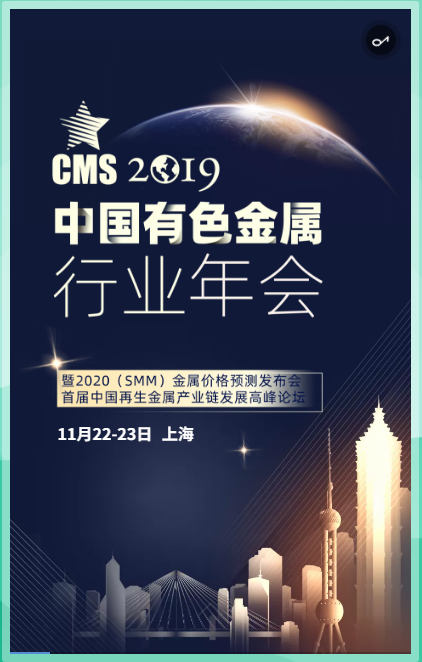
A grand event for thousands of people in China's non-ferrous metal industry

Shanghai colored net (SMM) annual meeting is the annual event of the metal industry, with an annual participation scale of thousands of people, domestic and foreign metal industry people gathered together to review and summarize the experience and harvest of the year, and lay the groundwork for the production, operation and operation of the coming year.

This year's "2019 China Nonferrous Metals Industry Annual meeting and 2020 (SMM) Metal Price Forecast Conference" was jointly created by SMM and China Renewable Resources Industry technological Innovation Strategic Alliance and Shanghai Nonferrous Metals Industry Association. At the same time, the first "China recycled Metal Industry chain Development Summit Forum" was held at the same time. At the same time, you will enjoy the establishment of the SMM Metal Price forecasting Conference and the waste Battery Recycling Exchange. From the development of the non-ferrous metal market to the recovery and utilization of renewable resources, from the detailed explanation of the policy system to the technical research and development of the industrial chain.

This is not only a meeting, but also a brainstorm for the industry to exchange information and collide with the spark of thinking!

"Click to sign up for SMM Annual meeting
Declaração sobre a Fonte de Dados: Com exceção das informações publicamente disponíveis, todos os demais dados são processados pela SMM com base em informações publicamente disponíveis, comunicação de mercado e com base no modelo de base de dados interna da SMM. São apenas para referência e não constituem recomendações para a tomada de decisão.

Para quaisquer perguntas ou para obter mais informações, entre em contato: lemonzhao@smm.cn
Para mais informações sobre como aceder aos nossos relatórios de investigação, entre em contato:service.en@smm.cn
Notícias Relacionadas
Lundin Mining reduz a orientação de produção de cobre para 2026 após fortes tempestades no Chile
há 59 minutos
Lundin Mining reduz a orientação de produção de cobre para 2026 após fortes tempestades no Chile
Leia mais
Lundin Mining reduz a orientação de produção de cobre para 2026 após fortes tempestades no Chile
A Lundin Mining reduziu sua projeção de produção de cobre para 2026 após uma segunda forte tempestade de inverno interromper as operações na mina Caserones, na região do Atacama, no Chile, prolongando o tempo de inatividade e atrasando a recuperação do local.​ A tempestade mais recente começou em 13 de agosto e trouxe chuvas intensas em áreas de baixa altitude, além de nevascas excepcionais e ventos fortes nas regiões mais elevadas. A Caserones sofreu um segundo apagão em 14 de agosto, depois que o mau tempo danificou novamente uma torre de transmissão já afetada por uma tempestade anterior, em julho.​ A mina já havia enfrentado um apagão de 18 a 30 de julho. A Lundin inicialmente esperava que o impacto da primeira interrupção ficasse restrito ao limite inferior de sua faixa de projeção original, mas a segunda tempestade atrasou o retorno à plena operação e motivou uma nova revisão das perspectivas da empresa.​ A projeção de produção de cobre da Caserones para 2026 foi reduzida de 130.000–140.000 toneladas para 120.000–130.000 toneladas. A estimativa de custo caixa também foi elevada de US$ 2,05–US$ 2,25/lb para US$ 2,15–US$ 2,35/lb.​ Em nível consolidado, a Lundin Mining agora espera uma produção de cobre em 2026 de 300.000 a 325.000 toneladas. A Candelaria ainda deve atingir sua projeção anual, limitando o impacto do clima adverso principalmente à Caserones.​ Equipes de reparo trabalham para restaurar a infraestrutura de transmissão danificada, com a energia plena prevista para o fim da semana, antes de uma retomada gradual das operações. Enquanto isso, geradores de reserva mantêm a infraestrutura crítica do local em funcionamento.​ Do ponto de vista do mercado de cobre, o corte na projeção se soma a uma série de interrupções no fornecimento relacionadas ao clima no Chile neste ano. A redução na Caserones é relativamente modesta em termos globais, mas os repetidos contratempos operacionais nas principais minas chilenas continuam reforçando a preocupação com a confiabilidade da oferta de curto prazo do maior país produtor de cobre do mundo.
há 59 minutos
Korea Eximbank fornecerá US$ 1 bilhão à Glencore para garantir o fornecimento de cobre
há 4 horas
Korea Eximbank fornecerá US$ 1 bilhão à Glencore para garantir o fornecimento de cobre
Leia mais
Korea Eximbank fornecerá US$ 1 bilhão à Glencore para garantir o fornecimento de cobre
O Banco de Exportação e Importação da Coreia afirmou em 17 de agosto que fornecerá US$ 1 bilhão em apoio financeiro à Glencore, sob a condição de que a empresa abasteça empresas coreanas com cobre durante o período do empréstimo. Os recursos serão usados como capital de giro geral da Glencore, enquanto a estrutura de financiamento foi projetada para ajudar as empresas coreanas a garantir matérias-primas essenciais. A Glencore opera minas, ativos de fundição e redes de comercialização em várias regiões, com exposição a países produtores de cobre como Chile e Peru. O Korea Eximbank afirmou que a base diversificada de ativos e comercialização da Glencore pode oferecer canais alternativos de aquisição caso ocorram interrupções de abastecimento em um país ou mina específicos. O acordo não acrescenta produção de cobre no curto prazo, mas fortalece a segurança na aquisição de cobre para as empresas coreanas.
há 4 horas
Vale acelera flotação de partículas grossas em Salobo, adicionando 30 mil toneladas de cobre até o primeiro semestre de 2028
há 4 horas
Vale acelera flotação de partículas grossas em Salobo, adicionando 30 mil toneladas de cobre até o primeiro semestre de 2028
Leia mais
Vale acelera flotação de partículas grossas em Salobo, adicionando 30 mil toneladas de cobre até o primeiro semestre de 2028
A Vale Base Metals confirmou que está prosseguindo com o projeto de Flotação de Partículas Grossas em seu complexo de cobre Salobo, no Brasil, aumentando a capacidade anual de processamento de minério em 6 milhões de toneladas, para 42 milhões de toneladas, e adicionando até cerca de 30 mil toneladas de cobre em concentrado por ano, com aproximadamente 15 mil onças de ouro como subproduto. O início da operação foi antecipado para o primeiro semestre de 2028, cerca de um ano antes do previsto. O capex foi otimizado, passando de US$ 225 a 275 milhões para cerca de US$ 215 milhões, com a Wheaton Precious Metals financiando US$ 40 milhões, o que deixa o gasto líquido da VBM em torno de US$ 175 milhões e a TIR do projeto acima de 50%. É a segunda etapa do pipeline de cobre brownfield de baixo capital da VBM em Carajás.
há 4 horas
CEO: economic slowdown in mining enterprises is still optimistic about copper demand, declining taste in mines and promoting technological innovation. - Shanghai Metals Market (SMM)